The Cook and The Bell

Yesterday morning, Minneapolis time, England won their first test match of the international summer, thanks to a calm and efficient run chase from Alistair Cook and Ian Bell. Watching them grind down the West Indies was neither fun or sexy, but it accomplished the ultimate goal: it put a check mark in the win column for England.

The combatants now move on to Trent Bridge, in Nottingham, where most pundits are forecasting a comprehensive English victory.  Again.  Just as they did before the Lord’s test, just as they did before the Sri Lanka series, and just as they did before the Pakistan series.

But I don’t see it happening. And sooner or later, cricket writers in England are going to have to come to grips with the fact that this is simply a good team, not a great team, despite their record of the last 18 months.

Most recently: they drew 1-1 with a weakened Sri Lankan side and were whitewashed by Pakistan in the UAE.

Sure, last summer they beat India 4-0, but I think it was pretty clear that the Indian players had given up after the defeat at Lord’s. Before that, England limped to a 1-0 series defeat of (again) Sri Lanka – thanks only to a tremendous collapse by their opponents in Cardiff.

And so since the end of the 2011 Ashes, England have played 13 tests, wnning seven, drawing two, and losing four. A winning percentage of .538 and a win/draw versus losing percentage of .692. Over that same period, they averaged 39.41 runs per wicket and 3.48 runs per over.

To compare, between January 1st 2000 and the end of the 2011 Ashes series, England played in 155 test matches, winning 70, drawing 41, and losing 44. A winning percentage of .451 and win/draw versus losing percentage of .716 – the latter only marginally better than the same stat since the 2011 Ashes. During the same time period, they averaged 35.95 runs per wicket and 3.25 runs per over.

And what does all of this tell us? That England have learned how to turn draws into wins.

Now that is nothing to sneeze at, teams that turn draws into wins are the teams that win championships, no matter the sport.

And it seems they have accomplished this by scoring a few more runs per over, and a few more runs per wicket.

Efficient run accumulation. Just ask the West Indies if a few more runs an innings makes a difference.

But that’s all that it is: efficient. Cook, Bell, Trott: all of them will remorselessly accumulate runs in an efficient manner. But at the end of the day, the team has no heart, no soul. And it will surely grate on the nerves of the saber-heads to read this: but it’s the heart and the soul that turns losses into wins, not just draws into wins, but losses into wins.

And that’s what England are lacking.

I do very little actually analyzation of play here on the site. But I have watched a great deal of England cricket over the years, and while this is a good team, it is by no means a great team. That is just my opinion, of course, but great teams pull a win out of the hat in the UAE, great teams don’t let the West Indies bully them at Lord’s, and great teams don’t have a captain that can’t score runs.

It might sound as if I am being overly critical here, and that is probably true, but you have to ask yourself: if the 2005 Ashes squad played the current squad, who would you back in a five test series?

The former, every day of the week and twice on Sundays.

If this current incarnation of England cricketers want to be considered great, if they want to be talked about a generation from now when old men gather to discuss the greatest squads of all time, then they need to go to India this fall and WIN. That will make them one of the greats.

*

My review of The Legend of Pradeep Mathew is finished and will be live on The SightScreen later tonight. Keep an eye out for it.

I will repost it here in the next few days, as well.

The Night’s Watch

When it comes to European sport, there are many intricacies that American sports fans simply do not get: draws, added time…etc.  And surely the nightwatchman would be on that list, as well.

Today, in London, with England already a man down and the light fading, Strauss and Flower sent out Jimmy Anderson, a bowler, to bat instead of Jonathon Trott – he of 48 test match innings, and a test average of over 50 runs. The theory being that if you lose Anderson due to bad light, it is better than losing a Trott due to bad light.

Now, I guess, it makes sense, on paper, but it is also a terrible strategy, if you ask me.  If you can’t rely on Jonathon Trott to survive a few tricky overs at the end of the day, then when can you rely on him? Only on sunny days in perfect conditions on flat tracks? Poppycock. He is one on the most reliable batsman in the world, don’t doubt his abilities by sending a bowler out there to do his job.

Batting, like everything else, is about momentum and confidence, and putting in Anderson to bat robs Trott of both – and to wit we saw Roach nearly get Trott out LBW with the first delivery he saw. If you don’t think Strauss’s decision was on Trott’s mind that first ball, than you are sadly mistaken.

Of course, the nightwatchman strategy had already backfired on Strauss the ball before, as Anderson had nicked to Ramdin, and England were 10-2 and had to expose Trott anyway.

Back to Americans, however, and there are similar such strategies in American sports: sacrifice bunts come to mind, as does the intentional walk. In gridiron football, there is taking a knee, the prevent defense, and heck even punting shows a lack of confidence in your offense. But, personally, the nightwatchman takes the cake when it comes to silly, aggravating sporting decisions, and it is just one more reason Americans will never truly embrace cricket.

ALL OF THAT SAID: I love the nightwatchman. Because I like to say nightwatchman. I think it is my favorite sports term ever.

I know you all agree.

*

I have been reading the Game of Thrones series (stop laughing). In the books, there is a group of men called the Night’s Watch that stand guard on a 700 foot wall of ice, protecting the realm against the Wildings and “Others” and giants that live beyond the Wall. It is a really fun part of the book, and I think the storyline that the author enjoys writing about the most.

Anyway, when a man decides to join the Night’s Watch, he is said to have “taken the black” because all those in the Night’s Watch wear all black, every stitch. So I think two things: in cricket they should make the nightwatchman wear all black; or, failing that, the TV commentators should at least use the phrase figuratively: “Anderson has taken the black.”

Forgive me, I have a bit of a hangover and I am watching Italian football.

*

Even England fans must have enjoyed seeing a reinvigorated West Indies on the pitch at Lords again. Watching Roach and Edwards steam in over and over again was like being transported back in time. And Strauss’s decision to bring in Anderson over Trott after edging to gully is evidence of his respect for the Windies new ball attack. Tomorrow will be fun. It would be a remarkable and famous win for the visitors if they can pull it off.

*

Speaking of ghosts: Here’s this I found:

*

This is my 200th post on Limited Overs. Huzzah.

Six Hours On

Just a quick post tonight, for I need to get to bed early, as test cricket returns tomorrow, with England v West Indies at Lord’s. First ball is in less than six and a half hours.

Although, I must say that since I have been reading a flawed yet lovely book about Sri Lankan cricket (look for a review in the next day or so), I find myself more in the mood for some Southern Hemisphere swashbuckling cricket than I am for St. John’s Wood and a watered down West Indies.

But Sri Lanka v Pakistan at the Galle International stadium is still over a month away, and tomorrow’s match is still test cricket, and England are still the number one test team on earth, and so I will wake early, and I will work from home so I can watch, and I will enjoy every moment.

As I mentioned on Twitter, I see the series ending 1-1. Expect a weather affected draw at Lord’s, double centuries from Cook and Trott and an England win at Trent Bridge, and a thrilling and famous win for the West Indies in Birmingham.

You heard it hear first.

The English summer begins tomorrow. Huzzah!

Blood Sport Summer

(The following post was inspired by this video. Hat tip to Ducking Beamers for passing it along.)

On the 6th of July, 2005, the city of London was awarded the 2012 Summer Olympics by the International Olympic committee.

The very next day, four Islamist terrorist detonated four homemade peroxide bombs, three on the London tube, and a fourth on a double decker bus. 52 people were killed, another 700 were injured.

Two weeks later, at Lord’s Cricket Grounds in the heart of the London, a coin was tossed, and thus began the 2005 Ashes.

In my last post, I railed against politics and sport, but at the same time, nothing, and I mean nothing, can heal a community like sport can.

Full stop.

England needed cricket, and cricket delivered.

Not at Lord’s of course, as Australia dismantled the hosts; winning by 239 runs, but I digress.

The 7/7 bombings were not the only terrorist attacks in what was a bloody summer around the globe: on the 4th of May, an insurgent exploded a bomb at Kurdish police center in northern Iraq, killing 60; and in Israel on July the 12th five people were killed and another 90 injured in a suicide attack on a shopping mall.

And of course, the Iraq and Afghanistan wars were raging. And I mean raging. 19 US soldiers were killed on the 28th of June in a failed mission in the Kunar province of Afghanistan. In Iraq, in July, August, and September, the three months that contained the Ashes series, 195 coalition troops were killed, including six Brits: Leon Spicer (26 years old), Phillip Hewett (21), and Richard Shearer (26) on the 16th of July in Al Amarah; Donal Anthony Meade (20) and Stephen Robert Manning (22) on the 5th of September near Basra; and Matthew Bacon (36) on the 11th of Septemer also near Basra.

Australia lost two soldiers in the Iraq War, the first was on the 11th of June, 2005: David Russell Nary. He was killed in a vehicle accident in Kuwait. He was 42 years old and had served in Australia’s military for 25 years.

The world will long remember Flintoff, Pietersen, Ponting, and Warne, but the world has already forgotten Leon, and Richard, and Matthew. That’s a stupid thing to say, I know, but I think it is emblematic of how modern society overvalues sport while simultaneously undervaluing life (says the guy who devotes hours of his time to a cricket blog) but I don’t think that’s entirely correct: we overvalue sport in order to escape from that we cannot change, to escape from the dark places. If we did not do this, we would all go mad. There is just too much tragedy in this world…

And with the backdrop of bloodshed, Australia won the coin toss under cloudy English skies at Lord’s, and chose to have a bat.

Harmison took five wickets, Flintoff and Jones each took took two, and Australia were restricted to a paltry 190 all out. Unfortunately, for England, their first four batsmen scored only 15 runs between them, Glenn McGrath took five wickets, and England’s first innings were over for only 155.

Australia then piled up 385 runs in their second innings in a well balanced offensive display, the stand out score being Michael Clarke’s 91. England were chasing 420 runs, and they didn’t even come close, losing by 239. The match began on July the 21st, a Thursday, and ended on July the 24th, a Sunday.

On July the 22nd, Metro Police shot and killed Jean Charles de Menezens, a misidentified suspect in the 7/7 bombings. His story is both tragic and important. Read it.

On July the 23rd, Bedouin militants detonated bombs in resorts throughout the Sharm el-Sheikh region of Egypt; killing 80 and injuring 200.

On July the 28th, after 3,527 deaths, including over 1,800 civilians, the Provisional IRA declared an end to its campaign, effectively ending the Irish “Troubles.”

On August the 2nd, an Air France flight skidded off a runway in Toronto and burst into flames. Fatalities: Zero.

And on August the 4th, 22 cricketers regathered in Birmingham, England for the 2nd test of the 2005 Ashes.

Australia won the toss again, but this time chose to have a bowl, despite the fact that McGrath had pulled up lame in training and was dropped from the starting eleven.

Trescothick, Pietersen, and Flintoff put up scores of 90, 71, and 68, respectively, to lead their team to 407 all out in their first innings. In Australia’s half of the first innings Flintoff and Giles each took three wickets and Australia were all out for only 308.

For England: hope.

Unfortunately, despite a magical 73 off of 133 for Flintoff, Australia dismissed England for just 182 in the second innings, setting a target of 282 runs. Achievable for Australia’s batsmen, surely.

But then, in the 13th over, Freddie Flintoff delivered what some have called the greatest over ever bowled, taking the wickets of Ponting and Langer.

It was a very nervy finish for England, but finally, Harmison got Kasprowicv to edge to Geraint Jones, and the match was won. The series was tied at one a piece. It was a Sunday afternoon, August the 7th.

On August the 6th, Robin Cook passed away. The UK politician famously resigned as Leader of the House of Commons to protest the UK’s involvement in the invasion of Iraq. His epitaph reads: “I may not have succeeded in halting the war, but I did secure the right of parliament to decide on war.”

On August the 9th, the Space Shuttle Discovery safely returned to earth – successfully completing the first shuttle mission since the Columbia was lost, 29 months earlier.

And, in the city of Manchester, on August the 10th, our 22 cricketers were at it again, at Old Trafford, for the third Ashes Test…and the enthusiasm for the series, and for cricket in general, was spreading, and building, as England looked for something to collectively believe in again, after those bombs had ripped through their sense of security one month prior.

England won the toss this time and chose to have a bat, with McGrath and Lee both in the side, but both still recovering from injuries. The hosts went on to score 444, thanks in part to Vaughn’s lucky 166 (he was dropped on 41, and 45, and 141). Australia were held to 302, as Simon Jones took six wickets whilst allowing less than three runs an over. Giles, too, had a good innings in England’s attack, taking the wickets of three of the Aussies’s four opening batsmen.

In the second innings, Strauss scored a century and England declared near the end of day four, a target of 423 set for Australia.

Day five dawned with hordes of England supporters trying to get into Old Trafford to see their country take a 2-1 lead in the Ashes. So many so that over 10,000 had to be turned away at the gates. Test cricket was alive and well that summer in England, thanks to Flintoff and Pietersen, but also thanks to Hassib Hussain, Mohammed Sidique Khan, Germaine Lindsay, and Shehzad Tanweek, surely.

But Australia received a heroic captain’s innings from Ricky Ponting (156 runs, nearly seven hours, 275 balls) and the visitors hung on for a draw. The Ashes were still tied at 1-1.

The match had begun on August the 11th, a Thursday; and ended on a Monday afternoon, August the 15th.

On August the 14th, Helios Airways Flight 522 crashed in Greece, killing 121 people.

On August the 16th, West Caribbean Airways Flight 708 crashed in Venezuela, killing 152 people.

And on August the 25th, the coin was tossed at Trent Bridge in Nottingham to begin the fourth test of the 2005 Ashes series.

Just as in Manchester, England won the toss and chose to have a bat. And just as in Manchester, they put up a huge score: amassing 477 runs, though the hero this time was of course none other than Freddie Flintof, whose 102 off of 132 led the team. Shane Warne took four wickets for Australia to limit the damage, but it was not enough.

England then went on to bowl out Australia for a mere 218, their highest scoring batsman was Brett Lee, a tail ender, and England forced the follow on. The second innings saw a better balanced batting performance from Australia, but they were still only able to score 387, leaving England only 129 runs to chase down, and almost two full days to do it in.

And that they did, by the skin of their teeth, but they did it nonetheless. England was now ahead in the series two matches to one, and a draw at the Kennington Oval away from winning the Ashes for the first time in 17 years.

It was August the 28th 2005, a Sunday.

On August the 29th, Hurricane Katrina made landfall in Southeast Louisiana. The storm, and its aftermath, would claim almost 2,000 lives.

Two days later, in Baghad, on the Al-Aaimmah bridge, a stampede killed 953 civilians.

One week after that, the Australian and English cricket teams were back in London, to decide the Ashes.

Just like in Manchester, and just like in Nottingham, England won the toss and chose to have a bat. And just like in Manchester, and just like in Nottingham, they put up a decent score, thanks in most part to one batsman. This time, it was Andrew Strauss’s 129 off of 210.

Australia batted well, too, with their openers Langer and Hayden scoring a combined 243 to lead their team to within six runs of England’s score, despite five wickets from Flintoff.

In the second innings, the hero was Kevin Pietersen with 158 off of 187, giving Australia a target of 342 runs.

Unfortunately, for the Australians, it was well into day five when Shane Warne finally took Shane Harmison’s wicket, and there just wasn’t enough time for a result. The match ended in a draw, and on September the 12th, 2005, a Monday afternoon, England regained the Ashes.

It was a bloody, violent, and destructive summer. Like so many summers before it and so many summers after, the summer of 2005 is looked back on by millions as a dark and awful and tragic time. But for cricket fans throughout England, young and old alike, it is remembered as a time of glorious victory, and I think that is okay.

Sports at is best is escapist, but unlike other escapist activities, it provides a real sense of black and white, it provides clear winners and clear losers, it provides pure heroes, and pure moments, and pure relief, and pure joy.  And the England cricketers provided all of the above in spades to their fellow countrymen that summer, when they needed it the most.

Blood on the front pages, glory on the back pages. A balance between light and dark. Keeping the universe level. A remarkable summer.

Ayatollah’s in Iran, (English) in Afghanistan

On September the 21st of this year, 11 men from England, and 11 men from Afghanistan, will gather on a field in Colombo, Sri Lanka, for a spot of cricket.

Of course, this isn’t just any cricket match. It is a group stage match in the 2012 ICC World Twenty20 Cup. It’s a marquee match in a marquee event.

Like most countries that will be competing in Sri Lanka this fall, Afghanistan’s history is linked to Britain in a myriad of different ways. In fact, most of the time, when England is playing an international cricket match, it is against a former colony: it is conquerer versus conquered, prisoner versus jailor, revolutionary versus oppressor.

In the case of Afghanistan, the country was seen as the dividing line between the British Empire and the Russian Empire, and therefore saw invading force after invading force for centuries. Furthermore, unlike England’s other former dominions, there are currently British boots on the ground in Afghanistan. Around 9,500, give or take.

412 British soldiers have died in the fighting since 2001, including 18 just this year, and the number of Afghani civilians that have died in the conflict since 2001 is incalculable, though conservative estimates put it in the tens of thousands.

England and Afghanistan will of course not be the first two nations involved in an armed conflict to compete against each other in an international sporting event, but I think it will add an interesting subtext to the tournament. Especially since, technically, Britain is not at war with the government of Afghanistan, they are at war with the Taliban. They are not invading, they are liberating. Or vice versa. Depends on who you ask. Like I said: subtext.

Hopefully, for all concerned parties, it will be a friendly little cricket match, one which sees the minnows Afghanistan make their country proud and give the English a good scrap.

Personally, I would rather keep politics completely out of sport. Yeah, sure, there are moments when it heals, when it transcends. Jesse Owens at the Berlin Olympics comes to mind. So does Sean Avery. Jackie Robinson, too. As does South Africa winning the Rugby World Cup

But too often it is Munich ’72, or Le Guerra de Futbol, or the USA boycotting Moscow ’80, or the Soviets boycotting Los Angeles ’84, or Tommie Smith and John Carlos* . Or even, more recently, the deadly football riots in Egypt which really had absolutely nothing to do with football.

And on a more subtle level, events such as the Olympics, the European Championships, and, truthfully, most international cricket matches, are gross exercises in nationalism: You live on that side of this imaginary line in the sand, and therefore we are enemies.

Sure most of the time it is harmless fun, I guess, and maybe I am making too big of a deal out of it, but what it comes down to is that I don’t think we should be mixing sports and politics at all, or sports and nationalism. Or politics and music, for that matter. Politics are the opposite of sport, they are the death of sport. If the ICC wants to talk about the “spirit of the game” then they should stop allowing it to be politicized. (You, too, US State Department.)

And because of that, the Indian Premiere League, despite being a big steaming pile of cricket killing ebola to some, is actually what might save it in the end, because it removes all those imaginary boundaries. Players from New Zealand line up alongside players from Holland, Sri Lanka, and Pakistan. It’s utopian, even.

To bring it all back home: there will be an interesting subtext to the England v Afghanistan match on September the 21st of this year, but I really do wish that that subtext did not exist. That it was simply a cricket match for us all to enjoy with a pint and a friend.

*I was quite hesitant to include that one. At the end of the day, it was a divisive gesture, and against the spirit of the games – it politicized a pure moment. I am interested to hear readers’ comments however. Also: the 1984 Miracle on Ice: patriotic hallmark for the USA? Or a globally divisive victory that set back Soviet-US relations? You make the call.

Too much cricket; not enough money

As I mentioned in yesterday’s post, the last match of the English summer is a t20 against South Africa on Wednesday, September the 12th in Birmingham, England.

Eight days later and six thousand miles away, South Africa is scheduled to play its first match of the ICC World t20 against Zimbabwe in Hambantota, Sri Lanka.

One day later, England will play Afghanistan in the same tournament in Colombo, Sri Lanka. (More on the interesting implications of this particular match in tomorrow’s post.)

Now that right there is some serious fixture congestion. Especially considering County Cricket will still be having matches AND today Sri Lanka Cricket announced that the Sri Lankan Premiere League will be happening in 2012, tentatively scheduled for August 10-31. Right in the heart of South Africa’s tour of England, and right up against the ICC tournament.

Of course, this jumble of fixtures will affect very few players. There are no other major tours going on during the SLPL, and cricketers will more than likely appreciate having the tournament to use as a warm up for the World t20s. And I am sure the English and South African cricket boards will, fairly or unfairly, keep their players in England for the tour and not allow them to whore themselves out to the SLPL.

But, again, here we are: too much cricket.

I understand Sri Lanka Cricket’s position. Most other test playing nations (even Bangladesh!) have international t20 tournaments in existence to line the wallets of their cricket boards via TV deals, sponsorships, and ticket sales – why not Sri Lanka, too?

I have no answer to that question. But it is just starting to get a bit out of hand, and sooner or later, the ICC is going to need to step in and draw a line in the sand. Players flying all over the world to play in a dozen different tournaments is detrimental to the game in so many ways.

The worst part, for me, is that while we fans do get plenty of matches to watch, the overall quality of the cricket is going downhill…and quickly. And that is genuinely scary for the future of the sport we all love.

I have said three hundred times before: cut back on the cricket, and we all win. There are too many matches, too many tournaments, too many series, too many formats. No other sport, not even football, stretches its players quite as thin as cricket does, and it needs to be stopped.

*

Another article today on the future of the sport we all love: India is in dire straits, financially.

The gist of the article is that India will be the world’s number one economy before the century is out, but economic growth is not keeping up with population growth. Furthermore, the entire region depends on India as a catalyst to inspire its growth, and so a serious downturn would greatly affect all of SE Asia, and in a ripple effect, the world.

Now, the article is one economist’s opinion, and what serious financial downturns have on sport is quite debatable, but if India starts to lose interest in cricket, then the sport really is in trouble.

I don’t think that will happen anytime soon, but what could happen is that India stops caring about the less financially attractive version of the game: test cricket.

That, I think, is a very real possibility, and a very real fear.

And, therefore, this fall, every neutral should be squarely in India’s corner when England visit for a highly anticipated four match series.

My two cents.

*

In blog news, I have been asked by Graywolf Press to review a book about cricket that they are launching later this spring. Keep an eye on the site for my review!

The English Summer Awaits

The English “Summer” is upon us.

This morning, at the County Ground in Hove, the West Indians played Sussex in the first warm-up match of the tour. It’s May the 6th, the football season is still very much happening, and the weather is cold, damp, and overcast.

Like I said: “Summer”.

Another instance of there being too much cricket. The “summer” should start in June, when the weather is hot and the skies are high. When the football cup finals  are a distance memory, not still fighting for column space on the back pages. But, hey, it’s here now, so why not enjoy it?

I enjoy the English summer for the same reason I enjoy tours in Australia, New Zealand, South Africa, and the West Indies: the matches make sense to me time-zone-wise.

The tests start at 5am local time, the ODIs at 5:45am (the day-nighters at 9am), and the T20s start at 9am-ish, as well.

Plus, the grounds in England are normally at capacity for the tests, which will be a welcome change from the empty terraces in the UAE, the West Indies…etc. Big crowds at lovely venues just make for a better viewing experience; even on my computer.

And what are we going to see this summer?

First up, the rejuvenated West Indies. While this won’t be the most thrilling series, as our friends from the Caribbean are of course no where near the quality of the West Indian teams of the past that gave England fits, they are far better then they were during their last visit.

Also, the big news: Chris Gayle is back for the ODIs and the t20. He should be enough to make the one-dayers competitive and fun for the neutrals.

But before the one-dayers, we will be treated to three tests: May 17-21 at Lord’s, May 25-29 at Trent Bridge, and June 7-11 at Edgbaston. Those are followed by three ODIs: June 16 at the Rose Bowl, June 19 at the Oval, and June 22 in Headingly.  And the tour wraps up with single t20 at Trent Bridge.

And then Australia comes to town for one ODI against Ireland (that should be fun) and five ODIs against England. No tests, unfortunately, but I am actually not all that bummed about that. The ODIs should be competitive and entertaining, and we have the Ashes to look forward to in 2013.

I am surprised that the Australian and English cricket boards didn’t schedule at least one t20, with the t20 World Cup coming up this fall. But, hey, cricket boards making questionable scheduling decisions is par for the course.

The ODI against Ireland is on June 23 in Belfast, the first ODI against England on June 29 at Lord’s, the second on July 1 at the Oval, the third on July 4 at Edgbaston, the fourth on July 7 at the Riverside Ground (Durham’s home ground), and the fifth on July 10 at Old Trafford.

And then: the series that is making cricket fans the world over salivate in anticipation, as South Africa comes to down for three tests (boooooo), five ODIs, and three t20s.  The number one test nation versus the number two test nation. And while it is really unfortunate that they are only playing three tests and that the second test is going to be played in the long shadows of the Olympics in London, it should be a great series.

Those t20s in particular will be great fun, as both teams get in shape for the World Cup.

The first test at the Oval, from July 19-23; the second at Headingley, from August 2-6; and the third at Lord’s, from August 16-20.

All three should be just lovely. the Oval in July, Leeds during the Olympics as London parties, and finally Lord’s to close it all out and possibly decide the world number one.

The ODIs are at Sophia Gardens (Cardiff), the Rose Bowl, the Oval, Lord’s, and Trent Bridge on August 22, 24, 28, September 2 and 5, respectively. The t20s are back in Durham, back at old Trafford, and back at Edgbaston on September 8, 10, and 12.

And that’s it, that’s the English summer. From the coin toss on May 17 at Lord’s to the final ball in Manchester on September 12. Four months, 22 matches, 46 total days of cricket (counting the Ireland match and if each test goes the distance).

The more I read and write about it, the more excited I get.

It should be a wonderful summer of sport: the Euros, the Olympics, and an all-round entertaining English cricketing summer.

And, considering I am able to work from home, and considering all three events are available to watch here in the states on ESPN3, over the air TV, and Willow, respectively, I hope to be able to watch big chunks of all three. Looking forward to it all.

#IPL

A quick bit of housekeeping: Yesterday Limited Overs received the most hits it has ever received in a single day. Thanks again to those that retweeted and reblogged, I do appreciate it. 

*

This morning, I was working from home, and therefore was lucky enough to be able to watch the first innings of Royal Challengers Bangalore versus Kings XI Punjab in the 44th match of the 2012 Indian Premiere League. 

KXIP defeated RCB by four wickets with one ball to spare, in a hard fought and entertaining cricket match. 

And I am going to go on record here: I like the IPL. I really do enjoy it. And I wish I could watch more of it.  

I like the uniforms, I like the crowds, I like that a vast majority of the best players in the world are on display, and I like that Willow TV carries every match live as well as on demand.  

And on that note, some news: I have “picked” an IPL team: Royal Challengers Bangalore will be the team I support going forward. I know this announcement sounds oh so terribly childish, but it is unfortunately just part of enjoying a sport that does not have a franchise in your home town. Sooner or later: you have to choose, or the sport starts to lose a bit of its luster. 

This was initially decided a few days ago, as I was reading Dirk Nannes’ IPL diary, which I highly recommend you read, if you have not done so already. 

Nannes is a pretty interesting dude: not a full time cricketer until his 20s (did not make his first class debut until he was 29), a world class downhill skier, and a well above average writer. Plus, according to Cricinfo, he speaks Japanese, plays the saxophone,  and operates his own skiiing tourism business. 

A true renaissance man, surely. 

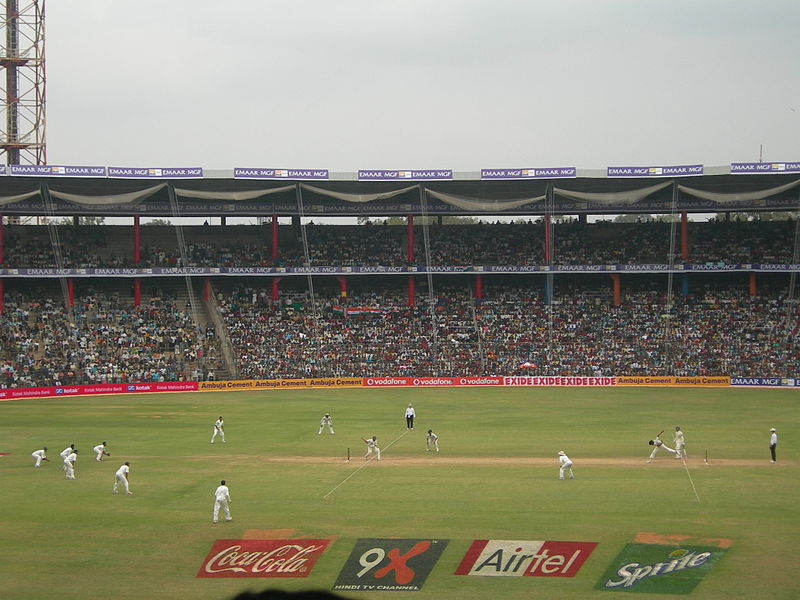
At first, I was not sure about RBC, as Nannes does not really play all that often for them, but the decision was confirmed as I was watching their match this morning, as they really are a collection of some of my absolute favorite current cricketers: de Villiers, Virat Kohli, Chris Gayle…etc. Plus they play their home matches at the understated yet lovely M. Chinnaswamy Stadium in Bangalore: 

Image

Two drawbacks: they are named after a booze. Lame. And their theme song is, well, not the greatest. 

But, either way, for the time being, they are my IPL team. Let’s see how this goes. Three weeks are left in the group stage, so hopefully that’s enough time for RCB to get back into the top four.  

*

And with that all said: the first test of the English summer is just 15 days away. 

15 days until the West Indies visit Lord’s. I cannot wait. 

And with the new job, and this working from home thing, I will be able to watch a great deal of it.  Huzzah. 

Until next time. 

The Confusing Blog Titles are Dead, Long Live the Confusing Blog Titles

First of all, I would like to thank everyone for the kind praise regarding the post on Kolkata 2001. It was an idea I had had for a few months now, but I was unable to find a good five day news cycle that matched up with at least a mildly interesting test match. But I think it worked out okay.

Secondly, as the Cricket Couch pointed out, if I am to be taken the least bit seriously as a cricket blogger, then I need to quit it with the confusing titles for my posts.

The point of them was always to drive home the fact that there was always cricket happening somewhere, every day of the year, and that I thought that was cool; but that point has been made, and even if I wanted to continue making it, I could do so without using confusing blog post titles. And when I started, I felt I needed a gimmick, and some structure. But, alas, I took it too far down the river.

And not only is it confusing, it is also misleading. If someone, for example, googles a Zimbabwean league match and ends up here only to see that I was actually writing about Yorkshire CCC, well, then that’s bait and switch, plain and simple. Even worse: it’s impression whoring. Egads, right?

Though, honestly, I never meant it to be as such.

And, so, the blog titles will now instead relate directly to the subject matter of the post. You’re welcome.

It’s the start of a new era here at Limited Overs. What’s past is prologue. Onward and upward, dear friends.

Kolkata 2001

The 1,535th test match took place on March the 11th, 2001 between India and Australia at the ground known as Eden Gardens in Kolkata, India.

Australia had won the first match of the three test series in Mumbai by ten wickets.

On the cricket pitch, India were stumbling. On the world stage, however, they were transcending. The previous May had seen the birth of their billionth citizen and a visit from the President of the United States.  In January of 2001 they joined the exclusive club of nations able to launch satellites deep into space.

January of 2001 also the city of Calcutta unleash the bonds of colonialism and officially revert to its pre-colonial name of Kolkata.

And speaking of British Colonialism, their opponents at Eden Gardens, Australia, had just kicked off a year celebration in January to commerate their one hundredth anniversary as a Federation. The previous summer Sydney had hosted the Summer Olympics.

It was not all roses, of course. At the time of the 1,535th test match, Indians were still mourning the 30,000 souls killed in a massive earthquake in the western state of Gujarat. And Australians were just a little over a year away from the tragic bombings in Bali.

Personally, I was living in the Uptown neighborhood of Minneapolis, on the second floor of a two story duplex, with my wife (then girlfriend) and a roommate. Two months prior, I had started working at the Manhattan Toy company, a job I would hold, and love, for the next six years. It was a tremendously happy time in my life.

And with that backdrop, on the morning of March the 11th, with fog and a chill in the air (the day saw a record setting low temperature, though the cool air was short lived), Australia won the coin flip and chose to bat. A little while later, as temperatures spiked into the 90s, where they would stay all day, out walked opening batsmen Michael Slater and Matthew Hayden to begin what is widely considered one of the greatest test matches in the history of the world.

At lunch on the first day, Australia were 88 without loss. Slater and Hayden were both 41*. At tea they were 193/1 – Slater had fallen for 42.

In the third session, Harbhajan Singh took a hattrick of Australian wickets, and the vistors ended the session, and the day, at 291/8.  A decent enough score, despite the collapse, but Australia would have hoped for more, considering the decent batting track.

Meanwhile:

In Southern Serbia, a cease fire between ethnic Albanian guerillas and Serbian forces was breached, as sporadic fighting broke out up and down the Presevo Valley.  An 11 year old Serbian boy was killed when Albanian mortar shell struck his house….

Bloody and violent protests broke out in Ukraine, the Dalai Lama called for a referendum on Tibet, and the Philadelphia 76ers beat the Boston Celtics 97-91.

*

Day two in Kolkata dawned in the same manner it had the day before, with fog and cool temperatures, but by the time Steve Waugh and Jason Gillespie walked back out to the crease, it was 90 degrees.

Waugh, Australia’s captain, and Gillespie, went on to produce a magnificent 9th wicket stand of 133. Waugh scored a century, Gillespie 46, his highest score to date in a test match.

At lunch Australia were 383/8, and 50 minutes before tea, they were finally bowled out for 445.

From 291 for eight to 445 all out.  The worm had turned, Australia were comfortably in the ascendancy.

And India’s troubles continued with the bat, despite the fact that the pitch appeared to be more than just a little batter friendly. Ramesh fell for a duck. And the rest of his side did not fair much better.

The day ended with India in all sorts of trouble at 128/8, needing a miracle to avoid the follow-on.

Also, on March the 12th, 2001: Pope John Paul II beatified 233 Spanish martyrs of the Spanish Civil War, the last step before sainthood, in an effort to avoid further attacks from the Basque separatists.

In an eery bit of foreshadowing, speaking in Spanish from Vatican City, the pontiff said:

“Terrorism is born of hatred and, in turn, feeds it. It is radically unjust and increases the situations of injustice, gravely offends God and the dignity and rights of people. With terror, man always comes out the loser,” John Paul said.

“No motive, no cause or ideology can justify it,” he said. “Only peace can build peoples. Terror is the enemy of humanity.”

Six months later, we all know what happened.

Also on the 12th, Astronauts aboard the International Space Station, completed the longest space walk in Nasa’s history: four minutes shy of nine hours.

Oh, and Rod Stewart released his 19th studio album: “Human”.

*

On day three in Kolkata, the worm turned again.

VVS Laxman played a brilliant half century in a vain attempt to avoid having to follow on, but Warne got him to edge to Hayden, and India ended at 171 all out before the lunch break.

In the follow on, India were 274 runs adrift. Das and Ramesh fell for 30 and 39 respectively, and then VVS Laxman was back at the crease, promoted to third in the lineup after his half century earlier in the day.

Laxman would go on to score a century that afternoon, and India would end the day at 254/4, with Laxman partnered with Rahul Dravid. Laxman was on 109, Dravid on 7.

There were seeds of hope among the Indian faithful, but it was still Australia’s match to lose.

And while hope was growing in Kolkata, six American soldiers were killed in Kuwait during a training exercise, a Palenstian was killed by Israeli soldiers during a bloody protest on the West Bank, the cease fire in southern Serbia finally took hold, as all was quiet in the Presevo Valley, and the Dow plunged 436 points, over 4%, to 10,208 and change, as part of a global sell off.

*

Day four: March the 14th: another hot, hot day in Kolkata, and a day that Indian cricket fans will never forget.

Dravid and Laxman walked out at ten o’clock in the morning, and they would bat all day.

The day began with India at 254/4.

At lunch they were 376/4 (Laxman 171, Dravid 50).

At tea they were 491/4 (Laxman 227, Dravid 106).

They just kept batting on and on and on.

And Eden Gardens turned into a sea of Indian flags, cheering on what was surely the greatest performance they would ever hope to see on a cricket field.

At stumps they were 589/4 (Laxman 275, Dravid 155).

As VVS walked off, to quote the Old Batsman: “His face was a picture, the look of a total chancer in love with the absurdity of it all.”

I cannot look at the picture without getting chills.

Elsewhere, on March the 14th, as Dravid and Laxman walked off at Eden Gardens: more clashes in the West Bank and Gaza Strip, a US ban on meat imports from Europe as fears of Hoof and Mouth disease swept through the UK,  and the Yugoslavian army moved into the Presevo Valley: Peace was coming to the Balkans after a decade of war.

*

Day five in Kolkata, and Laxman and Dravid walked back out.

Dravid fell in a run out, Laxman was caught by Ponting at slip, and India declared at 657 before lunch.

And the pitch was starting to spin.

Harbhajan Singh took six Autralian wickets, and to the delight of the Indian fans, the visitors could just not hang on for a draw.

Just after tea, Singh got McGrath out lbw and the match was over.

India had been forced to follow-on, but still won the match by 171 runs, thanks to a truly magnificent bit of batting from Dravid and Laxman.

Over those five days, 1.7 million babies were born.

Over those five days, 1.25 million people lost their lives.

It was a Test match. The world didn’t stop to watch. Time and history marched on alongside it. But for five days, it marked time for cricket fans the world over.

Only so much can happen during a 90 minute football match, but in five days, the whole world can change. And for many, during those five days in March, it did.

*