A Golden Age

I just learned that the test series between Bangladesh and the West Indies will be carried live here in the states on ESPN3.

This is how it is shaping up then:

#ausvsa: 1st test: Nov 9-13; 2nd test: Nov 22-26; 3rd test: Nov 30-Dec 4

#bangvwi: 1st test: Nov 13-17; 2nd test: Nov 21-25

#indveng: 1st test: Nov 15-19; 2nd test: Nov 23-27; 3rd test: Dec 5-9; 4th test: Dec 13-17

#ausvsl: 1st test: Dec 14-18; 2nd test: Dec 26-30; 3rd test: Jan 3-7

(All of above are those test matches live on either Willow or ESPN3 here in the states).

Conclusion:

We are going to be spoiled rotten with test cricket here for the next two months. Let’s enjoy it while we can.

And a cricket game runs through it…

Last night, I watched the cricket.

Put my feet up on the desk, put on my noise cancelling headphones, cracked a Fulton, and watched the cricket.

It was brilliant.

And I mean that.

There are few things in this life that give me more pleasure than watching test cricket.

And I mean that, too.

And by “few” I mean, like, 50. Which sounds like a lot until you start to think about all of the things there are in the world that give me pleasure.

And 50 is high. It could be as low as 25, or even 20.

But when Willow is streaming, and the outfields are green, and the uniforms white, I feel this supreme sense of calm wash over me. I am lulled not to sleep, but into this lovely zen like state where nothing matters outside of my relationship with the game.

It is not like other sports. I rarely exclaim, or groan, and I rarely watch a match while standing (I am a notorious pacer during Arsenal games). Instead it is like taking a warm bath after a long day.

In my house, during the Australian summer anyway, it is dark and drafty with winter roaring away outside, and life roaring away inside my mind; but on the computer it is warm green sunshine peace.

Cricket can be a violent sport. It is of course not nearly as pastoral as this is making it seem. But even the violence feels like part of the game’s rhythm. And of course everything is ruined when Willow TV gets the hiccups, and occasionally I step out of my meditation zone to discuss the match at cricket’s virtual pub (Twitter), and sometimes it rains, but last night, for the most part, I was positively 100% content to watch Hashim Amla quietly pick apart the Australian attack, Fulton in hand, at peace with the world, and all of those in it.

*

“Then in the Arctic half-light of the canyon, all existence fades to a being with my soul and memories and the sounds of the Big Blackfoot River and a four-count rhythm and the hope that a fish will rise.”

Start Your Engines

All right, here we go. My month long, and entirely hackneyed, previews of Australia versus South Africa are finally over and we are less than 24 hours away from the first match of the former series.

Brisbane. Amla. Ponting.

I can’t wait.

I will of course continue with some previews of India versus England as their first test at Ahmedabad is still a week away, but I must say that the series down under, despite being only three matches, could very well be the more entertaining of the two.

To wit: Of Australia’s last 20 matches, only four have produced draws; and of South Africa’s last 20 matches, seven have produced draws. 11 draws out of 40 matches.

Meanwhile, of England’s last 20 matches, four have produced draws, which is the same number that India’s last 20 tests have produced. Eight out of 40.

Wait a minute. What was I saying?

Please ignore the previous three paragraphs, and let’s take a look at my prediction above from a different angle:

Of the last 20 test matches played in India, six have ended as draws.

Meanwhile, of the last 20 matches played in Australia, only two have ended as draws.

There, you see, that’s better. 30% versus 10%. A 20 point gap. Barack Obama would murder for that kind of mandate.

Also, honestly, my gut just tells me that Australia versus South Africa is going to be attacking and aggressive and fun; while India versus England will only provide one of two scenarios: England remorsefully accumulating runs, or England getting buried by Indian spin. The latter is preferable to the former, but neither really gets me all that excited.

Furthermore, last winter, we saw Australia destroy India, and last summer, South Africa gave England a rather decent hiding, the same England that had shattered India in 2011, so based on recent form alone, we can reasonably expect BOTH series to be close, but the recent South Africa v Australia series in South Africa was an absolute belter; it was Arsenal versus Manchester United in 2002; while England versus India in England was Arsenal versus Manchester United in 2012; that is to say: yawwwwwwnnnnnn.

Anyway, enough of that, I am looking forward to both, but there is just something to be said about the Australian summer….

*

All Tomorrow’s Parties

As you may or may not be aware, tomorrow is Election Day here in the United States.

Trying to relate American electoral politics to cricket has turned into a bit of a fool’s errand.

Only one cricket match ever has been played on the same day as a US election: an ODI between New Zealand and Bangladesh in 2004 at Chittagong. The Kiwis won by a 100 and some odd runs. It was nothing to write home about. Chris Cairns steered his side to 224 all out with a score of 74 off of 83, then New Zealand bowled out the hosts in just 31.5 overs thanks to Kyle Mills’ 4-14.

That said, if the rain holds off, tomorrow we shall see the second cricket match to take place on an American election day, as New Zealand are set to play Sri Lanka tomorrow at Pallekele.

*

The big story for tomorrow of course is Obama versus Romney, but there are other races here locally that are just as important: the 6th and 8th districts, for instance, plus two potentially very destructive constitutional amendments.

I have very, very few Minnesota based readers (my wife doesn’t even read me anymore), so I won’t bore you with the details. But I will say that I am nervous as hell. Completely on edge and distracted and just want nothing more than to go vote and then start drinking.

Which, of course, in a lot of ways, is exactly how I feel before a big Arsenal match.

Sport and politics; politics and sport. Two twins, separated at birth.

Winners, losers, cheerleaders. Opinion, polls, cable channels. Flags, slogans, and lots and lots of frothing at the mouth.

Books have been written on the subject of course. I am not the first to point this out. And I am not the only one who watches poll results like others watch batting averages. And I am know that I am not the only person sitting on pins and needles today.

The big difference however is that while political elections can have very real and very lasting affects on ones life, sport is nothing of the sort. Sure, I get down a little when Arsenal play like shit and lose to Man United, but if Obama finds a way to lose tomorrow we could very well see another war and the most conservative Supreme Court in our history; and if the marriage amendment passes I will all of a sudden have good friends and good neighbors that will be constitutionally discriminated against.

Despite the similarities sport is the antidote to politics; it’s what we will all use to forget about tomorrow’s results, whether they go our way or not.

So I am looking forward to enjoying Arsenal v Schalke tomorrow to ease my nerves, and I am looking forward to Australia versus South Africa in just four days to help me recover from the election season.

*

Win or lose though, life goes go. That’s the important thing to remember. Whether it be Arsenal or the Ashes or an election. Life goes on.

Time Zoning

As a commenter mentioned in yesterday’s post, those of you in England (or thereabouts) are going to have a difficult time watching  Australia versus South Africa, because of the time zone issue.

First ball for those of you in GMT will be at midnight for Adelaide and Brisbane and 02:30 for the Test in Perth. The match in Perth will actually be okay, as the middle of the second session on will be at not-so-unGodly hours.

As I have mentioned over and over and over and over again, while being an American cricket fan can be frustrating at times, there are times when it is just great, and one of those times is when Australia is hosting a Test match. First ball at 18:00, and you are in bed by 02:00 at the absolute latest.

And it doesn’t get any better for England fans on 15 November with India versus England: first ball at 04:00 (or even earlier).

No matter what, however, cricket fans will be in heaven when the second Test at Adelaide overlaps with the second Test at Mumbai: non stop cricket for twelve straight hours (with about four hours worth of overlap).

I am not going to lie to myself or to my reader and say that I am going to be able to watch a great deal of India v England. I have good intentions, as I always do, but getting past midnight on a work day even with copious amounts of coffee is difficult. But I am going to do my best to watch every minute possible of Australia v South Africa – as this happens but once a year for American cricket fans: Test cricket in Prime Time.

*

South Africa of course is two hours ahead of England, and so South African cricket fans are going to have a bear of a time watching their team in Australia. First ball at 02:00 in Adelaide and Brisbane means they will only comfortably be able to watch the final sessions of each day, except for Perth where they will probably be okay seeing everything after lunch. And by “comfortably” and “okay” I mean at normal waking times of a normal day.

*

None of the above really takes into account work, or kids, or life getting in the way of the cricket. Because, sure, the West Indies are just one hour ahead of me, and sure England’s Test matches are for the most part taking place during a normal waking times, but they are not in prime time. You can’t relax with a beer and Twitter. You are instead at work following on Cricinfo and listening to the BBC or sneaking in a few minutes with Willow over lunch. It’s not the same.

And really, people in my hemisphere are among the few cricket fans in the world who get to enjoy Test cricket in such prime viewing hours. The only folks that come close are those India/Bangladesh/Pakistan/Sri Lanka when their squad happens to be playing in England. But that is only once every four years or so, while I get TWO Australian Test series every single winter.

All of this makes it sound like I am an Australia supporter, but I am not. Not in the least. I find the vast majority of their cricketers, past and present, really difficult to stomach.

They have great fans though, and great venues, and they always seem to be interested in playing attacking, aggressive cricket; so that in concert with the time zone thing is enough to forgive the general disagreeableness of their cricketers.

*

Like I mentioned above, my intentions are always good, but this time they are better. Instead of kicking back with a beer in hand, I am going to try the coffee route and really give it a go. We shall see what happens. I am not in school anymore so my responsibilities have technically been halved since India toured Australia last winter, so the odds really are better this time around.

*

This post has been shit. I know. I could have summed up everything in 50 words but whatever. I wanted to get a post out.

*

The Waiting

I cannot begin to tell you how excited I am for Test cricket to be back. Only five more days until Australia versus South Africa.

Five measly more days.

Totally doable considering it has been almost two months since the last Test (India versus New Zealand in Bangalore).

The longest wait between Test matches was of course during World War Two.

I have written about the last match before the war previously, but I have never explored the first match to take place after the fighting was over: New Zealand versus Australia at Wellington on 29 and 30 March, 1946.

It was Australia’s first Test match in New Zealand, and the visitors won the one-off match by an innings and 103 runs.

The hosts won the toss and chose to bat, only to collapse for only 42 all out. The highest score for the Kiwis was a measly 14 for Verdun Scott. Australia went on to amass only 199 before declaring (I think) and forcing the follow on – and promptly bowling out their hosts for only 52.

The match was a disaster for New Zealand, and there is really not a whole lot more to say about it.

The match did feature Walter Hadlee for the Kiwis, who would go on to be one of the most powerful men ever when it comes to cricket in New Zealand until a poorly thought out recomendation in 1980 that South Africa be granted Test status put a black mark on his legacy.

Mr. Hadlee was also, of course, the father of Sir Richard Hadlee, the greatest New Zealand cricketer of all time.

*

Momentum, part 2

The month long previews of #ausvsa and #indveng continue…

*

Yesterday’s post was flawed, I know. Mostly because in order to really see how much the first test matters to the outcome of a series, you need to bring the number of tests in the series into the calculation.

Unfortunately, I am not sure exactly how to create any such algorithm, but here is the raw data:

Series Start Date Winner of first Match Winner of Series # of Tests in Series
1933 England England 3
1951 Draw Draw 5
1961 Draw India 5
1964 Draw Draw 5
1972 England India 5
1976 England England 5
1981 India India 6
1984 India England 5
1993 India India 3
2001 India India 3
2006 Draw Draw 3
2008 India India 2

As the number of tests increase, the less the result of the first match has on the series. For series that had three tests or less, the opening match result predicted the series result all four times. For series that had five or more tests, the opening match correctly predicted the series result only 67% of the time.

Unfortunately, for this project anyway, India have never hosted England for a four test series, but I still think I can be confident in saying that if the first match ends in a draw (and all signs point to it doing so), then the series will end in a draw.

*

Here is the same information for Australia v South Africa:

Series Start Date Winner of first Match Winner of Series # of Tests in Series Does first match predict series?
1910 Australia Australia 5 Yes
1931 Australia Australia 5 Yes
1952 Australia Draw 5 No
1963 Draw South Africa 5 No
1993 Draw Draw 3 Yes
1997 Draw Australia 3 No
2001 Australia Australia 3 Yes
2005 Draw Australia 3 No
2008 South Africa South Africa 3 Yes

Of the nine tests series where Australia has hosted South Africa, the first match has correctly predicted the series result five times. Two of those occurrences happened in five test series, the other three in three tests series. So it looks like the number of tests in a series does not play a major factor.

Factoid: South Africa has never won a series in Australia after losing the first match

Factoid: Australia has only lost the opening match once, and they ended up losing the series

Factoid: Only two of the nine series ended in draws.

Prediction? We are going to get a result. And the first match matters. (Says Captain Obvious.)

Momentum, part 1

The month long previews of #ausvsa and #indveng continue…

*

For a bit there, this series had some rather decent momentum, but it’s been a busy and hectic few days, unfortunately.

And speaking of momentum: just how important is that first match going to be in Ahmedabad? In Brisbane?

This post will look at the former, tomorrow’s post will look at the latter:

India have hosted England for 12 test series. This count does not factor in the “one-off” Jubilee test in 1980.

Here’s how everything played out:

Series Start Date Winner of first Match Winner of Series
1933 England England
1951 Draw Draw
1961 Draw India
1964 Draw Draw
1972 England India
1976 England England
1981 India India
1984 India England
1993 India India
2001 India India
2006 Draw Draw
2008 India India

England have won three of the 12 series they have played on Indian soil. Two of those series saw them win the first match, while the third, in Mumbai in 1984, they lost.

India have won six of the 12 series against England. Four of those series saw them win the first match, drawing one and losing the other.

Therefore, of the nine series that finished with a result, the eventual winner won the first match six times, or 67%. Nearly seven in 10.

Meanwhile all three series that ended drawn opened with a drawn match.

What does this all tell us?

That if we get a winner in Ahmedabad, we will likely see a result in the series.

If we get a draw, we are more than likely to have the series end drawn.

Unfortunately due to the ground’s recent reputation, the latter is far more possible than the former.

New prediction: series ends in a draw.


Timeless

The month long previews of #ausvsa and #indveng continue…

*

Yesterday, Russ of Idle Summers pointed out that test matches in Australia in the pre-war era were “timeless” – which is why of the 92 tests that took place between 1877 and 1940 in Australia, there were only two draws.

After World War Two, Australia hosted 291 tests, 70 of which ended in draws, or 24% of all tests.

The post-war table for all test nations looks like this:
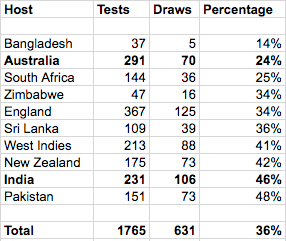
Australia are still near the top, just not as outrageously so. And I have yet to figure out what is going on in Bangladesh, but that is a blog topic for another day.

*

I found the notion of the timeless test match fascinating, and I must admit that I was unaware such a thing even existed until Russ pointed it out.

Between 1910 and 1932, South Africa played 10 timeless tests in Australia. They lost nine of them.

The only match the Saffers won before World War Two took place  January the 7th through the 13th, 1911, and was played at the Adelaide Oval.

The visitors won the toss on the opening Saturday and chose to bat. They ended the day at 279 for 5 .

Sunday was a rest day.

Australia bowled out South Africa on Monday, the 9th, for 482, and ended the day themselves at 72 for 1. On Tuesday they continued to bat on and on and on, thanks to Victor Trumper’s 204 not out.

Trumper, who would be dead of kidney disease in just four years time at the age of only 37, continued to bat on that Wednesday, and was the last man standing as the Australian tail fell apart, leaving Australia 17 runs short of South Africa’s first innings total at 465 all out, despite Trumper’s total of 214.

It was Trumper’s highest score ever, and quite unfortunate that came in a losing effort.

Wednesday’s play ended with South Africa at 232 for five in their second innings, and they would end their innings on Thursday at 360 all out, thanks in most part to a lovely century from Aubrey Faulkner, who would commit suicide in 1930 at the age of just 48.

Thursday (day five, mind you) ended with Australia at 187 for four and in modern times, the match would have ended right there in a draw, but since it was a timeless test, they came out to play again on Friday the 13th, and South Africa bowled out the hosts for 339, leaving them 38 runs short of the visitor’s total.

Reggie Schwarz took three of Australia’s final four wickets, two as a bowler and two in the field, to end with figures of 4 for 48. South Africa went on to win despite Tibby Cotter’s valiant 36 off of 28 at the death.

Schwarz died at the age of only 43, of Spanish Influenza on the Western Front in 1918; just seven days before the Armistice…

Cotter died when he was only 33; a member of the Australian Light Horse, he was killed by a sniper outside of Beersheba, Pakistan, in 1917.

A lot of tragedy happened to the stars of that match at Adelaide in 1911, the only timeless test South Africa ever won on Australian soil.

Of course, those were different times, life expectancy for men was only 50 in 1911, and so dying at the age of 43, especially during the age of  mustard gas and pandemics, was not at all that strange, but very eery how all four men of the match (unofficially) saw untimely and tragic ends.

Tonight, I drink to the memories of those four cricketers, and when Australia and South Africa take to the pitch in Adelaide this fall, I will do so again.

*

Drawing in the Rain

The month long previews of #ausvsa and #indveng continue…

*

Yesterday, I mentioned how few draws there seemed to be in Australia. And that assumption proved to be correct:

As you can see, only Bangladesh has had fewer test matches end in draws. Australia is a full 16 points behind the average and 27 points behind the hosts of our other big test series this fall/winter, India.

Looking at the grounds involved in #ausvsa and #indveng gives us the same conclusion:

Looks like Adelaide wrecks the curve a bit, but percentage wise Australia’s three grounds are 21 points behind India’s four grounds.

Now, what is the single biggest cause of draws? Why, rain, of course.

(Well, some might say teams that refuse to attack or bad pitches, but rain is really the only measurable quality in this equation).

I thought about doing average rainfall for each test nation, but with India and others being such massive countries, the numbers just would have not made sense.

So I made this chart:

Now, while it seems my conclusion was not entirely correct, that rain is the number one cause of the lack of draws in Australia, rain does play a part.

Interesting that Perth receives over 300 mm more in rain every year than Adelaide does, yet there are more draws at the latter ground. And Ahmedabad receives less rain than Perth yet over half of the matches played there have ended in draws. (Small sample size, admittedly.) The comparison between Mumbai and Kolkata is interesting, as well: fewer draws in Mumbai, despite receiving more rain per year.

Conclusions? Australia really does have far fewer draws than other test nations, but that has less to do with rain, and probably more to do with their century of dominance, their attacking nature, and their lively pitches.

What does this say in way of a preview of our two series this fall? Not much that you didn’t already know: results in Australia, draws in India.

*