17 Matches

Michael Clarke, captain of Australia: 11 matches, 18 innings, 1,595 runs – Most Test runs in 2012, calendar year. Average: 106.33. Hundreds: Five.

Alastair Cook, captain of England: 15 matches, 29 innings, 1,249 runs – 2nd Most Test runs in 2012, calendar year. Average: 48.03. Hundreds: Six.

If that does not whet your appetite for the 2013 Ashes, then nothing will. Two captains at the absolute height of their powers.

Though, of course, truthfully, Cook was not captain for the bulk of the year. However, in just four matches as captain, he scored 562 of his 1,249 runs and averaged a whopping 80.28 with three centuries. The armband suits him.

He suits England.

The first Test of the five Test series starts on 10 July at Trent Bridge in Nottingham.

And that is just one amazing series to look forward to next year.

There is also South Africa v Pakistan, India v Australia, and the second incarnation of the Ashes, this time in Australia, in November.

There will be 94 Test matches next year. The four series mentioned above account for 17 of them.

Other highlights:

Well, India will go to South Africa in the fall of next year for a few, Pakistan will “host” South Africa for a few more, and the resurgent West Indies will host Pakistan over the summer for a couple.

The rest of the matches feature non-Test-hardened sides like Sri Lanka, and New Zealand (sorry to all my Kiwi friends), and Zimbabwe, and Bangladesh – and after watching Australia toy with Sri Lanka, I really cannot say I am dying to watch the Lankans or the rest play Test cricket again any time soon.

So the bulk of the fun, for Test fanatics, will be the four series mentioned above: The Ashes in England, the Ashes in Australia, South Africa v Pakistan, in South Africa*, and Australia in India.

17 matches to savor.

*

My 2012 round up and 2013 resolution posts should go up this weekend.

*

*Matches in the UAE are not available here in the States, so I did not include these reverse fixtures

Same question, new answer

It’s Christmas morning.

I am up early with the dog and the coffee to watch India play Pakistan in a Twenty20.

*

I get asked a lot of if cricket – specifically Twenty20 cricket – will ever take hold here in the states.

Nevermind the fact that the question is mildly, albeit unintentionally, insulting – as in, Americans could never like something as nuanced as Test cricket because they are boisterous and loud and lacking in attention spans – my answer has always been a qualified “maybe.”

*

The question, and my answer, invariably revolve around a US-based, T20 league.

A league featuring a smattering of US players and a bunch of international one day mercenaries in cities where there are large ex-pat communities like San Francisco.

But I am watching India vs Pakistan this morning, and it is loud and swashbuckling and entertaining without being annoying (like the IPL; no dancers, no pop music), and I cannot help but retract what I said earlier about insulting and think to myself: Americans would watch this.

If this match was on ESPN, in HD, Americans would watch it.

It would be a novelty at first, like how we all watched Australian rules football in the 80s, but after 10, maybe 15, overs, a good majority of them would be hooked, and would tune in again.

*

The key here is the rivalry, and the crowd, and the general atmosphere, and the entertaining cricket.

They would not watch the sub-par mercenary club cricket that a US league would produce, they would not watch England v New Zealand in a half empty Oval, but they would watch India v Pakistan, and other entertaining sides with a well defined rivalry, play Twenty20 cricket.

*

And so now I have two answers to the question above: a US league? Maybe. But they would definitely watch big-time T20 internationals.

*

Merry Christmas to all my readers.

One Long Day

And, so, Sachin Tendulkar has retired…

…from one day cricket.

It is as if we were all expecting a massive earthquake, a seismic event that would rattle the very core of this sport we all love; but instead there was just a small rumble, enough to shake the dishes in the cupboard but little else.

Cricket writers, both the paid and unpaid versions, were ready the world over to hit “publish” on their Sachin retirement posts – most of which had been written sometime between the Test against England at the Oval last summer and the Test against England at Nagpur last week.

But like a flurry of wickets at the end of a day’s play, the script had been rewritten, and so with it all the sportswriters’ copy.

He was retiring, but only from one day cricket; stop the presses.

This is not to say that Sachin retiring from ODIs is not a big deal. It is a very big deal. He redefined the genre. He did for cricket what Nirvana did to rock music. It’s just that, well, his announcement felt a little…disappointing. It missed the mark, expectation wise.

We were expecting New York Strip, instead we got meat loaf.*

Now, I was not hoping for him to retire from all formats, but the kind of a send off he would have gotten, like the one Dravid received, would have been the kind of send off he deserved. Now all the posts I am reading feel half hearted, like they really aren’t as sad as they had hoped they would be. His ODI stats are remarkable, of course, but it is when they are combined with his Test stats that he becomes God-like. And can you really go on for 1,000 words, lyrically eulogizing him with platitudes and whispers and tears and metaphors when he is only retiring from one format?

It’s almost as if, for the first time in his career, he did not do the thing we all expected from him – he went against tradition, against the system, and decided to do it differently than Dravid, than VVS. And in doing so, he disappointed us.

Or maybe his hand was forced by the BCCI, which means that retiring solely from ODIs was definitely Sachin staying true to form: doing what it is required, and not asking questions.

*

All of the above said, he is no longer an active participant in the format he changed forever, and that is a story. Maybe not the story we were hoping to write, but a story nonetheless.

One day cricket is here to stay, and one can argue that Sachin is the  reason why it is here to stay. I am not quite sure if that is the right legacy for him, or one that he deserves, but it is still a powerful legacy to behold. In a game beloved by two billion people from the village cricket fields of southern England to the Mumbai backstreets, one man changed one facet of it forever. And that is something worth noting.

When Presidents in America leave office, historians always ask: what will their legacy be?

With Lincoln it was the Civil War; with Wilson the depression; with FDR the new deal and World War II; with Carter inflation and hostages; with Bush Jr. Iraq.

For Sachin, I feel it will be the ODI format.

Right or wrong, that is my opinion.

And the fact that he is retiring from the format he reinvented means there is room for another to possibly step up, and change it forever again, positively or negatively.

Which I think is an exciting prospect.

Cricket in general, and one day cricket specifically, and Indian cricket even more specifically, are going through a rebuilding phase, which is something all fans enjoy**, despite the depths we have to endure before the rebuilding begins in earnest. Change brings light into darkness.

India’s ODI squad in the 2015 World Cup will look vastly different than it did in 2011, and so could the sport in general. I am looking forward to seeing the changes that both bring to this wonderful, old, but still evolving, game that I love.

*

*I am a vegetarian.

**Jarrod Kimber wrote a post about this that I cannot seem to find, otherwise I would have properly cited with a link.

India v Pakistan

On Christmas Day, 2012, India will play Pakistan in a cricket match in Bangalore.

It is the first of a five match series, two Twenty20s and three ODIs, and their first series since 2008, though they have played each other five times since 2009 in various tournaments.

The two nations have played each other 183 times since 1952 in all formats and all competitions. India has won 59; Pakistan has won 81; there was one tie; there were 38 draws; and four no results.

*

Since the partition of India in 1947, India and Pakistan, both nuclear states, have been involved in four officially declared wars: 1947, 1965, 1971, and 1999.

The casualty figures for those conflicts are spotty at best, with each side claiming different numbers, but the total military deaths are close to 20,000 – and that does not even take into account civilian killed and wounded, or the atrocities in Bangladesh, or the war spawned diseases and famines.

*

The first cricket match between the two countries took place in 1952 in Delhi. India won by an innings and 70 runs. India scored 372 in their first innings, Pakistan replied with only 150, was forced to follow on, but only scored 152.

Vinoo Mankad, infamous for other reasons, took 12 wickets: four in the first innings and eight in the second.

*

The conflict in 1947, also known as the First Kashmir war, began when Pakistan invaded the Kashmir region out of fear that it was going accede to India. The UN negotiated peace in 1948, splitting the Kashmir between the two nations.

At least three thousand soldiers were killed, and at least eight thousand were wounded.

*

Between 28 November 1952 and 13 February 1961, India and Pakistan played each other in 12 Test matches…every single one of them ended in a draw.

Due to the second and third aforementioned conflicts, after the draw in 1961, they would not play another cricket match until an ODI in October of 1978, a seventeen year gap.

*

The Indo-Pakistani War of 1965 was once again a conflict over the Kashmir region. It lasted only six weeks, but both sides suffered thousands of casualties – over 6,800 total based on neutral estimates. According to Wikipedia, the largest tank battle since World War 2 took place during the five weeks of fighting.

The shooting stopped because of a UN mandated cease fire.

There were no permanent territorial changes.

*

The two nations have played each other in a World Cup five times: 1992, 1996, 1999, 2003, and 2011.

India have won all five matches.

*

In 1971, India intervened in the Bangladesh Liberation Movement, inciting full scale hostilities between India, Pakistan, and Bangladesh, then known as East Pakistan. It was by far the bloodiest of the three conflicts, even though it was the shortest: over 12,000 were killed in just two weeks of fighting.

India and Bangladesh won a massive victory, and East Pakistan became the Independent State of Bangladesh.

Bangladesh’s cricket team would be promoted to full Test status in November of 2000.

*

India and Pakistan have played 59 Test matches: India have won 9, Pakistan have won 12, and there have been 38 draws.

They have played 121 One Day Internationals: India have won 48, and Pakistan have won 69.

They have played three Twenty20s: India have won 2, Pakistan have won zero, and there was one tie.

*

In 1974, India went nuclear.

*

Sachin Tendulkar has, of course, scored the most runs over the 60 year history of the rivalry with 2,474.

Wasim Akram has taken the most wickets, with 60.

*

In 1998, Pakistan went nuclear.

*

53 of the 183 matches have been played in Pakistan. The first was in 1955, the last one was in 2008 – and that could very well be the last one ever, after the attacks in Mumbai in 2009.

*

In 1999, the fourth conflict, known as the Kargil War, took place. Pakistan moved troops into the Kashmir region, thinking it’s nuclear weapons would deter an escalation, the gamble proved wrong, and superior Indian forces forced Pakistan troops to retreat. Over 1,000 lives were lost, and the fighting, while sporadic, took place throughout May, June, and July of 1999.

*

India and Pakistan’s only match to take place during an armed conflict between the two nations was in June of 1999, during the World Cup, in Manchester, England. India’s innings featured fine 50s from Dravid and Azharuddin, setting a score of 227 for Pakistan to chase, but they fell short by 47 runs.

Venkatesh Prasad took five wickets for India.

*

Since 2000 the relations between the two nations have ebbed and flowed, but never have they been what anyone would call friendly. And the attacks in Mumbai in 2009 set relations back a decade. These upcoming matches are a big step, however. Even though at the end of the day they are just cricket games, they are far more important than that; they are baby steps towards peace between two of the largest nations on earth.

It is by far the most interesting, complicated, and intense sports rivalry on earth.

Hopefully, the matches will go off without a hitch this December and January.

***

Addendum:

I cannot believe I forgot to mention this in this post, because I have written about it before on several occasions: the national cricket stadium in Lahore, Pakistan is officially known as Gaddafi Stadium. Yes, that Gaddafi. Colonel Muammar Gaddafi – the former Libyan dictator.

It is named after him because in 1974 he gave a speech in Lahore in which he spoke in favor of Pakistan’s right to pursue nuclear weapons.

*

And, yes, India have played Pakistan in the Gaddafi stadium, the ground named after the man who said Pakistan should get nuclear weapons in order to defend themselves from the recently nuclear India.

It’s all so…complicated…and surreal…and for lack of a better term: foreign.

Anyway, they have played each other 13 times at the ground. India has won four, Pakistan has four, and the rest were draws.

An interesting footnote to the history of a fascinating rivalry.

Guns

I am going to talk about guns.

*

Claude Tozer: First-class Australian cricketer, World War 1 veteran and a medical doctor. Played in seven matches for New South Wales in the 1920-21 Sheffield Shield Season. He averaged 46 and change and scored a century and a handful of half centuries.

Shot and killed by a patient in 1921.

*

Jeff Stollmeyer: West Indian Test cricketer in the 50s, played in 32 Tests, and averaged over 42 with the bat.

Shot and killed by home invaders in 1989.

*

Haseeb-ul-Hasan: Pakistani first-class cricketer.

Shot and killed in 1991.

*

William Strydom: South African first-class cricketer. South African Cricketer of the Year in 1977.

Shot and killed by robbers in 1995.

*

Ashley Harvey-Walker: English first-class cricketer who scored over 3,100 runs for Derbyshire and took seven wickets once as a bowler against Surrey. He played in the infamous “snowed out” match I brought up a couple weeks ago.

Shot and killed in a Johannesburg bar in 1997.

*

Francois Weideman: South African first-class cricketer who played in 40 first-class for two different clubs. After retiring he worked for the South African Cricket Union, a “development program aimed at disadvantaged communities.

Shot and killed during a robbery attempt in 2001.

*

Rahatullah: Pakistani first-class cricketer and also represented his country for the U-19s.

Shot and killed by unknown assailants in 2008.

*

Louis Vorster: South African first-class cricketer. Played 95 first-class matches and scored 4,786 runs.

Shot and killed by armed robbers just this past April.

*

Errol Peart: American cricketer.

Shot and killed during a robbery.

*

All of the above thanks in large part to this wikipedia article.

*

This has been a complicated post for me in a lot ways.

America has an issue with gun violence, with gun culture, and with guns in general. I firmly believe that the answer is less guns, not more guns, and not the same amount of guns in the hands of different people.

The above list of cricketers of course contains only one American, and almost all of their murders happened during robbery attempts, and therefore might have very well been foiled if the victim or a bystander had been armed; and in the case of Claude Tozer, who was killed by a mentally unstable patient, the idea that guns are not the problem, that the mental health safety net is, also comes into play.

And so in a lot of ways, this list of murdered cricketers does not reinforce my belief, in fact it contradicts it: gun violence is not an American problem, and it can be solved if “good” and “sane” people are able to protect themselves, and it can be solved if the “evil” and “insane” are off the streets getting the help they need.

But I stand by my premise: America needs far fewer guns. And anyone who thinks otherwise is wrong.

I don’t think we should melt them all down, but I do think that laws similar to Australia’s and the United Kingdom’s (both enacted after horrific mass killings: Port Arthur and Dublane, respectively), while draconian by American standards, would go a very long way toward savings countless lives. And I am going to stand by that belief.

It is just not worth it. Not anymore. Your guns are not worth it.

And no, it is not solely an American problem, and yes upstanding citizens should be able to protect themselves, and yes our mental health safety net is a laughing stock, but none of the above matters* if we simply make if viciously illegal in this country to own a handgun, a semi-automatic weapon, an assault rife.

I firmly believe that.

And I firmly believe that if laws such as the UK’s and Australia’s had been implemented 10 years ago, then those kids and those teachers in Newtown are very much alive at this moment.

We are late, America. We have failed those kids. And it cost them their lives. But now is our chance for redemption. Change the laws, change the culture, and save lives.

It’s just not worth it anymore.
sandy_hook_victims_final_20121217130407_320_240

*

And don’t talk to me about arming teachers. It’s a fallacy. It’s a non-starter. Owning a gun means you are more likely to be a gun shot victim. It is time for a serious discussion about guns in this country. Preaching bullshit clouds the discussion and keeps us all from progress. Stop it.

*

More cricket tomorrow. If anyone is still reading.

*

*A mental health safety net is vitally important, don’t get me wrong. In fact, far more than just a safety net is required if we are to maintain a functioning society, but we would no longer need to be as scared of those that fall through the cracks, and there will always be cracks, if guns are not readily accessible.

Cricket at the Edge of the World

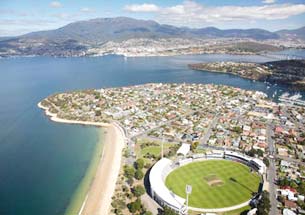
My favorite cricket ground on the planet is the Bellerive Oval in Hobart, Tasmania, Australia.

The pitch is not really anything to write home about (though of the 11 Tests played at the ground, eight have produced a result), and the terraces and stands are not particularly spectacular or historical, but the views of the Derwent river and the hills across the river it affords those of us lucky enough to watch the matches there on television are truly breathtaking:

belleriveovalAs the matches progress, the cameras often show us the Tasmanians sailing, fishing, and otherwise enjoying the Australian summer; it gives the games a nice summery and festive feel that other grounds do not. It does not hurt of course that when it is warm and sun soaked in Australia, it is cold and miserable here in Minneapolis.

*

So many cricket grounds, especially those it seems in Australia, are outside of the city centers, in warehouse districts, settled in among bland office buildings; and so it is nice when there is a ground like the Bellerive Oval to savor.

V_16

*

And speaking more lyrically, there is something to be said for cricket at the edge of the  world.

Bellerive is not the most southern cricket Test ground, those plaudits go to University Oval in Dunedin, New Zealand, but Bellerive is a very close second, and Hobart is on an island, adrift in the Southern Ocean, the last outpost before Antarctica. A lone watchtower on the far edge of the known universe.

Again, speaking lyrically, but it does give the matches a touch of the fantastical, that I enjoy.

If I had to pick one ground to see a Test match at, I would not pick Lord’s or the MCG or the Wankhede, I would pick the Bellerive Oval.

Cricket at the end of the world; at the bottom of it all.

*

header-bellerive-01

Major Announcement

Dear USA based readers (and other assorted parties):

I wanted to introduce you to a new page here on Limited Overs, the World Cricket Internet Schedule for US Viewers.

The page will list all upcoming International matches (including IPL, BBL, and other major tournaments), separated by date, with a local US time – AND it will tell you where to watch the match, on the Internet, in the United States.

I feel that as the sport grows in popularity here in the states, both among the ex-pat community, as well as among native born Americans, and coverage of the sport increases, this will become an invaluable resource for my fellow stateside cricket fans. And while of course right now the only Internet sources showing cricket matches are Willow and ESPN3, I think that will change in the future, so I am getting a head start. And even before other sources come along, it will be a good place to see which matches are coming up on any given day, on a site geared toward fans in the United States, so you can plan your days and nights accordingly.

I also hope to expand it soon to include those matches on actual television, not just the Internet.

Anyway, check it out, bookmark it, and come back often. Also please do let me know if you have any thoughts or feedback or suggestions.

Thanks, as always, for reading.

Cheers.

Dessert Course

A few days ago, over on The Full Toss, James Morgan expressed his thoughts on how enjoyable the India versus England series has been due to the fact that there is no DRS. He took quite a flogging in the comments, and I have to ask: would James be just as dismissive of replay technology if England were down 2-1 instead of up 2-1? Probably not.

That said, I have to say: I agree with him.

After watching Australia v South Africa and all of the appeals and all of the reviews and all of the reversals, it feels quite cleansing to watch a series where when the umpire puts his finger up, the batsman walks. You don’t have to put your joy or sorrow on hold, you get to enjoy the pure moment. It is one of the things I enjoy about County Cricket, and I must stay that I am enjoying it on World Cricket’s biggest stage, as well.

Bear in mind throughout this post that I only started following the sport in the spring of 2007, and DRS came around not two years later, so it is not like I am a hopeless traditionalist longing for the bygone days when men were men and out was out. It is just simply cleansing to watch, like I am enjoying the sport how it was meant to be enjoyed. Like a pacemaker restoring the rhythm of an old man’s heart.

Unfortunately, I feel like a bit of a heel, I feel a little embarrassed, and I feel a little dirty. For over the past few years I have done nothing but extoll the virtues of technology in sport. I have gotten on my high horse and bemoaned the lack of goal line technology in football; I have cried foul at baseball’s reliance on the human eye to judge whether a 98 mile-per-hour tailing away fastball was a millimeter too far outside in game seven of the World Series, not to mention in every other game of the season; and I have nodded approvingly at sports like American football and rugby and cricket and basketball that use technology and use it well.

Getting the call right, that’s the important thing – that’s what I always say: there is too much at stake to fool around with human error.

But maybe I was wrong, maybe all I have wanted my entire life is to debase myself in that quintessential trait of humanity: the fact that we are prone to mistakes, and that is what makes life interesting.

Perfection is boring. Imperfection is what gets us up in the morning.

Or maybe not. Maybe this is just a nice palette cleanser, like a sorbet between courses, before getting back to the nuts and bolts of the real world; a real world where we use all the tools at our disposal to ensure the team that wins deserves to win – and that’s not all that terrible of a world to live in.

Plus DRS or no DRS, we still get plenty of imperfection in cricket: just ask David Warner.

*

You can’t go home again

This post inspired by Subash’s post over on the Cricket Couch.

*

In less than three hours, Sachin Tendulkar will walk out to play his 194th, and quite possibly last, Test match for India.

I am not saying he should or should not retire, or that he will or will not retire, that decision lies solely with him, for he and he alone knows if there are runs left in his bat, and he has earned the right to make the decision himself, but the point remains: come Monday evening, he could very well be walking off the pitch wearing the Indian whites for the very last time.

Only 39 years old, and it feels as though I am writing his obituary.

And that’s the thing about athletes, they achieve so much when they are still so young – the average Olympian is only 26 years old, for instance – and because of the way the body breaks down as we all age, they are forced to hang it all up just as the rest of us are starting to hit our strides.

For most people, our 20s can be a little aimless. We are unsure of our skin, this world and our place in it; but by our thirties, we know what makes us happy, we have decent incomes, we have people around us that we love. In a lot of ways, for regular folks, life doesn’t really begin until our 30s.

The opposite is true for professional athletes.

After spending their entire lives, 30+ years, doing just one thing, and doing it better than 99% of the people on planet earth, they are forced to walk away from it forever.

That must scare the living crap out of them. It must feel like dying.

It’s identity theft, but instead of your bank account number, they steal your soul. Reach down and scrape it out and leave it on the bathroom floor.

I cannot imagine the level of emptiness athletes must feel when a new season rolls around and they are home with the kids, and the walls, and the quiet.

Am I being overdramatic? Of course I am, to some degree, but it is not uncommon for athletes to respond to the aforementioned blackness with drugs, spousal abuse, and other anti-social behaviors.

I look at Olympians on the medal stand and I think to myself: Christ, peaking at 19, how bloody depressing is that?

Honestly, of course, they are not peaking, they will go on to have kids and earn Doctorates, but I cannot help but think that those tears we all see gold medalists shed as their anthems blare are not tears of joy, but tears of sadness, tears of ending.

*

Sachin, of course, will be okay. He has two children to hang out with, he has his millions of dollars, and he will probably go into coaching, or announcing, or maybe serve on a board or work for the ICC or start a business or just do nothing at all: take naps in the afternoon, and look back on a marvelous career.

All I am saying is that the cliff he is looking over and contemplating is not separating playing cricket from not playing cricket, it is separating life from death. If he jumps, a part of him dies – a very, very large part of him – and it dies forever. Therefore I honestly cannot begin to imagine the thoughts that must be in his head right now; though all of us have noticed the lack of twinkle in his eye, as if a darkness rests back there, tormenting him.

I do know that the above will be in my head as I watch this Test.

*

I don’t talk a lot about Sachin on this blog, though I really could not tell you why. But just for the sake of my non-cricket-fan readers (and it turns out there are a few): Sachin Tendulkar is the greatest cricketer who ever lived. Full stop.

Cricket was already popular in India of course when he made his debut in 1989, but in the 23 years since, the game has gone from past time to obsession for one billion Indians, and countless more cricket fans the world over, no matter their allegiance.

He has 15,643 Test runs, the most all time, and over 2,000 more than the second most all time.

He has 51 Test centuries, the most all time.

He has 100 centuries in all formats, the most all time by a country mile.

He has 34,079 runs in all formats. No one else has 33,000, 32,000, 31,000, 30,000, 29,000, or 28,000; the closest is Ponting with 27,483.

He is a revolutionary, an iconoclast, and the game as we all know it does not exist in its current format without Sachin.

He is Michael Jordan. He is Roger Federer. He is Tiger Woods. He is Pele. Babe Ruth, Wayne Gretzky, Jesse Owens.

But more. Picture any of those guys, but picture them carrying the weight of the whole of India on their backs, yet still able to perform at the highest level for 23 years.

I don’t talk a lot about Sachin Tendulkar on this blog, but I am going to miss him when he is gone. This game we love will not be the same ever again. But the hole he is going to leave in this sport and in our hearts will pale in comparison to the hole he will carry in him for the rest of his life after his cricketing days are over.

*

442px-A_Cricket_fan_at_the_Chepauk_stadium,_Chennai
Image shared via the Creative Commons Attribution 2.0 Generic license. Image links to original.

Mystery Series

The two lowest ranked Test nations currently are of course Zimbabwe and Bangladesh (actually Zimbabwe isn’t even on the charts at this point, but let’s say they are for the sake of argument.)

In 2010, Zimbabwe played zero Tests. In 2011, three; in 2012, one; and next year they are scheduled to play six.

In 2010, Bangladesh played seven tests. In 2011, five; in 2012, two; and next year they are also scheduled to play six.

Now, 2011 and 2012 were of course World Cup years, so I guess their boards and the ICC and the boards of other nations can be forgiven for the lack of Tests scheduled for the weakest among us, and next year, a non-World Cup year (however, there is the Champions Trophy) they each have six Tests scheduled, which is an improvement, but I still think the lack of Tests, and the gaps between Tests, is simply shameful.

In their only two Tests this year, against the West Indies, Bangladesh got shellacked. It was hard to watch. And this is a decent enough Bangladeshi one day side that beat the West Indies in the ODI series.

But in the Tests it was not even close, and for the ICC who is looking to grow their game globally, it is a problem. And why even bother promoting Ireland to full Test status when they probably won’t be playing more than one or two Tests a year anyway?

Look, I understand that there are scheduling conflicts and backroom politics that I will never even begin to fully comprehend; plus of course there is the IPL and the Champions League and other competitions that, you know, actually make money, but I really do think it is time for Zimbabwe and Bangladesh and even other consistently under-performing Test sides like Sri Lanka and the West Indies and New Zealand to greatly increase their Test schedules – even if it means blowing up the current FTP and starting from scratch – in order to make the game globally more competitive.

And this all rolls downhill: better Test sides make better one-day sides, so everyone wins.

Here’s the all the raw data from the last few years, for fun: (countries sorted by current ICC ranking):

Picture 79

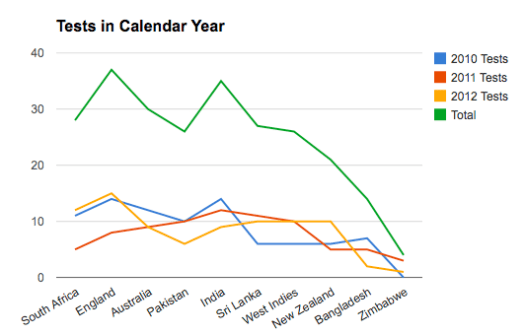
And here it is in graph form, for fun (x axis is nations in descending order of current ICC ranking):

Picture 80

After India, the drop off is dramatic.

Now this could very well be a “which came first the chicken or the egg?” situation, but it is rather obvious: fewer tests mean a poorer ICC ranking.

So how do things look going forward?

Here is the raw data again, with 2013 matches included (more on that in a second):

Picture 81South Africa might experience a dip in form down the road, as might India; while countries such as England, Sri Lanka, and the West Indies can probably expect their current form to hold.

I expect improvements, slight but improvements nonetheless, from Pakistan, Bangladesh, Zimbabwe, and New Zealand.

Regarding NZ, they are only playing one more Test in 2013 than they did in 2012, but it is still more than double the number they played in 2010, so I still expect an improvement in form, despite current, errrrr, difficulties.

All of the above is for fun, meant to be taken with a grain of salt.

*

Finding calendar year 2013 Tests was a vastly more difficult task than I thought it would be.

There is not a single good source out there that lists them all.

ICC’s Future Tours Programme is about as close as one gets but it is not divided into calendar years, it is clunky and difficult to navigate, and the data is not infallible, or all that reliable.

One quick example: they have a four Test series scheduled for February and March of this year, India versus Australia, in India.

The tour is not listed on Cricinfo. It is not listed on Cricket Australia’s website. It is not listed on BCCI’s website. The only place I could find it listed was on Willow.tv’s website, but they are not exactly the bastion of good information.

Subash over at the Cricket Couch talked to some pals of his in Chennai and confirmed the match there is happening in March, despite the fact that some sites I found had the matches happening in the West Indies (seriously.)

I think the mystery is solved in the last sentence of the above link: the schedule is not yet “declared” and then something something Cricket authority (lower case a).

I do think the series is of course actually going to happen, but it is just so utterly and completely ODD that there is not a good source that lists all upcoming matches in a clean, easy to navigate, format; one that includes not just matches in the next six months, but ALL scheduled Tests, ODIs, and T20s…

If this source already exists, please do let me know.

*

This is just another example of how bloody difficult it can be to be a cricket fan in 2012, despite all of our advances.

*