Programming Notes

As I mentioned over on Twitter, the U19 World Cup and the Sri Lanka Premiere League are both available to US viewers in their entirety on ESPN3.

I have my issues with ESPN. Their sports as entertainment rather than athletics mission (see their idiotic “Who’s More Now?” campaign from a few years back), as well as their east coast bias have always turned me off. But ESPN3 is one thing they do very, very well.

Let me backtrack a bit: I don’t have cable. I watch all my cricket via Willow.TV, and all my other sport via ESPN3 or I head on down to the Pub. (My pub here in Minneapolis is The Local, if you ever happen to visit.) (And let me know if you do, I will buy you a drink.) (I do not watch illegal streams. It is a personal choice. I do not think you are a bad person if you do).

Despite this handicap, and despite the fact the FIFA World Cup and the UEFA European Championships are only on ESPN’s family of networks, and despite the fact that ESPN is a cable only network, I was able to large nearly every kick of the 2010 World Cup and Euro 2012: thanks to ESPN3. It is a fantastic product. It is sport for everyone. I do not think that ESPN’s motives are pure, of course, but they come across as so. Sport for the masses, not just for the elite. And they show everything: not just the big four, but also cricket, and rugby, and football, and Formula 1, and polo (horses, not speedos), and boxing, and lacrosse, and tennis, and on and on and on. There is no west coast bias, there is no flash, there is no “entertainment”. It is not American centric. It is just sport. Turn it on and watch.

And to top it all off: the streams are of the highest quality. They rarely freeze, and they always work, unlike other legal sport streams. (Cough, WillowTV, cough).

All of this brings me to NBC’s Olympic coverage. Despite the fact that NBC is a free, over the air channel, and despite the fact that NBC owns the rights to every Olympic event, I have been unable to watch the vast majority of the Games.

The flagship over-the-air channel has shown nothing worth watching. During the day it is mostly volleyball or water polo. And at night it is tape delayed events that I already know the outcome to. (Sure I could go on Internet Blackout but going spoiler free during the Olympics is damn near impossible).

And while they do have online streaming available, you cannot watch it unless you have cable. I could not pay for it even if I wanted to, and I would have wanted to.

It is the opposite of ESPN3. It is the opposite of the Olympic spirit. It is sport for the elite. Sport for rich people. It is Target Field, while ESPN3 is the Metrodome (local reference, sorry). And it just makes me sad. Because I love the Olympics.

Over the years I have been a staunch defender of NBC’s Olympic coverage. But no more. And I hereby put out an official request:

Dear ESPN,

Please purchase the USA Television rights for the Olympics.

Yours Truly,

Matt

*

Yuvraj

Big news this morning out of Mumbai: Yuvraj Singh has been named to India’s T20 squad for the upcoming series against New Zealand as well as the T20 World Cup next month. This is just delightful news. It really is amazing to me how far the world has come in the treatment of cancer. Now instead of thinking “death sentence” when we hear the word, we instead think of Lance Armstrong, Mario Lemieux, Dave Callaghan, Eric Abidal, and now: Yuvraj Singh.

Unfortunately, it is not always good news. Cancer still kills. A little research brought me to New Zealand wicket-keeper, Ken Wadsworth. He played in 33 tests for his country, scoring over 1,000 runs. His last test was February 13-17, 1976 against India in Wellington. He took four catches and New Zealand beat India by an innings and 33 runs.

Six months later, at the age of only 29, Wadsworth was dead of skin cancer.

There was also South African Tufty Mann, who died in 1952 of abdominal cancer. As well as a whole host of other cricketers who died in their prime. Some in war. Some from on the pitch accidents. Some from car accidents.

All too young.

And this is why we should all celebrate Yuvraj’s comeback. As cricket fans, as humans. It is a triumph over a disease that has killed millions, and it is a triumph of the human spirit. Cancer still kills, and so we all need to celebrate those that beat it.

Welcome back, Yuvraj:

*

Four Stories

Today, the front page of Cricinfo is made up of four different stories, none of which have anything directly to due with the actual playing of the game, but have a great deal to say about the future of this game we love (not counting the lead story about Sri Lanka v India, despite the fact that Virat Kohli is going to have a huge impact on cricket in the future, but that’s a blog for another day):

Boyd Rankin is “retiring” from Irish cricket. South African Mark Boucher is retiring, sans air quotes, from all cricket. Meanwhile Kevin Pietersen’s international future is in doubt, while Chris Gayle’s international career is seemingly back on track.

Mark Boucher’s story has the least to say about world cricket, but it is by far the saddest of the four. I know a lot of us were hoping he would have one more go with the gloves after that freak accident stole his farewell tour, but it looks like that is not in the cards. What this does remind us of however is that despite the pastoral history of cricket, it is still a violent and dangerous sport when played at the highest level. Especially considering we are in the age of the super athlete. One wrong move and your career is over.

Meanwhile, Irish bowler Boyd Rankin is going to quit the Irish national team after the T20 World Cup in September so he can move to England and hopefully make the England test squad. This talent drain going on in Ireland has to stop at some point. I am not sure accelerated test status is the answer, but I do think tighter restrictions on player movement is. This is one thing that FIFA gets right: play for your country at the U19 level or higher, than you cannot play for any other country. Done. Make this happen, ICC. There are enough Hessians in world cricket, we need to plug the drain on cricket boards at the international level at least before it is too late.

Just think how good South Africa or Ireland could be right now? And just think how poor England could be?

Speaking of which:

South African Kevin Pietersen’s future with the England squad is in doubt after a bizarre post match press conference yesterday in Yorkshire. The rift between KP and the ECB is deep, wide, and bridgeless. And I really do not think it can be fixed. KP is going to retire from all international cricket after the Lord’s test and England is going to be without one of the most exciting batsman in the world.

This is terrible for England, of course, but it is also a tragedy for all cricket, and test cricket specifically. If the longest form of cricket is going to survive in our fast food world, it needs to have players such as KP.

The good news here is that test cricket has another extraordinarily exciting batsman back in its fold: Chris Gayle for the West Indies. Great for test cricket, great for everyone.

These four stories are only loosely connected, but I think together they do a nice job telling the story of the modern cricketer. Its dangers, its obstacles, its shortcuts, and its payoffs. Players right now are more powerful than they have ever been, and the game they are playing is more dangerous than ever, and the ICC and every cricket board needs to stand up and take notice of those facts.

Until next time.

Athletes Without Borders

Yes, I know, this is a cricket blog…bear with me…

*

There is so much happening right now. In sport. In cricket. In real life. My 10th wedding anniversary was Friday. The next night my wife released her second album. On Sunday I woke up on a boat. On August 21st, I graduate. There is also the second test between England and South Africa happening right now, and despite the rain it has been a truly brilliant game. Kevin Pietersen’s knock on Saturday was easily the most entertaining century I have ever seen, though I freely admit my experience is limited. And now with 40 overs left on the fifth day South Africa have declared 252 runs ahead and Strauss has sent KP out to open with Cook and so both captains look to be going for the win. Wonderful stuff. Ebbing, flowing, drama: Test Cricket.

And through everything, the Olympics have been happening.

I have not watched as much as I would have liked. I have been busy (see above), and I am cable-less at the house and NBC’s flagship coverage has been dreadful. Nothing but beach volleyball and water polo. Where’s the team handball and the judo and the fencing? And the football and the field hockey and the discus? Oh, right, Americans are not good at those events, and so NBC assumes I am not interested.

Poppycock.

And this all brings to mind my ongoing issue with all the Olympics: all of the bloody Nationalism. If I had my way, the IOC would do away with all of the medal counts and national anthems and patriotic brouhaha and just have the best athletes in the world get together every four years and compete. Sure, there would be logistical concerns, and team sports would of course be a concern, but there is no reason why the Olympics can’t be treated like, say, a grand slam tennis tournament, for instance. Just invite the best athletes via a points qualification system. People can still of course cheer for their country men and women, like the Brits did for Murray during Wimbledon, but stripped of the competition will be all the obsolete and divisive patriotic bullshit. I mean, seriously, who cares if the USA wins more medals overall than China? And just because an athlete happens to be American, why does that mean I am more interested in their performance, or more excited if they win?

It would be so much more Olympic. 

For instance:

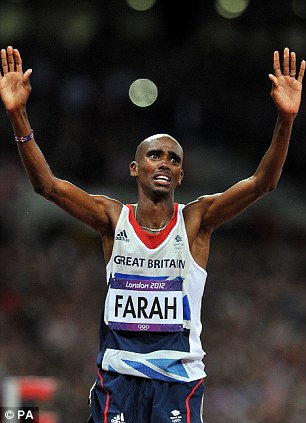
Mo Farah’s win the in 10,000 meters on Saturday night was easily, EASILY, the highlight of the Olympics for me so far. Not Gabby Douglas, not Micheal Phelps. Shoot, Farah’s win will probably make my top five sporting moments of 2012. It was an absolutely brilliant 20 minutes of sport. There was drama, courage, joy. Everything we all love about athletics. My wife and I were both off the couch and standing with nerves as the bell lap started. Inside a cauldron of light and noise, Farah went ahead with 450 meters to go and held off the finest class of distance runners the world has ever seen. He crossed the finish line and collapsed from joy and exhaustion. It was a brilliant moment. I have not stopped thinking about it. The way a good film or concert sticks with you for days.

Mo Farah: a British citizen who was born in Somalia and trains in Oregon.

Thank you, Mo, for proving my point for me.

And nice running.

Tomorrow more cricket, I promise.

Updates: 

My friend Tim over at 7amkickoff points out that Mo is an Arsenal supporter, among other revelations.

And Mike Marqusee discusses the ultimate Olympic gesture, and points out that the medal counts are an invention of the media.

Soil and Sky

A few weeks ago, I went to see the Rembrandts at the Minneapolis Institute of Arts, supposedly the largest collection of works by the Dutch Master in America ever.

It was amazing. Around every corner of the gallery lurked four hundred year old profound beauty waiting to be discovered. I loved every second of the forty five minutes I spent at the exhibition. I could have stayed for hours. I cannot wait to go back.

And thanks to law of Public Domain and its section on two dimensional works of art, I can repost images of his work here on the blog:

Rembrandt captured all the beauty and the joy and the complexity of the human existence in his portraits. He was a master of telling a complicated story with simple brush strokes. You look at his work and you recognize the subject’s deepest fears as your own. You are two parts chilled and one part in supreme and magnificent awe.

There is no true way to describe the experience of being surrounded by so much human genius in one small space. It would take a Rembrandt, to accurately describe what was like to behold a Rembrandt.

*

Sport is often mentioned in the same breath as art. Last March, David Green of The Reverse Sweep compared Virat Kohli to Rembrandt. A decade ago, when describing a throw from the Seattle Mariners’ outfielder, Ichiro, to third base, a beat reporter famously said it (the throw) needed “to be framed and hung on the wall at the Louvre, next to the Mona Lisa.” Video here (warning: you are going to have to watch an ad).

And even I have compared athletic endeavors to artistic triumphs: calling athletes poets, for instance.

But I think in doing so those of us writing about sport are failing to keep our eyes on the ball, and thereby are, in small ways, assisting in the destruction of art. Sure, there are moments when sport transcends and fills us with the kind of awe that a beautiful piece of music can inspire. But sport is not art, it should not be placed next to art. That is not to degrade athletes or athletic competitions, but I think we are destroying art when we use its language to describe sport. It’s like using light to describe darkness, or vice versa.

It’s okay to use hyperbole, but it’s not okay to say that Ichiro’s bullet from right deserves the kind same recognition the Mona Lisa receives. We need a da Vinci to describe a da Vinci. A Japanese singles hitter does not suffice.

And by “not okay”, I don’t mean that it’s wrong. Or that sportswriters like myself who use such similes and metaphors are ignorant hayseeds, it’s just that the comparison is incorrect, is off-base, is low and outside.  Sport is terra firma; art, nirvana.  You cannot use soil to describe sky.

However, in one very important way, art and sport do belong in the same breath: They show us what we humans are capable of, if given genius, and talent, and time, and space. There are horrors unimaginable in this world every day, but there is also art, and poetry, and, well, sport. They all inspire hope, they do it in different ways, but they inspire it nonetheless. That there can be beauty in a world with so much pain is something we should be reminded of daily. It’s good for the soul.

Life is dark and sad and mournful. But in it we can find certain things sometimes that make us feel okay about being human.

Picasso. Ichiro. Kohli.

Ali:

Rembrandt:

Soil.

Sky.

Meaningless

Like most cricket fans, I have been enjoying the Sri Lanka v India ODI series. This morning, whilst following the ball by ball (men’s road race on TV in the background), I thought to myself: “the test portion of this tour is going to be fantastic. I wonder how many they are playing?”

The answer: none.

Forgive my ignorance, but sometimes I have trouble keeping up with all of these series.

But it just doesn’t make any sense: why would two test playing nations get together and not play any tests?

Of course this is all on the heels of the positively meaningless and stupid ODI series between England and Australia.

Shoot, at least Sri Lanka is a puddle jump for the Indian team, unlike the 24 hour long haul flight between Sydney and London.

And coming up Australia face Pakistan in a one-day-only series this August/September, and Australia (again with the Aussies…what the fuck, Australia?) face the West Indies in a one-day-only series next February.

Now, I know the one day formats have their place in world cricket, but they should be the appetizer or the dessert in relation to a test series, they should never, outside of a world cup, be the main course. (With the exception of the India-Pakistan series this winter: there are extenuating circumstances there.)

All of the above thoughts this morning reminded me of my discovery yesterday that on August the 15th, three days before the opening weekend of the Premiere League and two days before the opening weekend of Ligue 1, FIFA and UEFA and every other major football board have scheduled a literal boatload of meaningless international friendlies.

All of this sport, all of it so meaningless, all of it so obviously one big giant cash grab by greedy bureaucrats who haven’t stepped foot inside the lines in decades.

Say what you will about the Olympics and the money and the corporate sponsors and the TV coverage and the fact that it is no longer an amateur competition, but at least the events all feel meaningful. At least there is a facade of competitive pride from the athletes.

*

With that all said, I took a peak at the upcoming international cricket tours (that include tests) over the next 12 months: India v New Zealand, India v England, Australia v South Africa, South Africa v New Zealand, Australia v Sri Lanka, South Africa v Pakistan (drool), New Zealand v England, England v New Zealand, and the Ashes.

Okay, I am officially excited. And most of those will be available on WillowTV.

Also: what big, big year this will be for New Zealand.

And with the exception of the Ashes, that South Africa v Pakistan series should be the highlight of the year.

A little meaningful sport goes a long way.

Until next time.

*

Olympiad

The Olympics start tonight.

I love the Olympics.

I have loved the Olympics my entire life.

The first games I remember watching was 1984 Los Angeles. That was the year the Soviet bloc nations boycotted the Olympics in retaliation for the US boycotting 1980 Moscow which was in retaliation to the Soviet’s invasion of Afghanistan in 1979 (everything always comes down to Afghanistan…) Because of the boycott, the US cleaned up, medal count wise. They won 174 total medals that year. The next best was West Germany with 59.

Eight year old me watched with rapt attention for the entire fortnight. I didn’t give two shits about invasions or boycotts or geopolitical conflicts…I just liked to watch Carl Lewis tear it up.

(Link above goes to Lewis’s win in the 200 meters. Which is my favorite track and field event (despite the fact that I am long distance guy). Michael Johnson’s win in the 200 at 1996 Atlanta is one of my personal favorite sporting moments ever.)

I have watch large swaths of most Olympics since, and actually enjoy the Winter Games a bit more than their summer cousin. Though one of my other favorite sporting moments was during Beijing 2008: I was at a bar in New York City when Jason Leczak came from nowhere on the last leg to win the 400m Medley Relay and keep Michael Phelps’ dream of eight golds alive.

This year’s games are, of course, in London.  And this blog is, of course, about cricket.

And so: This summer there will be a tantalizing test match happening 200 miles north in London, but having international cricket in England during a London Olympics is not a complete rarity.

In 1908, the first time London were Olympic hosts, the England cricket team were in Australia for the Ashes, but the last match of that series (a series that England lost 4-1) was in February of that year. They did not play another match in 1908.

There was the County Championship, of course. Yorkshire won it that year (shocking).

However, in 1948, the second and most recent time London hosted the games, England played 11 test matches, including hosting the Ashes series. However, none of the matches were played during the two week period of the Olympics. England lost those Ashes, too, falling to the visitors 4-0. The series is known for being Don Bradman’s last appearance in England.

England also traveled to the West Indies in the spring of that year, and traveled down to South Africa in the Fall.

Glamorgan won the County Championship that season. It was their first title.

*

Despite its immense and worldwide popularity, cricket has only featured in the Olympics once: in 1900 in Paris. There was one 12 a side match played between England and France, though the French side was made up of primarily Englishman.

England won by 158 runs.

Cricket has not made an appearance since.

However, with the popularity of Twenty20, I could see it making an appearance at some point. Shoot, if the Olympics can survive BMX bikes, Rhythmic Gymnastics, and Ryan Seacrest, it can handle cricket.

*

Now off to watch the opening ceremonies. Expect more Olympic talk here throughout the next couple of weeks.

Hashim Amla

What else is there left to say about Hashim Amla’s knock at the Oval against England this weekend?

Very little. It has all been said already. My early read has Firdose Moonda saying it best so far, but that could easily change.

Forget all of the speculation about whether he was fasting for Ramadan or not, forget all the talk about how the pitch is a road (it’s not, just ask Andrew Strauss, Alastair Cook, Jonathan Trott, and Kevin Pietersen), at the end of the day: this was everything I love about cricket, wrapped up in a nice little package.

Like Cloud Cult sang once: it was “like New Year’s Eve and the Fourth of July making love in the snow.”

This 29 year old, quiet, devout young man walked out onto a ground 10,000 miles from his home, that was built 148 years before he was born, and on a perfect July weekend on the far edge of the world’s greatest city, simply batted for 790 minutes, just a hair over 13 hours, scoring 311 runs along the way.

He only left the pitch when his captain said “enough.”

It was elegant, it was peaceful, it was everything I love about cricket.

Again, there just isn’t a whole lot more to say.

There are times when sport transcends itself. When moments are pure and the athletes poets. These happen very rarely. But one happened today in London. And the 25,000+ at the Oval knew and understood what they were seeing: as evidenced in the massive standing ovation they gave the man that was burying their team.

Even his opponents on the England team cheered for the South African. It was a remarkable moment. I get goose-bumps just thinking about it.

The series might have already achieved its zenith. I can very well see South Africa riding on Hashim Amla’s big beautiful wave all the way to a 3-0 white wash. In fact, it is already happening, just ask Andrew Strauss, Alastair Cook, Jonathan Trott, and Kevin Pietersen.

Hashim Amla, cricketer:

The Local Club

Earlier this week, the sport of cricket, specifically the Minnesota Cricket Association, made the front page of the St. Paul Pioneer Press. A couple weeks back, the same organization made the front page of the lifestyle section of the Minneapolis Star-Tribune.

My initial reaction was, quite literally: HOLY CRAP!

But after a few minutes, my reaction was more along the lines of: okay…sooo… when does England v South Africa start?

When it comes down to is that I don’t give a shit about the MCA. That sounds overly harsh, but there is no other way to put it. I also don’t give a rat’s behind about the USACA – whether it be on the pitch or off. My fellow American cricket fans are always all a-twitter about the organization and its crazy antics, but personally I just don’t care. I am far more interested in what Cricket South Africa or the BCCI is up to.

A few months back, when the USA were playing in the T20 World Cup qualifiers, my fellow American cricket fans were all firmly in the corner of their countrymen, while I was quietly hoping Ireland and Afghanistan would be the two teams that went through. I just didn’t care. I had no allegiance whatsoever to my home country’s cricket squad.

That is not to say that my fellow American cricket fans are fools – the exact opposite is true: I feel the fool for not supporting my country in the sport I love, for not supporting the thriving league that exists right here in my hometown. I feel like my fellow American cricket fans are doing real, solid good for this sport we all love, while I would rather sit around in my pants and read about Sussex’s chances in the knockout stages of the FLT20.

And all of the above is true for other sports I enjoy: I love, LOVE, football, but the MLS is completely outside of anything I am remotely interested in. I think I have watched a grand total of maybe 20 minutes worth of MLS in the last three years. I hear good things though.

Also, Minnesota has a thriving second division football team. They have an active and fun supporter’s group that gives out free beer before matches (seriously). And shoot they even won the god damn league last year. But I am lucky if I make it to one match a season.

All of the above always makes me feel like a bit of a heel.

I wish I was one of those guys that supported the local club no matter what. That took the time to nurture the game in their communities. That didn’t waste their time away in a pub watching a team play on television 4,000 miles away when there was real, live football and cricket to watch just down the street.

I have tried. But I am just not that guy. Nor will I ever be, it seems. I am happy for the MCA, and I am thankful the US has cricket supporters like Peter Della Penna, for instance, who support the grassroots cricket happening throughout the country, and I am thrilled to see the MN Stars put 4,000 people in their rickety old stands every Saturday night…but it’s just not for me.

And so, fellow American Cricket Fans: keep writing, keep reading, keep supporting. You are doing the Lord’s work. And I while I thank you, envy you, and respect you, I am not going to join you.

My passions lie elsewhere.

*

(Note: the only real exception to the above is that I am a huge supporter of the US Men’s National Soccer Team. I nearly died with joy when Donovan scored for the US against Algeria in 2010.)

Race

“England’s not the mythical land
of Madame George and roses,
it’s the home of police who kill
black boys on mopeds”
-Sinead O’Connor, from Black Boys on Mopeds.

*

Angry, naive lyrics from a young, angry, possibly naive, pop singer. Surely. Nothing more. But also a comment on the volatile racial viper pit that was London in the 1980s. The Brixton Riots. Colin Roach. Nicholas Bramble. This article from The Independent dated 21 November 1993 is a proper summation of what life was like for the black English in London at the time. It was a difficult time, a time when England’s racial problems took hold and threatened the civility of an entire nation.

And those problems have not gone anywhere. It was just seven years ago that the police gunned down Jean Charles de Menezes in the wake of the 0f the 07 July bombings in London. And earlier this week, the captain of England’s football team was acquitted of racially abusing Anton Ferdinand, despite reams of evidence to the contrary.

There is not an Englander alive that won’t tell you that England doesn’t have a race problem. A problem that saw its genesis on the backstreets of Stoke Newington and one that continues today.

You can even see it in the faces of the country’s international cricket team.

The England squad that is to face South Africa in the first test of a hugely anticipated series is, with the exception of Ravi Bopara, as white as driven snow.

Meanwhile, South Africa’s squad features seven non-white athletes: Hashim Amla, Jean-Paul Duminy, Alviro Petersen, Robin Petersen, Vernon Philander, Thami Tsolekile, and Lonwabo Tsotsobe.

Now, I realize I am wading in dangerous waters here, and I realize that when it comes to racial problems, South Africa’s are incomparable to England’s, it’s not even apples to oranges, it’s apples to hand grenades, but I still think it is worth noting that England’s squad is noticeably whiter than that of South Africa’s: the country that stripped its dark skinned populace of citizenship not 42 years ago.

Who cares? That might be your response. And what does it matter what color cricketers are anyway?

Because I think a strong African English and Caribbean English interest in cricket is necessary for not just the continued growth of the sport, but for the continued bridging of the racial divide discussed above. I feel the same about Major League Baseball and African Americans: I think it is a shame that more African American kids do not want to play baseball; I think it is bad for baseball, and bad for America.

Why?

Because: there should not be white sports and black sports. Right now: cricket is a white sport, and it shouldn’t be that way. In America: baseball is for whites and hispanics; hockey is for whites; basketball is for African Americans, as is gridiron football (except for the quarterback, of course, and the kicker.)

The racial divide in sport among the two shining lights of Western style democracy is a chasm deep, wide, and bridge-less.

Yes, of course, football has a huge race problem, in England, and throughout the world. I get that. I am not saying cricket is the only devil here. I am just saying that it is a shame that while we demand racial equality in the workplace and in the schools, we allow it to fester between the lines of our favorite Saturday pastimes.

And so what do we do? How do we kick racism out of football? How do we get more Afro-Caribbeans interested in cricket?

In researching, and reading, I came across this article that I think is worth your time. There is also the Chance to Shine project, and many other worthwhile attempts to keep the sport healthy, vibrant, and diverse.

But otherwise, I don’t have any answers. I just think it is a shame. And really something that the ECB should actively be talking about. And it looks like they are. Good on them.

*

If any of the above offends, please take a moment and remember that it was not meant to do so. It has been just something I have been thinking about the last couple of days. Please do let me know your thoughts in the comments.

*

Here is a hauntingly beautiful version of the song quoted above:

*

All of the above, I am excited as can be for the series. See everyone on Twitter.