South Africa goes down under

The month long previews of #indveng and #ausvsa continue…

*

Australia has hosted South Africa for 35 tests.

Australia has won 20, South Africa has won 7, and the rest were draws.

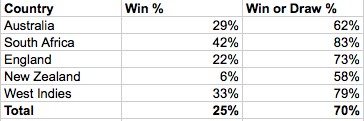
Not exactly great stats for the visitors, a wining percentage of only 20% and a win or draw percentage of only 43% but let’s look at how other countries have fared down under:

Australia has played 383 home test matches, winning 216, losing 94, and drawing 72. (There was one tie which is why the numbers don’t add up).

Which means all countries, including South Africa, have a winning percentage of 25% and a win or draw percentage of 43%. So right on target with South Africa’s performance in Australia.

If we remove South Africa from the above totals, however, it looks something like this:

Total tests: 348

Australia wins: 196

Opposition wins: 87

Draws: 64

Opposition winning percentage: 25%

Opposition win or draw percentage: 43%

Again, right on target. So while South Africa has a rather poor record in Australia, so does everyone else, it seems. Though South Africa could do with turning a couple of those draws into wins, as their winning percentage is five points below the average.

A couple points of interest:

– South Africa has won two of the last three tests played in Australia. Beating the hosts in December of 2008 by six wickets at Perth and in the 2008 Boxing Day test at Melbourne by nine wickets. They lost in January 2009 at Sydney however by 103 runs. And so they might just be turning the tables against Australia. Of course this point also makes it clear that between 1910 and 2006, South Africa had won only five tests down under.

– I am going to explore this more but there are shockingly few draws during South Africa’s trips to Australia. I am not sure if this the weather, the teams, or what, but tomorrow I will write about draws. Should be thrilling.

*

KP’s back

The month long previews of #ausvsa and #indveng continues with a bit of breaking news: Kevin Pietersen is back in the squad for England.

What this means for England is unclear.

KP has played five tests for England in India.

Mohali in 2006: draw

Punjab in 2006: India win

Mumbai in 2006: England win

Chennai in 2008: India win*

Mohali in 2008: draw*

*KP was captain

That’s a winning percentage of 20% and a win or draw percentage of 80%: right in line with England’s long term performances in India over the last 80 years, as we learned yesterday.

Over those five matches, KP scored 365 runs. 144 of which came at Mohali in 2008.

His scores per inning look like this:

15, 87; 64, 4; 39, 7; 4, 1; 144, DNB

Respectable, but not earth shattering, and probably not game changing with the exception of the knock at Mohali.

KP does of course add a certain je nais se quois to the England line up, and whether that will be a positive je nais se quois or a negative je nais se quois is hard to tell at this point.

I can safely say however that he will make the entire series more entertaining for the neutrals.

*

Can’t lose ’em all

The month long previews of India versus England and Australia versus South Africa continues…

*

England has played 51 test matches in India.

England has won 11 of those matches, India has won 14, and the rest were drawn.

And so despite England’s well worn reputation as subcontinentally poor, they actually have done, well, okay in India.

Of course, those wins have been few and far between as of late. They won in 2006 at Mumbai, but before that had not won on Indian soil since 1985 in Chennai.

All told, they won twice in the 30s, once in the 50s, four times in the 70s, three times in the 80s. zero times in the 90s, and once in the aughts.

Not exactly dominant but not exactly push overs either.

Let’s look at the other non-sub-continental test nations and their records in India:

Australia: played 42, won 12, lost 15, tied 1, with 14 draws

South Africa: played 12, won 5, lost 5, with 2 draws

New Zealand: played 31, won 2 (yikes), lost 13, with 16 draws

West Indies: played 43, won 14, lost 9, with 20 draws

All in all, it shapes up something like this:

Now, I consider South Africa a bit of an outlier, but even with omitting them, England’s winning percentage does not look all that impressive, but they actually fall right into the middle of the pack when it comes to securing either a win or a draw in India.

Unfortunately for England, based on the column totals,  non-subcontinent teams have a terrible time winning when India are hosting, but they do have a knack for scratching out draws. Of course, that latter silver lining might have something to do with rain, but the point still stands: England probably won’t lose every match in India.

Grounded, part 2

And so we continue with our month long previews of India v England and Australia v South Africa…

This morning I wrote about the grounds that are set to host the former series, and so without further ado a similar post on the grounds set to host the latter:

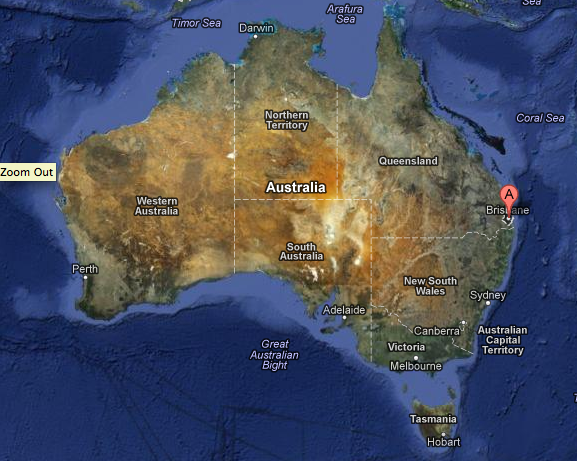
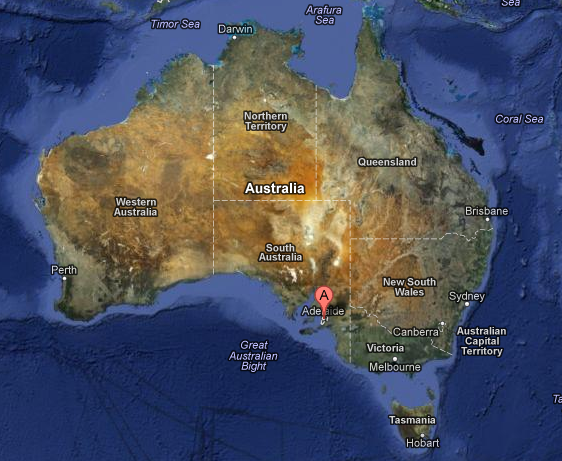
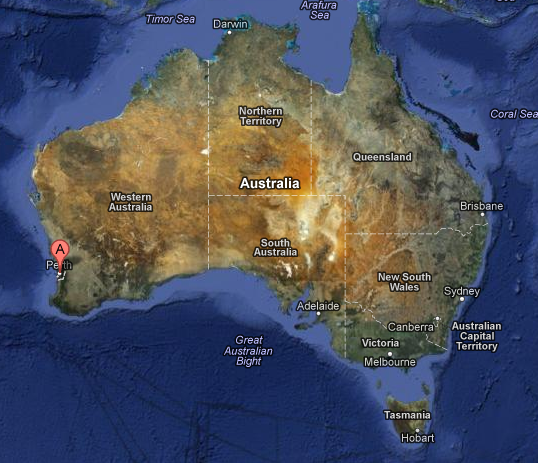
The three tests of the South African tour of Australia will be played at the Brisbane Cricket Ground in Wooloongabba (aka, the “Gabba”), the Adelaide Oval in Adelaide (no fancy nickname), and the Western Australia Cricket Association Ground in Perth (aka, the “WACA”.

Your geography lesson:

Brisbane:

Adelaide:

Perth:

South Africa has played three tests at the Gabba (including the first one ever, in 1931, which Australia won by an innings and 163 runs) but none since 1963; seven at the Adelaide Oval; and two at the WACA (which was opened in 1970, and so due to the Apartheid ban, South Africa did not play their first test there until 2005.)

Over those 12 matches, South Africa has won three, lost five, and drawn the rest.

South Africa has never won at the Gabba, but they have won two of their seven matches in Adelaide, and they have not lost at the WACA, drawing their first ever match there in 2005 and then winning their second match there in 2008 by six wickets.

Australia, throughout the years, have been quite dominant on their home patches, including these three grounds. Since 1884, they have played 163 test matches at either Brisbane, Adelaide, or Perth, winning 91 and only losing 34, with one tie and the rest draws. A winning percentage of nearly 56%.

And so despite the fact that South Africa are the number one test side on the planet (whatever that means), I think they will struggle down under.

My predictions (subject to change):

Brisbane: Australia win

Adelaide: Australia win

Perth: Draw

More soon.

*


Grounded, part 1

Now that the World T20 is finally over (belated congrats to the West Indies), I guess we can move on and talk about test cricket again. Thankfully. (I am just going to go ahead and ignore the fact that the Champions League T20 is happening).

We have two big Test series to look forward to this fall: England in India and South Africa in Australia. The number two test side against the number five test side, and the number one test side against the number four test side. Both should be entertaining, and thanks to the new Willow TV, I will be able to watch both. And so today’s post is the first in a long series of posts previewing both series.

I will start with some bits about the grounds in the India v England series.

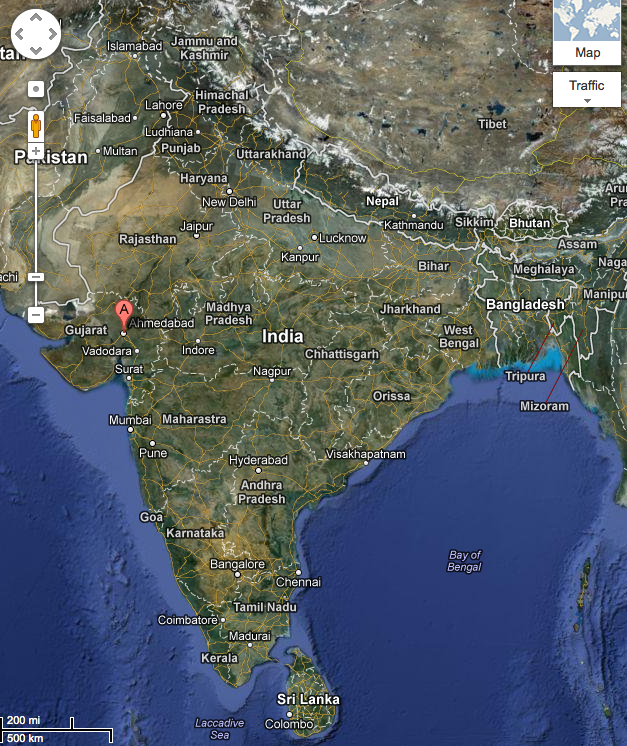
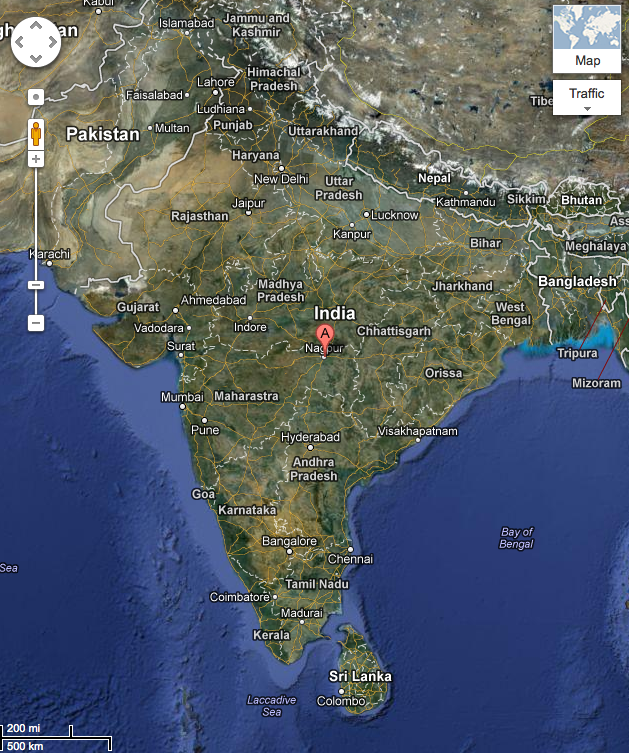
The four grounds being used for the tests are: the Sardar Patel Stadium in Motera, the Wankhede Stadium in Mumbai, Eden Gardens in Kolkata, and the Vidarbha Cricket Association Stadium in Nagpur.

Geography lesson:

Motera:

Mumbai:

Kolkata:

And Nagpur:

England has played one test at the Motera, six at the Wankhede, eight at Eden Gardens, and none at Nagpur.

Their combined record for the four stadiums is three wins, six losses, and eight draws.

Two of the wins came in Mumbai with the third at Eden Gardens. So England has won more matches at the Wankhede despite playing two more matches at Eden Gardens.

It’s a small sample size, surely, but if history is our guide, than England’s best chance for a win will come in the second test in Mumbai.

Also, the stadium in Nagpur has only hosted three previous tests: Australia in 2008, South Africa in 2010, and New Zealand also in 2010. All three matches produced a result, with India beating Australia and New Zealand but losing to South Africa. As such, we can expect a result when England visit in December.

Conversely, at the Sardar Patel Stadium there have been 11 tests but only five have produced results, including only two of the last seven matches at the ground, so we can probably expect a draw there during the series this fall, as well.

And so, using the above information, my early prediction for the series is as follows (subject to change):

Ahmedabad: Draw

Wankhede: England win

Kolkata: India win

Nagpur: toss up, but should be a doozy, and we should get a result

More soon.

*

Home Sweet Home

And so the hosts Sri Lanka are in the finals of the World T20.

They will face the winners of tomorrow’s match between Australia and the West Indies but no matter who the face I think Sri Lanka will be considered favorites because, of course, they will have home field advantage.

Which got me thinking: how have the hosts fared in other cricket world cups (both ODI as well as T20) and are they receiving a home field advantage to the point where the ICC should look into holding their tournaments in neutral locations such as the UAE, for example?

In the ODI format, there have been 10 World Cups. The host nation has only won the tournament twice, 1996 (Sri Lanka) and of course 2011 (India). The caveat there being that both those tournaments were hosted by three different nations (Sri Lanka, Pakistan, and India in 1996 and Sri Lanka, India, and Bangladesh last year) and the final of the ’96 tournament was held in Pakistan.

It is also an admittedly small sample size but interesting that both tournaments where a host nation won were on the Subcontinent.

How did the host nations that did not win perform?

Here’s a list:

1975, England: lost in the semi-finals to Australia (winner: West Indies)

1979, England: lost in the final to the West Indies (winner: West Indies)

1983, England: lost in the semi-finals to India (winner: India)

1987, India & Pakistan: both teams won their respective groups but both lost in the semi-finals; India to England and Pakistan to Australia (winner: Australia)

1992, Australia and New Zealand: Australia did not qualify for the knockout stages, while New Zealand lost in the semi-finals (winner: Pakistan)

1996, Sri Lanka, India, and Pakistan: Sri Lanka won the whole thing, India lost to Sri Lanka in the semi-finals (match held in India) while Pakistan lost to India in the quarter-finals (match also held in India)

1999, England: finished fourth in the their group and did not qualify for the second round (super sixes) (winner: Australia)

2003, Kenya, South Africa, and Zimbabwe: Oddly, South Africa did not qualify for the super sixes, while its fellow hosts did. Zimbabwe did not however advance to the knockout stages, but Kenya did, where they lost to India in the semi-finals. (winner: Australia)

2007, the West Indies: The Windies won their group but did not advance past the super sixes (winner: Australia)

2011, India, Bangladesh, Pakistan: India won the whole thing, as mentioned, beating fellow host Sri Lanka in the final. Bangladesh did not make it past the super eights.

And in the T20 version there have been three world cups, and the host nation has not won of any of them.

2007, South Africa: advanced to second round (super eights) but did not advance to knockout stages (winner: India)

2009, England: same as South Africa in ’07 (winner: Pakistan)

2010, West Indies: same as England in ’09 and South Africa in ’07 (winner: England)

*

Based on all of the above, it looks as though the ICC should continue to select host nations using the same format they currently use, as it does not seem to provide an unnecessarily unfair home field advantage to the host nations. And there even does not seem to be an advantage based solely on conditions. Subcontinental teams do not seem to have an unfair advantage in subcontinental conditions, for example.

*

Looking at other sports as I am want to do:

Football has recently taken to awarding major tournaments to countries that are not known as world footballing powerhouses. They do this under the guise of growing the game around the world, but it might have a little bit to do with not giving the home field advantage to teams that simply do not need it.

A couple examples here include the 2022 World Cup in Qatar, the 2010 World Cup in South Africa, the 1994 World Cup in the USA…etc. Meanwhile UEFA has given hosting rights of its championship recently to Austria, Switzerland, and Poland.

Of course my theory is shot to hell because the 2014 tournament is being held in Brazil.

A quick survey shows that in the 19 FIFA World Cups, the hosts have won five times: Uruguay in 1930, Italy in 1934, West Germany in 1974, Argentina in 1978, and France in 1998. Meanwhile in the 14 European Championships, the hosts have won three times: Spain in 1964, Italy in 1968, and France in 1984.

And just for fun, and because it is more similar to cricket in that there are only handful of nations where the sport is popular, a look at rugby: in the seven World Cups, the hosts have won three of them (New Zealand in 1987, South Africa and Matt Damon in 1995, and New Zealand in 2011).

Just based on percentages, Rugby is the sport that should have a serious think about having its tournaments in neutral locations.

*

To sum up:

In the 50 over cricket world cup, the host nation has won 20% of the time.

20 over cricket world cup: 0%

FIFA World Cup: 26%

UEFA Championships: 21%

Rugby World Cup: 43%

*

All of that said: I will be cheering for the West Indies tomorrow, and Sri Lanka on Sunday.


Wednesday News Dump

As the World T20 continues to run like a virus scan in the background, I thought I would hit on a few other topics, and then return to the tournament tomorrow as it really starts to kick off with the Super 8s:

Video Games

This article from ESPN gives credit to, of all things, the FIFA video game series for the recent surge in popularity of soccer in America (number two sport for 12-24 year olds). The author of course also gives credit to things like, you know, the Internet, but the crux of the piece is that MLS and US Soccer and definitely the European leagues owe a debt of gratitude to EA Sports.

The cynic might read that as ESPN giving a reach around to one of its favorite advertisers but I must say that I agree with the writer. I also give credit to FIFA for soccer’s recent surge, just as I give credit to Fantasy Football for its role in the growth of the NFL over the last 20 years.

And so I say to the ICC, if you want to build cricket’s brand in America, partner with EA Sports and develop a high quality cricket video game series.

When I first started following cricket, I looked around for a video game, as I have always been a fan of that particular form of entertainment, and really loved the FIFA franchise, but I was unable to find one. They were all region specific and, based on reviews, pretty terrible for the most part either way.

What cricket needs is its version of FIFA, its version of Madden, its version of Tiger Woods Golf…

If you build it, they will come.

Minor League Baseball

I posted a link to this video on Twitter yesterday but I thought I would post it here, too.

Midway stadium is only about a mile from my current house (we are moving in two days, however) and I always forget what I wonderful piece of Americana I have in my backyard. Railroads, baseball, summer nights. I talk a lot on the blog here about County Cricket and its ties to the past – I need to remember that those same ties exist here in America in the form of baseball. Attending a game at Midway is like being transported back to a simpler time that never really existed in the first place.

Watch the video. It’s great.

Replay

Even those of you on the other side of the world probably heard about the last play of the game between the Packers and the Seahawks on Monday night. (More information here…and here).

Even with instant replay, the call was still blown.

What does this have to do with cricket? I am not sure. I wrote this part of the post in my head last night as I was drifting off to sleep, and I really cannot remember what my point was.

Though I guess we should be thankful that cricket’s officials, while not infallible, do a better job of using technology than the current lot of replacement referees in the NFL. We should also hope that nothing like what happened on Monday ever happens during a match, say, between India and Pakistan. Green Bay and Seattle don’t have nukes and haven’t been inches from all out war multiple times over the last 60 years.

Ireland

Now that they are done blaming the rain for their quick exit from the World T20 (failing to mention of course that they were positively hammered by Australia a few days earlier), it seems Ireland want the ICC to get them on the Future Tours Programme so they can play more quality sides and, theoretically, get better and not be an embarrassment next time around.

While I agree with the theory, I don’t think it is necessarily fair for them to be added to the FTP instead of other quality Associates such as Kenya, Afghanistan, Canada, or even Scotland. There is plenty of quality cricket out there for you, Ireland. Play in the CB40, for starters. Snubbing your nose at that tournament did you no favors, in my opinion.

The ICC cannot handhold Ireland and shun the other Associates, is what I am trying say. Sorry, Irish cricketers, you are going to have to do it the hard way, just like everyone else, and now you are going to have to do it with out Niall O’Brien, too.

Moving

My wife and I are moving on Friday, as I mentioned above. It is sad and bittersweet and hard and exciting. The next blog post you read will have been written in my new kitchen. So until then…

*

Predictions

Over on the Sight Screen, I predicted that the Associates would be THE story of the ICC World T20 group stage.

And, well, I was right.

But not in the way I thought I would be.

The Associates (Ireland and Afghanistan) and fellow minnows Bangladesh and Zimbabwe are THE story (so far) of the group stage, but the story is not one of David slaying Goliath or David even giving Goliath a little scare like I thought it would be, but instead it is the fact the Associates (and Bangladesh, and Zimbabwe) simply do not belong in this tournament.

They are just not good enough.

And while in some ways that really is too bad for the overall future of world cricket, it is unfortunately the hard truth.

All of world cricket was up in arms when the ICC kicked the Associates out of the 2015 50-over World Cup, but now I think we can all see that they had it right, and we all had it wrong. Having the Associates and even low level Test nations in knockout tournaments makes for far too many lopsided matches, far too many dead rubbers, and, well, makes the tournament just simply too long.

And, so, despite my initial protests at the lack of Associate inclusion in the upcoming 50-over world cup, I think the ICC should move to only allow the top eight Test nations into its knock-out tournaments.

The tournaments would be shorter and the matches more meaningful, thereby making the entire tournament more accessible to the average fan, or even the prospective fan.

For instance: ESPN here in the states has been promoting the heck of the World T20, and if by any chance an American has tuned in, all they have seen is a Test nation kicking the crap out of a Minnow, not exactly a great advertisement for the sport, in other words. But imagine if they tuned in and the first match they say was India v England, or South Africa v Sri Lanka? The difference is marked.

And so while limiting the participation of the Associates (and Bangladesh and Zimbabwe) from major tournaments might stunt the growth of the game, I think that more competitive and more accessible and more entertaining tournaments will surely make up for that lack of growth…and then some.

That’s my story, and I am sticking to it.

Now let’s hope this tournament really kicks off during the Super 8s.

And, don’t worry, I won’t be making any more predictions.

*