Cricket and Social Media, Part 4

(Parts one, two, and three are here, here, and here.)

This is it. This is the big one.

Below you will find everyone* on Twitter that covers cricket, in one aspect or another, sorted by number of followers, number of tweets, number of accounts following, and Twitter Strike Rate (Twitter SR).

*Not everyone who covers cricket, as I am sure I missed some. Please suggest any and all that I have missed and I will add them.

*

Note: Twitter Strike Rate is the term coined by @paperstargirl for the stat I invented,  formerly known as “Tweets per Follower” or “TPF”.

Simply put, Twitter Strike Rate is the number of tweets divided by the number of followers. The lower the number, the more effective the social media campaign…supposedly. It is by no means scientific.

As an example, ECB’s Twitter SR is .05, which means they are earning 20 followers per tweet. While mine is 9.95, so I am earning one follower every 10 tweets or so.

A few other quick notes before I post the results:

–  The list includes bloggers, journalists, editors, photographers, podcasters, and photojournalists, amongst others – the only really strict criteria I had was that the person’s main body of work had to be about the sport of cricket – just general sports journalists didn’t make the cut, for instance, though I am sure a couple slipped through. I made distinctions between each group in my master spreadsheet, but not in the spreadsheets below because in a lot of cases the line was just too thin, and I did not want to rub anyone the wrong way. I also think the work bloggers do is very important work, so I don’t want to degrade the hours they put in by putting them in a different class from journalists.

(That said, I believe that journalists have a role in cricket that simply cannot be replaced by a herd of amateur bloggers…but the blogger vs journalist debate is best left for another day.)

– I think the list is more or less complete, as far as active accounts are concerned, but it is by no means exhaustive. Please do not feel insulted if you are an active blogger but are not listed – just shoot me a note and I will get you up. Also please do let me know if you have suggestions for other accounts conspicuously absent from the lists.

– I also had to make a couple calls with regard to whether an ex-player-cum-commentator was a journalist or not. I made those decisions on a case by case basis. Ian Botham is not included but Sourav Ganguly is, for example. Again, it’s a grey area that I did my best with.

– The list was compiled over about a 10 day period, so things have of course changed for most of the accounts. Just a heads up there.

– As with the previous posts, this was a copy-and-paste job, so all errors are sics.

– Because this was done over a longer period of time, there will be some duplicates. I deleted all those that I could find, but I am sure I missed a couple.

– With very few exceptions, the lists are individuals only, not organizations or blog collectives such as The Sight Screen. I hope to do those in a later post.

– I politely recused myself from the competition.

– Ctrl-F works within the spreadsheets, if you want to search for yourself.

And so, without further ado, the results:

Number of Followers:

Number of Tweets:

*2.6 million total tweets.

Number of Accounts Following:

Twitter Strike Rate:

*

The Sunday Four

My regular readers know that I have been writing a lot about cricket and The Great War as of late. Well, it turns out I had a great-great-uncle that was killed in action in France during World War One. Albert Zwiefelhoefer, my great-grandmother’s brother, who was fighting as an American (don’t let the name fool ya) was killed on the 5th of November, 1918 (six days before the Armistice) during the Meuse Offensive.

He is buried at Meuse Argonne American Cemetery near the village of Romagne-sous-Montfaucon in northwestern France. As far as I can ascertain, no family member has ever visited his grave.

I mention this here primarily because I do have a lot of international readers, and if any of you ever make it to France, and happen to visit what looks to be the most charming village ever, I would be overcome with gratitude if you could head a few miles east and take a picture of his grave.

And, goodness, six days before the Armistice. That’s just simple rotten luck. The opposite of serendipity.

I was going to bring this all back home and talk about the cricketers killed shortly before or after 11/11/18, or those also killed during the Meuse offensive, but there are simply just too many to go into.

Such a sad and tragic and awful war – a war that changed cricket, county cricket especially, forever.

*

Over on Twitter I follow a fella named Jamie Harrison, the president of the United States Youth Cricket Association, and a huge Baltimore Ravens fan.

For those unaware, the Ravens won the Super Bowl last weekend.

I did not watch the game. I don’t care for gridiron football, and I find the way Americans salivate over the advertisements a bit nauseating, but that’s only my opinion.

Watching Jamie’s reaction though via his Tweets has been a lot of fun however. He has been a fan of Baltimore’s football team his entire life, had his heart broken when the Colts left in the 80s, lived through a decade without a team at all, and now has been rewarded with a second Championship.

Sport in the end is trivial, we all know that, but when our team wins, it is something special, something to savor, something not to take for granted. And Jamie understood that it was special, and took full advantage of it. Nothing unites a populace like sport, except maybe for weather – and when a championship is involved, that is the zenith of community.

Thanks, Jamie, for letting me live vicariously through you.

*

In more non-cricket news, Fox Soccer has decided to groom announcer Gus Johnson to be there go-to soccer announcer, as they prepare to cover the 2018 and 2022 World Cups. And despite the fact that he admits that he knows nothing about soccer, they are not starting him off slowly, they throwing right into the mix and are going to let him call Champions League games and the FA Cup final.

My initial reaction to this news was shock, anger, and disappointment.

But after a lot of whinging, I decided to really think about why I reacted in such a manner.

Was it because Mr. Johnson knew nothing of the sport? Was it because he is American and not British? Or is it because I simply do not care for Gus Johnson as an announcer? (I was more or less quite unfamiliar with him but throughout this process I watched clips of calls during basketball and football games).

I decided it was not the first two, by relating the situation to cricket.

If Willow TV decided it was going to have, say, Bob Costas, call cricket matches, I would be totally okay with that, despite the fact that he is an American and despite the fact that he (probably) knows nothing about cricket. He is a professional and a good announcer and would give the games the respect that deserve.

Gus Johnson is not Bob Costas however. He is a shouting maniacal douchebag.

Football announcers need to let the games breath. Gus is going to choke the games to death.

If they hired an American announcer with great knowledge of the sport, I would be fine with the decision. If they hired an American announcer who knew nothing of the sport but had great announcing chops, I would be fine with that too.

But they did not. They hired a loudmouth egomaniac who makes the games he calls more about him and less about what is going on on the field.

And it’s a shame.

*

Finally, a note to media regarding the match fixing scandal in football: stop acting like you are shocked. Gambling is big business, and sports gambling is the biggest business of them all. It is not a football problem, it is not even a sports problem, it is a societal problem.

I am not sure what the solution here is. But changing the fact that gambling is so accepted a vice in our modern world is the first step.

And with that in mind, I challenge the ICC to ban all gambling related advertisements and sponsorships. Until they do that, they are just as much a part of the problem as those that are fixing matches and buying off players.

*

49 and 11

I had a whole post written. But I deleted it. Not because it was rubbish, even though it probably was, but because it was spiraling out control. There was no central point, no consensus, and it did very little but contradict itself from paragraph to paragraph – collapsing in on itself like a dying star.

Over on Twitter, I whined a bit about it, and received some feedback on my blog overall: that what I see as being wishy-washy is actually seen by others as being able to admit when I am unsure about something. (Cheers, as always, to Devanshu from DeepBackwardPoint).

And so, with that in mind, I decided to plow forward.

But still got nowhere.

So I had dinner.

And cracked a beer.

And started again.

My point more or less is this: cricket is going to be irrevocably changed by the Twenty20 format – even more than it has been already. The very core of the sport is going to suffer plate tectonic shifts heretofore unseen at any point during the game’s history. Cricket has its very own San Andreas fault: and it’s called T20.

And we might have seen some signs of things to come this week in Johannesburg, or a couple days ago in Brisbane, a few days before that in Perth, or last year in Napier: teams are being bowled on a regular basis for shockingly low totals – albeit not record breaking, and not really all that more often than at any point in the game’s history.

But still, I think, and I might be wrong, and I am surely not the first person to say this, that scores like Pakistan’s 45 and hauls like Steyn’s 11 will become the norm in cricket. Not a trend, mind you, but the norm.

A new age will dawn – and this will be because of Twenty20 cricket.

The financial benefits of the T20 format are immense, and therefore national boards are rearranging series and tournaments in order to schedule as many T20s as possible, and the players themselves cannot help but see the dollar signs as well. Simultaneously, the format encourages free swinging, swashbuckling style batting – which is great for TV audiences and crowds and venues filled with rock music and dancers – but it is not great for batting in a test match, or even in an ODI for that matter.

Entire generations of cricketers are growing up in the shadow of the IPL, and the Dale Steyns of the world are going to take full advantage.

We are on the cusp of a bowling revolution in Test and ODI cricket – and it is because T20 places an emphasis on scoring runs when the batsman’s main job in cricket is defense – and so the obvious benefit is to the bowler.

It is just like in football: if you throw too many guys forward, and don’t leave enough guys back to mind the shop, then you are going to ship goals.

But, to continue the football analogy, goals sell tickets, and garner better TV deals, and increase sponsorship levels – and once the almighty dollar gets involved, well, it is all down hill from there.

It is not a trend, it will be the norm, it is a sea change.

Some might say that we are just entering a new cycle – that that is how things in this world, especially in sport, work. In cycles. But in life, and in politics, and in art, and in sport, there are sea changes. There are Rosa Parks and Monets and Martin Luthers. There are some changes that are so monumental that there is just simply no going back.

Of course, down the road, T20’s wave may very well crest and roll back, but the soil it takes back to the ocean floor will be gone forever.

Cricket opened the door, invited Stuart Robertson in, and that’s that – there is no going back. You can’t close the stable door after the horse has bolted.

Well, you can, but there is no point in doing so.

And yes in this particular case Stuart Robertson is represented by a horse.

Even if T20 disappeared tomorrow, its consequences will still reverberate around the game for generations.

*

In baseball, in the early 70s, the game changed forever – because the balance between offense and defense was forever altered. The pitching mounds were lowered, the American League introduced the Designated Hitter, the strike zone shrunk, and the rest was history.

Home runs sold tickets. Major League Baseball learned that in the 1920s, but it took 50 years for them to do something serious about it. And it became such an issue that the race for more runs nearly killed the game during the steroid era – but even now, in the post-steroid era, every advantage possible is given to the hitter – all in the name of the dollar.

And that just simply is never going to change.

It’s not a trend. It’s the norm.

It happened to baseball in the 1970s, and it is happening to cricket now. Only in kind of a backwards, reverse, complicated manner – which of course is cricket’s way of going about most things.

We are going to see a lot more 49s. And a lot more 11s. And it’s because fans crave offense.

*

And while you might be shaking your head at this post, here’s the thing: I know I am not saying anything groundbreaking or revolutionary. Also here’s some facts: there will be consequences of the T20 format, that is a fact that no one can deny. Another fact that no one can deny is that no one has any idea what exactly those consequences will be – last week T20 was killing Tests, this week it is killing ODIs, who knows what it will be killing next week – and so, quite frankly, my guess is as good as any.

And here is my guess: the age of the bowler has arrived.

*

Cricket and Social Media, Part 3

Just a reminder that this is all for fun.

And a further disclaimer with  specific regard to this post: I am not claiming this is an exhaustive list.

Below you will find all of the cricketers, past and present, that I could find on Twitter, ranked by the number of Followers they have.

There isn’t a great deal of commentary to add there.

A couple notes: Those are not all Twitter-Verified accounts, but I deleted the obvious fake ones. Also, I did not employ a service like Statuspeople.com to see how many of, say, Sachin’s three million followers are SPAM-bots. The numbers are what the numbers are, in other words. I also did not factor in the fact that some of these accounts are obviously run by a PR firm. The numbers are what the numbers are.

I compiled the list over the period of a couple days, so things might have shifted in there a bit, but I think the list is about as accurate as you are going to get.

And as I mentioned above, the list is by no means exhaustive, so if you can see someone that I am missing, please do post their Twitter handle in the comments and I will be sure to add them. It does not matter if they are an International or someone playing club cricket in Jamaica, I am happy to get them on the list.

And speaking of handles, this was all a cut-and-paste job, so any errors that you might see in handles or names are sics – e-mail your corrections to the cricketer’s PR people.

*

Those of you that have read my earlier posts are aware that I like to use something called Tweets per Follower (TPF) to see how effective a Twitter campaign is. Simply put, it is the number of Tweets divided by the number of Followers. It is by no means scientific, but the lower the number, the more effective a campaign is.

For instance, the ECB’s official Twitter feed has a TPF of .05 – which means they are gaining 20 followers for each and every Tweet. Meanwhile, yours truly has a TPF of 9.95 – which means I am gaining one follower for every ten times I Tweet.

Again, presented without comment. It just is what is.

Some of those numbers are jaw-dropping, however. I mean, Virat Kohli gains 1,000 Followers each and every time he Tweets, for instance.

*

This was a very time consuming collection of data, but it was a fun exercise nonetheless. While working on the above, I was simultaneously working on a similar post for journalists, bloggers, and media members. It will be a couple weeks before I am able to publish that one – but trust me when I tell you it is going to be fucking fascinating. Seriously.

*

While working on this post I also learned how to insert a Google Doc into a WordPress post – so it was all worth it just for that. You can learn how here.

Cricket and Social Media, Part 2

Here is part one.

Today: Clubs.

*

First a note about the “Tweets per Follower” (TPF) stat for those new to the blog: TPF is simply the number of Tweets divided by the number of Followers. The lower the number, the more effective one’s Tweets are…kind of…It’s not science by any means, and does not account for existing popularity (the BPL vs the IPL, for instance), but I think it gives us a general idea as to the effectiveness of each organization’s Social Media manager, surely.

For instance, the English Cricket Board’s TPF is .05, which means they earn 20 followers for each and every Tweet – while Pakistani Cricket Board’s is 5.32, which means they earn one follower every 5.32 Tweets.

Again: it’s not science. It’s just for fun.

All of this is just for fun: it does not factor in population or Internet access and, again, is not meant to be gospel.

*

I chose three leagues for this part of the exercise: The Big Bash League, the Indian Premiere League, and the 18 Major English Counties. I thought about adding the Australian or Indian first class teams, or maybe the Caribbean T20, but decided against it. I believe that the three leagues above are the three most popular, globally speaking.

I am going to explore each league individually, ranked by Facebook likes, Twitter Followers, and TFP, and then compare all leagues to each other in all three categories.

Then at the end I have a couple surprises for you.

*

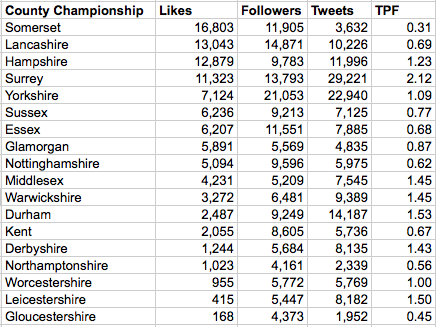
The County Championship (or the CB40, or the Friends Life T20…your call):

Facebook Likes:

Picture 6Somerset is the clear winner of the Facebook like category, and you can see that they have a strong presence on Twitter, as well. The Leicestershire and Gloucestershire numbers are not typos. Also Lancashire CCC does not, as far as I can tell, have an official Facebook page – that is one of those placeholder Facebook “interest” pages.

Twitter Followers:

Picture 7Now Yorkshire and their 30 bazillion County Championships lead the pack – by a country  mile, too.

That is an official Lancashire Twitter feed – and Somerset despite falling to fourth in this category are still putting in a fine showing. Northamptonshire was not in the bottom three in the Facebook category which makes Gloucestershire the clear overall loser when it comes to Facebook likes and Twitter Followers.

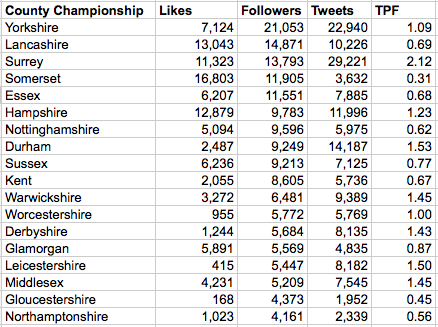
Now, FPT:
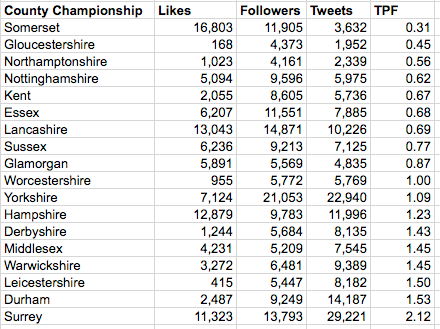
Picture 8It looks like Somerset is the clear winner: most Facebook likes, fourth most Twitter followers, and the lowest FPT. Congrats to the intern running their Social Media campaign: you are doing a bang up job.

While no squads break the .2 barrier I invented as a benchmark in Cricket and Social Media, part 1, it is nice to see that Gloucestershire is running a very effective Social Media crusade with a FPT of .45 despite their lack of Followers and Likes.

Finally, Surrey: lay off the coffee. Nearly 30,00 Tweets is probably over doing it. No reason to Tweet every gosh darn ball in other words.

*

Big Bash League:

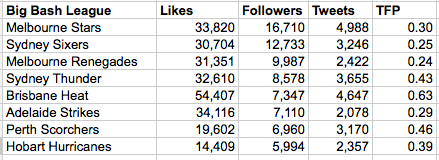
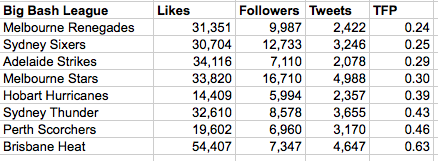
I am going to post these without much comment, simply because I am not all that familiar with this league (the matches are on in the middle of the night here in the states.) Just for a reference point however, Brisbane won the league this year, the Sydney Sixers won it last year, and here is a link a list of cities in Australia sorted by population. Those three factors probably explain the following two charts:

Facebook Likes:
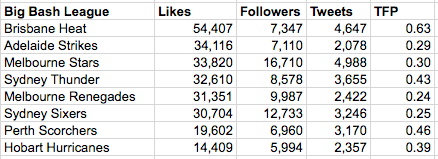
Picture 10Twitter Followers:

Picture 11But now let’s take a look at FPT:

Picture 12I was hoping Hobart would pull a Gloucestershire, but not quite.

I see no clear winner here at the club level, but speaking generally, the Big Bash League is doing quite well, Social Media wise. They seem to be including it as part of their overall marketing strategy (they rank the teams on their homepage by number of Facebook likes and their Twitter handles are all standardized: @sixersbbl, @heatbbl…etc), something the County Championship clubs in England don’t appear to be doing (I cannot tell you how many Facebook “buttons” on County pages went straight to 404 town – but it was at least a half dozen.)

The Big Bash League does have the fact that it is truly an international league going for it, as well, however, something that not even the FLt20 has in its corner.

And, so, how does the BBL compare to the other big hitter on the block, the IPL? Let’s find out.

Indian Premiere League:

Facebook Likes:

Picture 13Mumbai, the clear winner. Thanks probably to the Tendulkar-effect, as well as to population – the latter factor probably explaining the chart overall.

The new team from Hyderabad is an outlier, of course, because they have yet to play a match – and as you can see the entire IPL is an outlier compared to the County Championship and the Big Bash League. Incomparable really. Though I will do it anyway. Later.

Twitter Followers:

Picture 14Kolkata, the 2012 champions, shoot to the top, as do the Super Kings.

And who is the most effective?

TFP:
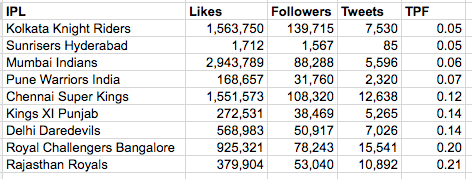
Picture 16Kolkata, again, in a tie with the outliers, Hyderabad – but all the teams are running highly effective campaigns on Twitter. Only one team is higher than the .2 threshold.

Also, unlike the BBL, we have a clear winner: Kolkata Knight Riders. The 2nd most Facebook likes, the most Twitter Followers, and the lowest TPF.

*

As mentioned above, comparing the IPL to the BBL or to the English Counties is folly. It is comparing apples to oranges. Actually, comparing the BBL to the English Counties is apples to oranges; comparing the IPL to the English counties is comparing apples to hand grenades.

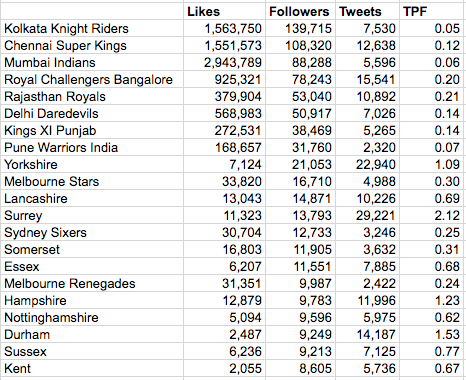
Therefore, charts comparing all of the clubs from all three leagues are a little pointless, but let’s do it anyway. At the very least, the FPT stat puts the three leagues on equal standing (only doing the top 20, no reason to embarrass anybody):

Facebook Likes:

Picture 17Twitter Followers:

Picture 19As you can see, when it comes to Twitter, the Counties are holding their own, relatively speaking. And I will say that I really do enjoy the Twitter accounts of the Counties – they are quietly enjoyable and not entirely annoying.

And, finally, FPT:
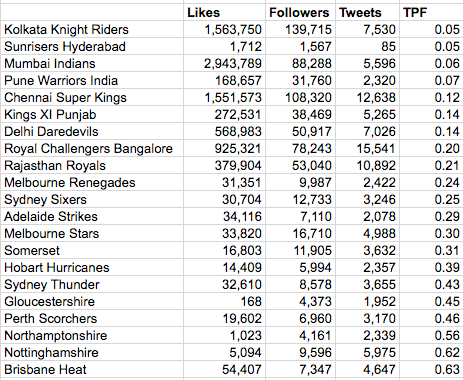
Picture 20Congrats to Kolkata Knight Riders: they are running the most effective Social Media campaign in the world of International Club Cricket.

*

Note: I hope to do a redux of this post in the future that compares all of the first class leagues (Ranji Trophy, Sheffield Shield, County Championship…etc) to each other and all of the International T20 leagues to each other (BBL, SLPL, IPL…etc) – apples to apples in other words.

This was just for fun, however, and to give my reader a decent idea as to what our favorite clubs are up to in the crazy, mixed up madness of World Cricket and Social Media.

That said, I do stand by the point I made earlier that these are the three most popular cricket leagues – so it is at least apples to apples in that regard.

*

Surprise #1:

My personal TPF is 9.95. In other words, I am gaining a follower once ever 10 Tweets. If I want to get to 1,000 Followers, I will need to Tweet a jaw-dropping 8,000 more times.

*

Surprise #2:

I ranked each tournament’s sponsor by Facebook Likes:
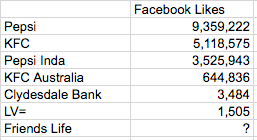
Picture 23I could not find a Facebook page for Friends Life.

The fact that nearly 10,000,000 people “like” Pepsi on Facebook is disconcerting, but the fact that over 5,000,000 “like” KFC makes me seriously question humanity’s future.

*

Stormont

As I mentioned a couple days ago, I found myself on the Cricket Ireland Facebook page. I had “liked” their update in my newsfeed about the upcoming Ireland v Pakistan ODIs this summer and also made a snide comment about rain and wanted to go see if anyone had, officially or unofficially, replied.

That is when I noticed that they had less than 9,000 Facebook likes and the rest was history.

But I also noticed that Cricket Ireland, officially, replied to my snark with an upbeat and jokey comment about the forecast for this summer, and then further down I noticed a couple people complaining about the as yet to be determined location of the two matches.

One commenter in particular was hoping that both matches would not be at Stormont in Belfast because the ground was “unwelcoming” – he was then accused of bringing politics into sport, and round and round they went.

An example, from Facebook user Jeremy Martin:

“Owen Stornmont is no more unwelcoming thatn Clontarf ? Yer just a sectarian and bised prcik who wants eevry game played in Dublin it’s an all Ireland team and there are more players form the North in it that the South !”

(Too many sics to mention. Trust me it’s verbatim.)

It is sad that after all these years of peace, something as trivial as the location of a cricket match can still unearth the sectarian issues that killed 3,500 people between 1969 and 2001. Or, more correctly, unearth the post-sectarian issues of constantly accusing others of being sectarian.

But, then again, to say that the Troubles are over is folly. Just this last November, for instance, a Northern Ireland prison guard, and a member of the Orange Order, was killed in a drive-by shooting by members of an IRA splinter group.

And just last week there were violent protests in Belfast over the Stormont government’s decision to no longer fly the union flag.

I guess I should really not be surprised that it is going to matter to people where cricket matches are played.

*

Here’s the thing: There are two ODI grounds in Ireland: one in Belfast, and one in Dublin. The former holds 6,000, the latter 3,200. Neither has floodlights. They are a little over 100 miles apart – about a two hour drive. Logistically, and just speaking geographically, and not being at all sectarian, it would make sense to have one match at Stormont and one match at Clontarf – one in the north and one in the south – to ensure that fans throughout the country who want to attend at least one match can do so without driving 100 miles.

Though from what I have read, cricket is mildly more popular in Northern Ireland than in Ireland proper, and Stormont has double the capacity, and so in the interest of simple dollars and sense, it might make sense for Cricket Ireland to play both matches in Belfast.

Then again, there are 5,700 Pakistanis in Ireland – and giving them easy access to both matches has to be a priority, as well.

*

It’s a complicated issue, surely, one that involves not just age old sectarian divides but the age old problem of money as well: Cricket Ireland is struggling for legitimacy and they need to fill their coffers just as much as they need to field a competitive team if they want to eventually be promoted to full Test status.

At the end of the day, they need to put one match in Dublin and one match in Belfast. It’s the right thing to do. Putting both matches in Belfast, though maybe the financially viable decision, might unintentionally and unnecessarily deepen the divide between Southern fans and Northern fans, which would not serve Cricket Ireland’s attempts at legitimacy, nor would it serve the ongoing peace process.

My two cents on a complicated issue.

*

I realize I am making a big deal out of a couple of comments on Facebook, and I realize that the violence in Northern Ireland pales in comparison to the violence seen in other cricket playing nations, but I still find it fascinating how cricket and history march alongside each other, as they do in this case, and it is something I will continue to write about.

*

The Takedown

Okay so a bit about the DMCA Takedown Notice I received a couple of days ago and mentioned on Twitter.

First of all, if you are unsure what I mean by “DMCA Takedown Notice”, or even if you think you are sure what I mean by “DMCA Takedown Notice”, I urge you to read Devanshu’s overview of it on DeepBackwardPoint.com. It is succinct and clear, even if it is in specific reference to the BCCI and Twitter and not, in my case, Destination360.com and WordPress.

*

Here is the text of the e-mail I received from a “Ryan M.” at WordPress:

“Hi there,

We have received a DMCA Takedown Notice (http://automattic.com/dmca/) for the following material published on your WordPress.com site:

https://limitedovers.com/wp-content/uploads/2011/05/st-kitts-and-nevis.jpg

As such, we were legally required to remove the material from our servers.

If you wish to challenge this notice we will be happy to provide you with all of the appropriate details.

Thank you.

Ryan M.
WordPress.com | Automattic (sic)”

*

As you can see from the file name above, the picture was of the island of St.Kitts and Nevis in the Caribbean, the home of the Test ground, Warner Park.

After doing some digging, I found the post that included the offending picture. It’s of a beach, not the slightest bit cricket related, and it was lifted from a travel site called, as I mentioned above, Destination360.com.

I am not going to link the post, because it was from a million years ago and reading it made me cringe. Finding it should not be difficult, but I am not going to make it any easier for you.

It’s utterly random, however, a picture of a beach on a cricket blog from a two year old post finally ending up the radar screen of a lawyer somewhere who sets the wheels of the DMCA into motion. It all seems like such a waste of time and money.

The time and money of WordPress, and the time and money of Destination360.com.

All of that said: I should not have used the picture.

Again, from Devanshu’s post:

“DMCA is bad law. It’s been bad for 14 years. But your public link to pirated content? Let’s not pretend that was a great idea either.

Cricket rights around the world are a complicated matter. Being smart about what you post on the Internet is not complicated at all.”

Like I said: I should not have used the picture.

Unfortunately, it was not the only time I have violated copyright with an image. I do it more often than I care to admit. Sometimes, quite simply, a story is better told when there is a photo included – and sometimes there just isn’t an image in the Public Domain that tells the part of the story that I need it to.

I don’t feel great about it. And that’s why I am going to stop doing it.

I will not be taking down old images, but from here on out, I will not be using pirated photos. That is my pledge to you, dear reader. And it is one that I feel pretty good about.

*

“The falcon cannot hear the falconer”

One major difference between the last County Championship season before World War Two (1939) and the last County Championship season before Word War One (1914) was that in 1939 the winds of War were already swirling across Europe and the Channel, while in 1914 the majority of people did not see war coming until as late as July of that year. There was no talk of war in the pubs or in the streets or in the House of Commons – war instead fell like a hammer from the sky.

As the season started, surely the majority of the players, and the fans, expected the County Championship to play out through September where a winner would be crowned – just as it had for the previous 24 seasons in its current incarnation, and for 20 seasons before that in different incarnations.

And even after the final two matches of the 1914 season had been cancelled, the players and their brothers in arms who marched off to war expected to be home by Christmas – and be ready for the 1915 season.

How wrong they were.

Surrey won the war shortened Championship that year. And as nearly as I can tell, their entire squad survived the war.

But they were the lucky ones.

Colin Blythe, of Kent, who took the most wickets that season, 159, who joined the army in 1914 despite his Epilepsy, was killed by random shell fire in Belgium in November of 1917. He is interned at the Oxford Road Cemetery in Belgium.

In 2009, the English cricket team visited the cemetery and laid a stone cricket ball at the foot of Blythe’s grave – the visit is summed up in this BBC article:

‘”It was a deeply moving and humbling experience,” said Andrew Strauss.

The skipper added: “It’s important to take a step back from cricket at times.

“We learned a great deal about the sacrifices made by a previous generation of England cricketers, and I would like to thank the people of Ieper for making us so welcome.”‘

Major Booth, who I have written about before, also played County Cricket in that fateful summer of ’14. He was in fact one of Wisden’s Cricketers of the Year. Here’s a link to the commendation.

I will quote the Wiki article on Booth’s death:

“On 1 July 1916 he went “over the top” near La Cigny on the Somme while serving with the 15th (Service) Battalion, The West Yorkshire Regiment (Prince of Wales’s Own), also known as “The Leeds Pals”. He was followed a short while later by another wave of soldiers among whom was Abe Waddington (later also Yorkshire and England). Waddington was hit and found himself in a shell hole with Booth and held him until he died. Booth’s body then remained there until the spring, when he was buried at Serre Road No 1 Cemetery.”

From his brilliance on the cricket field in 1914, to leaving his trench and attacking out across an open foreign field in 1916, to dying in a friend’s arms – his body left moldering in the mud and the blood until spring.

Only 30 years old.

The things we do to our young men.

*

Cricket and Social Media, Part 1

The structure for this post comes from an article written for the website I work at (MinnPost.com) by the incomparable David Brauer (on Twitter at @brauer) that ranks all of the local Twin Cities media members and organizations by number of Twitter followers – but the inspiration came from the Cricket Ireland Facebook page and the jaw-droppingly low number of “likes” it has (less than 9,000), despite the fact that Jarrod Kimber urged all his readers to go like it a few months back.

So I decided to take David’s idea and move it into the world of Cricket, but include Facebook and the number of overall Tweets – plus a new stat (hey this is cricket) that I “invented” (maybe) called “Tweets per follower” (TPF) – which is simply the number of followers divided by the number of Tweets. The lower the number, the more effective one’s Tweets are…kind of…It’s not science by any means, and does not account for existing popularity (the BPL vs the IPL, for instance), but I think it gives us a general idea as to the effectiveness of each organization’s Social Media manager, surely.

For instance, the English Cricket Board’s TPF is .05 – which means they earn 20 followers for each and every Tweet.

*

Tonight I am doing national boards for Test nations (with the exception of Zimbabwe, as they do not seem to have an official social media presence and I get a malware warning when I try to go to their official site – I also added Ireland since they were the impetus for this project) – in a later posts I will do the same thing for clubs, leagues, media organizations, associate nation boards, cricketers past and present, journalists, bloggers…etc. It should be fun.

Tonight, though: national test boards.

Facebook Likes:

Picture 2

India is the winner by a million miles. Of course, cricket is wildly popular there, more so than any other sport, and they do have 1.2 billion people, so that’s not too much of a surprise. The only real surprise here is Australia and South Africa ahead of England – in fact Australia has nearly three times that of England – everything else is down to population and popularity of the sport; as well as, quite simply, access to the Internet.

Twitter Followers:

Picture 4Again, India takes it, with Australia a close second. England and South Africa have flip flopped. Meanwhile Bangladesh and Pakistan have fallen off the map, while Sri Lanka, New Zealand, and the West Indies move up.

The fact that Ireland has more Twitter followers than Bangladesh and Pakistan combined is an interesting fact, though again probably easily explained away with a discussion of Internet access.

Interestingly enough, the list does not simply follow GDP ranking – Sri Lanka is ahead of New Zealand for instance. So while Internet access is a qualifier, it is not THE qualifier.

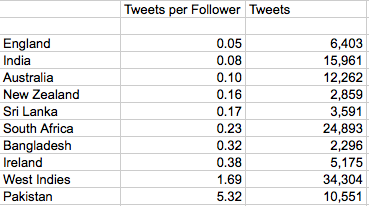
Tweets and Tweets per Follower:

Picture 5England have a very effective Twitter campaign…seemingly…

Since this a newly invented stat, it is tough to tell what is good and what is not. For the purposes of this exercise, I am going to say that anything under .2 is good.

As you can see, the West Indies Tweet A LOT, but it takes more than a Tweet and a half for them to gain a follower – meanwhile England is racking up followers at the rate of 20 per Tweet.

England, India, Australia, and New Zealand all seem to be maintaining effective Twitter campaigns – but despite England’s phenomenal FPT of .05, I think the winner here has to go to India – almost 200,000 followers and an FPT of .08.

And considering their immense following on Facebook, I would have to say that despite their sizable population (not to mention their growing and thriving diaspora), and the immense popularity of the sport in their country, India is the clear winner overall in this exercise.

*

On a side note, the generic Facebook page for cricket has 15,823,390 likes. I am going to go ahead and surmise that that is about the number of active cricket fans alive in the world today.

Edit: this was meant as a joke, but it got some play on Twitter, so I am going to provide a better stat: there are supposedly 1 billion Facebook users among the nearly seven billion people on planet earth. So the number of Facebook likes above represents roughly 1/7 of the world’s cricket fans – putting the revised guesstimate at around 105,000,000 active cricket fans.

*

I mentioned it in passing above, but none of this takes into account Internet access, economic stability…etc. And for the most part, I am going to have to leave that out of consideration. I am not a global economist; nor am I an expert on international Internet access or censorship.

I will point to this wiki page for information on that subject, and leave you with this thought: this is supposed to be for fun.

Where possible however, I will use percentages and per capita stats in order to level the playing field.

*

Lots brewing here at Limited Overs. Keep an eye out for more posts in the social media series, some more stuff about World War One, a post about Cricket Ireland and the Irish Troubles, and finally, a bit about the DMCA removal notice I received this afternoon.

Cecil Abercrombie, 12 April 1886 – 31 May 1916

Cecil Abercrombie was born in 1886 in India. A capped rugby player for Scotland, he played one year (1913) in the County Cricket Championship for Hampshire. 13 total matches. That year he scored three hundreds including a high of 165 against Essex. In those thirteen first class matches, at the age of 28, he scored 936 runs. He also played three first class matches for the Royal Navy.

In 1914, he shipped off to War.

In May of 1916, not two years removed from his accomplishments on the cricket field, he was killed while serving aboard the HMS Defence – along with every other man on board.

His remains, and the remains of nearly 900 of his brothers in arms, still sit at the bottom of the North Sea.

*

The HMS Defence, a Minotaur class armored cruiser, was commissioned in 1909 and transferred to the Grand Fleet in January of 1915.

Image in public domain

In May of 1916, the Defence, serving in the Grand Fleet as part of the Battle of Jutland in the North Sea, was struck by German artillery. One salvo caused an explosion in her rear armory, and the ensuing fire sunk the vessel to the bottom of the sea.

As mentioned earlier, none of the nearly 900 crew survived.

*

The Battle of Jutland was fought over naval control of the North Sea over two days in 1916. The battle is named after Jutland, Denmark, which is near where the majority of the fighting took place, and it was largest naval battle during the war.

It involved 250 ships (151 from the United Kingdom including Australia and Canada, and 99 from Germany). There were more than 6,000 killed on the Allied side, and more than 2500 on the German side. Most of them are buried in watery graves. The UK lost 14 vessels, the Germans 12.

175,600 in total tonnage and 8,500 souls sent to the bottom of the North Sea over two days in the spring of 1916.

The result of the battle was “tactically inconclusive.”

*

And that’s thing about World War One. There are no Trafalgars, no Waterloos, no Gettysburgs, no Battle of Midways…the decisive victories were few and far between. So many lives were lost – entire generations – and yet so often the lines held, and held, and held.

I hate to say those brave young men and women died in vain – but it is hard not to.

One of those young men was Cecil Abercrombie, cricketer. Hopefully by writing about him today, in 2013, 97 years after his death, I have given his legacy a little bit of an extension into our century, thereby keeping his name and his accomplishments alive.

Men and women might die in vain in war, but that does not mean they should be forgotten.

And so in that spirit: Cheers to Cecil Abercrombie: first class rugby player, first class cricketer, and sailor aboard the HMS Defence.