Clutchiness

My favorite baseball blog ever is the now defunct FireJoeMorgan.com.

Their ongoing theory was that there was no such thing as “clutch” in sports. That there were good baseball players and there were bad baseball players. And the former performed well when it mattered because they were excellent at the game – and while occasionally the latter performed well in big moments, under the lights, on the biggest stages, it was just a matter of a blind squirrel finding a nut, and that the sample sizes provided by baseball’s playoff system were just too small to use for true statistical analyses.

How a guy does over 162 games, that’s what matters, that’s how a player’s quality should be defined – it should not be defined by how they played for one week in October.

And I always agreed with them.

People that deride Sachin Tendulkar for only scoring centuries in losing causes or against Bangladesh come across as bitter old fools. Same with those who called Alex Rodriguez a choker because he never hit .450 in a Divisional Series or knocked in the game winning runs in game seven of the World Series.

The opposite is true, too. One great Ashes series followed by a lifetime of drudgery and ducks does not make a great player. Seasons, years, decades of performing at the highest quality makes one a great player – and those that are on winning teams get moved into an even higher category of greatness, whether they had great series or tournaments or not is beside the point.

I guess what I am trying to say is: MS Dhoni is great under pressure because he is a great cricketer – not because of some sort of phantom “clutchiness”.  He is just really good at scoring runs. Period.

Someone in the above Facebook thread mentioned how Rafael Nadal is better under pressure. Now while that is first of all like comparing apples to hand grenades, it is also total bullshit: Nadal is just really fucking good at tennis. Again: period. 

And let’s also put it this way: There is a ton of pressure in professional sport. All the time. In every game. In every situation. Being able to “clear the mechanism” and push the pressure to the side and maintain composure is what separates the professional from the amateur.

I have taken penalty kicks in my rec soccer league and have wanted to throw up beforehand. I was not mentally built for professional sport, in other words. But some people were born with that “thing” – and that thing is the ability to collect the ball in the 18 yard box, clear the mechanism, and score. That thing is to be able to stand in against Dale Steyn – no matter the situation – and perform.

Every professional athlete was born with a very high clutchiness rating, but some are simply better athletes than those around them, which is why they appear to perform better when it really matters.

I would rather have a guy that scores runs consistently over the long haul than a guy that only performs when it’s the playoffs.

You can have Kareem Abdul Jabar. I’ll take Alastair Cook.

*

That said.

There is magic in sport. And that is why we all watch. For those unexpected moments when spin bowlers no one has ever heard of step up and score runs and runs and more runs when their team oh so desperately needs them to.  Those times when lifetime .280 hitters tear the cover off the ball for two weeks in October. Those closing pitchers who shut the opposition down when the game is on the line on such a consistent basis that you have no choice to think that maybe, just maybe, there is something to the whole idea of “clutch.”

Or maybe not.

Either way, those moments alone do not a great player make.

However: those moments are why we all love these games.

About last night

I never get to talk about cricket.

I read about cricket a lot, and I write about it some, and I watch it a bit (though not nearly as much as I would like) but I rarely, very rarely, get to talk about it.

Last night I got to talk about cricket.

I got to talk about it with fellow Minneapolis cricket nuts and long time Twitter pals, Jon and Diane. As well as (drumroll please) my absolute favorite cricket writer, Jarrod Kimber, and a surprise guest, Simon King, the founder of Cricinfo. (They were in town to film a documentary about the site, which as you know was invented in Minneapolis in the early 90s.)  (Simon, who basically invented the god damn Internet, isn’t on Twitter).

We met at a British pub, went to a chain fish joint, and finished the night at an Irish bar – never once leaving Nicollet Mall. And so we were unable to give our guests a good dose of local flavor, but that was neither here nor there, because I got to talk about cricket – with two guys who have watched the game from every corner of the globe – who understand it in ways I never will, who know the game like people know their own hands. Two people who have lived the dream: travel the world and write about cricket.

I will admit that I mostly listened and nodded (and drank beer), but it was still a discussion about an obsession that I never to discuss. And it was grand.

I am not going to tell you what we talked about in any detail, of course, but suffice it to say that this morning I considered myself at least 75% more knowledgable about the game – both on and off the field – and about Cricinfo. And of course we also talked about other things, such as Texas and the West Wing and Seinfeld and how fucking cold Minnesota is and Justin Verlander. But everything always swung back to the cricket, for that was the uniting force that brought us all together.

Me, my favorite cricket writer, the guy who invented Cricinfo, and two local pals.

It was a perfect night.

20131016_234411

*

In other news, I have a new job. It is a Communications role for One Heartland – a nonprofit that organizes camps for kids with HIV/AIDS, type 2 Diabetes, and social challenges such as homelessness. It is an amazing operation and I am incredibly proud to be a part of it. Plus, hey, I get to write. For a living. And so while it’s not writing about cricket, it’s still writing. For a living. So that’s something.

The days are long and the work challenging, but I still plan on posting here as much as possible.

Especially now that we are getting closer…and closer…and closer…to the Australian summer:

The Ashes start in just 36 days.

World Test Championship

I’m excited and here’s why:

1. Cricket needs to evolve to survive, and the need is just too urgent to allow it to do so organically. The World Test Championship is just the kind of forced evolution the game needs.
2. It adds meaning to all those meaningless two Test series.
3. “Every ball counts” is the best value proposition in sport.
4. It puts the first class game back in the spotlight – at all levels, international and domestic.
5. It does not put a cramp into any other current competitions.
6. The game is now finite. No, that’s a good thing.

And so next steps:

1. Decrease the ODI World Cup to six teams in order to make those tediously long ODI series at least a little more interesting
1a. Find a way to still involve the Associates
2. Involve the Associates in everything: including the World Test Championship
3. Find a better hash-tag. #wtc does not make me think of cricket, it makes me think of this.

Sachin

This is my tribute post to Sachin Tendulkar.

I never saw Sachin bat in person. Sachin never made me cry tears of joy in my living room. I never thought he was God. He did not define my childhood. He did not represent my nation’s coming of age. And his career for the most part while not in decline, was nearing its natural conclusion when I started following the sport.

But I am a cricket fan, and so I respected him as one of the all time greats, and I loved watching him bat, and I loved the adoration he commanded wherever he went. At the same time, however, I am not an Indian cricket supporter, and so his successes or failures did not affect me in the way they affected the one billion Indian cricket fans the world over.

There is no real reason for me to mourn his retirement from Test cricket – but I still do. Very much so.

I mourn because my friends the world over are mourning. I see them weep for their hero, weep for their childhoods. And I cannot help but empathize and get wrapped up in their sadness. It is never easy to see people you like in pain.

But it is more than that…

I mourn because the tributes I have been reading all day – whether they be 12o character tweets or 2,000 word essays or just simple pictures – have been heartbreakingly perfect and sad and full of that strange sort of melancholy we reserve for our childhood heroes, even if we only knew them as old men.

As I have mentioned time and again, cricket – and cricketers – inspire fantastic sportswriting, the best sportswriting, and so it would follow that the retirement of the greatest cricketer in a generation would generate beautiful tribute after tribute, and you all have not disappointed. I look forward to reading all of them. With a lump in my throat.

But it is more than that…

I mourn his retirement because I feel it might be one of the final nails in cricket’s coffin. If India turns its back on the game, then the game dies. And without Sachin, it will be far easier for India to do so – even with its current crop of rising stars lighting up the Wankhede.

As I tweeted earlier, I feel that cricket, the game, has lost its center of gravity, and is spinning uncontrollably into deep, dark, cold space. I am not sure if it can be saved. There will never be another Sachin – no one else will be able to elevate the sport quite like he did – and so this might be it, this might be how cricket dies. Historians will not write about DRS or matchfixing or the IPL when they talk about the death of the game, they will simple say: the game died with Sachin.

But it is still more…

A few months ago, I wrote a post about my dad and Sachin. Linking the two forever even though my dad probably didn’t know a blessed thing about cricket. And all the talk about Sachin’s debut in November of 1989 keeps bringing me back to that fateful day a month earlier. And I mourn my dad again. And I think about all the times Sachin batted: all those matches, all those runs, all those hundreds – and it just makes me realize how long my dad has really been gone. And how much has happened since he died. And it makes me so unbelievably sad.

And so I guess it worked. And I guess I was wrong above. My life is intrinsically linked to Sachin Tendulkar’s – tenuously linked but linked nonetheless – and now that he has retired, I feel like the grief for my dad should be changed in some way. But it hasn’t changed. And it won’t change. It will continue.

Sachin will soon be gone. But my grief will be here always.

And that is why I mourn Sachin’s retirement. All those reasons above.

Many of you are losing a hero, some of you are losing the last links to your youth, and all of us are losing the Patron Saint of this game we love. That right there is plenty of reason to mourn. But because I decided to write the post linked to above, Sachin’s career timeline also reminds me of my personal grief cycle – and that is enough to send me over the proverbial cliff.

And so I mourn.

God speed, Sachin.

We miss you already. 

Jack vs KP

Earlier today English and Arsenal footballer Jack Wilshere and English cricketer Kevin Pietersen got into a Twitter spat about some comments Wilshere made in a press conference about how the English national football team should be for English atheletes only. Comments that were later completely overblown by the English media (shocker).

Everyone who has read this blog knows how I feel about this particular topic: international sport is a farce and nothing more than an exercise in obsolete nationalism. It’s 20th century flag-waving bullshit and nothing more. The world has moved on, but sport for whatever reason (cough…$$$$…cough) has not. And this little spat between Wilshere and Pietersen just further proves my point: Pietersen –  a South African by birth but who plays for England’s national cricket team – is angry at an English footballer for saying that a Belgian/English/Albanian footballer shouldn’t be considered for England because he isn’t English enough. Or something.

So while I agree in the end with KP, it just goes to show what a circus international sport has become. If it wasn’t a circus and a farce, KP would be in the UAE preparing to play Pakistan and Wilshere wouldn’t have even been asked about Adnan Januzaj in the first place because of course he could never play for England – and if Jack did say something like “the English national football team should only select English players” it would be like him saying “the sky is blue“.

A circus. Through and through. It is time for sport to move out of the 20th century. Athletes like Mo Farah – who was born in Somalia but trains in Oregon and competes for the United Kingdom and whose favorite football team is Arsenal, a team owned by an American but based in north London and whose manager is French and whose best player is a German national of Turkish descent – athletes like Mo, and teams like Arsenal, are the future of sport. They will define sport in the 21st century. Borders are meaningless now. And sport needs to stop clinging to them.

My friend Tim over at 7amkickoff said it way better and also reminded us that we should ignore the wicketkeeper’s sledging and try to keep our eye on the ball:

I find it highly troubling that Qatar has been accused of using slave labor and of killing their migrant workers to build the stadiums which will host the World Cup and people are up in arms about whether Januzaj is going to corrupt the sanctity of the English national team.

*

Winter is Coming

As the Champions League T20 wraps up tomorrow in India, international cricket is about to explode: in a good way. There will be so much cricket available to watch that I find updating the World Cricket Internet Schedule for US Viewers a terribly daunting ask.

There is New Zealand vs Bangladesh (two tests, three ODIs, and one T20), and Australia vs India (one T20 and seven ODIs), and West Indies vs India (two Tests and three ODIs), and the Ashes Part Deux (five Tests, five ODIs, and three T20s), and India vs South Africa (three T20s, seven ODIs, and three Tests) and, finally, Sri Lanka vs Pakistan in the UAE (five ODIs and three Tests).

That takes us through mid-January. Five massive series, 53 total matches, and every single one of them live on Willow TV for us folks here in the States.

Looking at those numbers a little more closely, however, and there might be an interesting trend:

53 total matches: 15 Tests, 30 ODIs, and 8 T20s. That’s right, nearly the double amount of Tests in comparison to the T20. And the ODI, despite all evidence to the contrary, is still the dominant force in world cricket.

Which is fine, I love the ODI format.

But is it really a trend?

Looking back over the 2012-13 Winter of Cricket, I find the following series:

New Zealand vs Sri Lanka:  two Tests, five ODIs, and one T20
South Africa vs Australia: three Tests
England vs India: four Tests, two T20s, and five ODIs
Sri Lanka vs Australia: three Tests, five ODIs, and two T20s
New Zealand vs South Africa: three T20s, two Tests, and three ODIs
India vs Pakistan: two T2os and three ODIs

Again, that is basically all of the international cricket (more or less) that took place between October of 2012 and January of this year.

43 total matches: 15 Tests, 21 ODIs, and 10 T20s. 10 fewer total matches, but the same amount of matches in the longest format as are scheduled this winter. The ODI sacrificed the most matches, with nine, and the T20 added two more than are scheduled this year.

Test cricket is dead? Bah. I say.

Now, of course, the FTP (pdf) is made up years and decades in advance, and so schedulers cannot foresee trends in format popularity. All they can see and react to is when there are ODI or T20 world cups – which probably explains the lack of ODIs in the 2012-13 season.

But here we come to yet another problem with how World Cricket operates: the fact that the FTP is made up years in advance.

I am not going to wade into the deep and muddy waters of the CSA-BCCI tussle over India’s tour of South Africa, but this might be a case where a board (the BCCI) saw an opportunity to recreate a schedule that was more financially beneficial to them, as was theorized over on deepbackwardpoint.com earlier this week.

Now, I am by no means a BCCI apologist – they are corrupt with capital C and what they are doing to AlternativeCricket.com is ludicrous – but despite their ulterior motives and poor behavior, their stances against DRS and against the rigidness of the FTP, while called reprehensible by some, are putting them on the right side of cricket history.

*

At any rate, lots of cricket to look forward to – should be a fun winter.

Cricket, like most sports, is at its best when it is being played, and at its worst when it is being discussed (says the cricket blogger, ironically) – and I have grown tired of all of the bad news on Cricinfo, and in the blogs, and on Twitter. And I just want to watch some cricket, to read some match reports, to see 11 men in white walk out on  a perfectly green pitch on a bright sunny morning on the other side of the world. See them toss a coin and play cricket for five days.

And on that note: the first Test of the Ashes at Brisbane is only 47 days away.

*

A moment we’ll mark time by

Today is the first full day of fall in the Northern Hemisphere. Which made yesterday – officially anyway – the last day of summer.

But as humans we have a tenuous and shifting concept of time, and our personal last day of summer rarely matches up with the last day of summer on the calendar.

As a kid growing up the States, the last day of summer for me was always Labor Day – the first Monday in September – the last day before school started back up again.

But as an adult it changes every year.

In 2002, my last day of summer came in October. My wife and I were in the kitchen of our downtown condo, listening to the Minnesota Twins lose their playoff series to the California Angels in crushing fashion, as my Step-dad clung to life in a hospital bed. It was a summer of real hope and light, but it ended that early fall in almost complete darkness.  I remember Adam Kennedy, of all people, hitting three home runs for the Angels that lonely Sunday afternoon.

Nine years later – and two years ago today – my summer ended on the first day of fall, when my wife and I had to put our old dog down. The sky was mournfully blue that morning, with white patches of clouds that looked like steps into the heavens. Later that afternoon it clouded over completely and a cold wind kicked up out of the north. From summer to winter in just a few short hours.

And as I have written about before, the summer of 1989 also ended in October – October 8th to be exact – though that year the best stretch of Autumn weather I can ever remember stretched on for weeks following that awful Sunday.

*

Today is the first full day of fall, but it feels like the last day of summer, and so that’s what it is.

*

The English international cricket summer ended earlier this week, as Australia defeated England to take the ODI series. The county season ends later this week with a whole host of championship matches. But as we all know, cricket is not a finite sport with seasons and endings – it stretches on forever – with domestic competitions in the southern hemisphere starting up again soon – and we are only three months away from Ashes II.

But still, when those Championship matches end on 27 September, it will feel for many as the last day of summer. The long shadows across the pitches, the chill in the late afternoon air, and that feeling of deep and unexplainable melancholy that sits in our chests.

I think the coming of those matches next week, and the ending of the international season on Thursday, at least half explain why my brain has decided today is my personal autumnal equinox. So much to look forward to in April, and now it is all but over.

*

For cricket fans in 1939, the last day of summer was September 1st when six Championship matches ended. That same day, Germany invaded Poland. And so when that summer finished, it didn’t come back for six long years. (I have written about the summer of ’39 previously).

Same deal in 1914: the last matches of that season ended on September 1 as the winds of war whipped across Europe, and the pitches sat empty until 1919.

Sometimes winters last longer than they should.

We’ve all had those winters.

*
And so today is my last day of summer, but for some it was weeks ago, and for others it will be weeks from now. For some cricket fans it was earlier this week in Cardiff, for others it will be 09/27 at Hove. For some baseball fans it will be the last day of the regular season in a couple weeks, but for a lucky few it won’t be until the end of October.

It was not entirely the case this year, but I have on many an occasion used to a match or game to mark the end of summer. And while non-sports people will cast spurious glances at those of us who use sport to mark time by – I think the fact that sport allows us to place the passage of the seasons into easy to understand patterns is one of the best things about these silly games we endlessly obsess over.

At any rate, happy last day of summer, everyone – whenever it may be – and may it be a short and mild winter, and may spring be here before we know it.

http://instagram.com/p/PIRzbKj1aO/

*Last day of summer, 2012

DRS

(Note: for the purposes of this post, when I refer to “DRS”, I am specifically referring to the ICC’s Umpire Decision Review System and its rules and guidelines as they stand today. I am not referring generally to a technology based review system. Clear as mud? Good.)

Ah, DRS. What would we all talk about if it wasn’t for DRS? Cricket, probably. You know, things like strike rates and pitch conditions and the like.

But instead, we get DRS as a discussion topic time and again. And with the ICC meet up happening this week in Dubai, we can expect yet another round of debate about the flawed review system.

First of all – cricket and DRS aside – I am of two minds when it comes to technology in sport, as I am sure most fans are. On one hand, I approve of and support the use of technology in officiating – no matter the sport. It works quite well in gridiron football, basketball, rugby, and tennis. Baseball is new to the technology party but it seems to be working all right so far, well enough to expand it starting next season. Association football is lagging far behind other sports, but this season the Premier League instituted goal line technology which is a step in the right direction.

And the above progression toward technology is a good thing because it is important, in the end, to get the call right, and it is worth a couple of delays in the game here and there. We, as fans, have all seen our team end up on the wrong side of a blown call, and so it is comforting to know that most sports have tried to take that out of their respective games. But fandom aside, there is simply so much money involved in sport these days that the financial stakeholders need to have assurances that calls are being made with the upmost accuracy. Otherwise the investment is just too risky, the money leaves, and the leagues collapse.

Get the call right, the technology is there, and it should be used.

That said: my other mind thinks that it really does take all of the rock n’ roll out of the game. I positively loathe those interminable checks for no-balls after big wickets in big games, for instance. And the review system in baseball just feels wrong – like it has stripped away the last vestiges of that great 20th century tradition that was BASEBALL in America.

And sport is great because it is unscripted – it is about human effort overcoming obstacles despite pressure both mental and physical. And the officials are part of that drama; but removing their humanity makes the games slightly more scripted – which is a real shame.

Like I said: two minds.

But then we come to cricket, and the DRS, and the situation becomes even more gray – it becomes three minds instead of two – because DRS, more so than any review system in any sport, is flawed beyond repair. And while some might disagree with that statement – that when used properly it works fine – it is too late, as the system has become so irrevocably controversial that the only solution is throw the entire system out of the ballpark.

Then what though? Go back to letting the umpires on the field make every call  – like what we have in County Cricket and other domestic leagues – while waiting for something better to come along? Or does the ICC allow the DRS to limp along until said better system can be introduced?

Tough questions. But these are the questions we should be debating, and these are the questions the ICC should be answering in Dubai this week.

Because while we all might be of two minds with regard to technology when it comes to sport, we should all be of one mind with regard to cricket’s DRS as it stands today:

It needs to go.

**

Note: this is blog post number 400.

Zimbabwe

Today, in Harare, Zimbabwe beat Pakistan by 24 runs. It was their first victory in a Test match that wasn’t against Bangladesh since June of 2001 when they beat India by four wickets. It was also only their 11th Test victory against any opposition since gaining Test Status in 1992.

94 matches, 11 wins.

To put that into perspective England have played 940 Test matches and won 336.

Ten times the number of Tests played and 30 times the number of Test victories.

And Zimbabwe and England are both part of the exclusive global club that is Test playing nations – and so therefore are, for all intents and purposes, in the same league. Which is kind of ridiculous when you think about it.

But is it really? I mean every team needs to start somewhere. Should Zimbabwe be “relegated” back to Associate status?

Their population is 12 million, which is more than New Zealand’s and Ireland’s combined, and only 10 million less than Australia’s. Meanwhile, fellow minnows Bangladesh have a population of over 150 million.

Population therefore cannot be a factor used in relegation. But what about GDP? Using the IMF’s formula Zimbabwe ranks 132 out of 184 – sandwiched between the economic powerhouses of Armenia* and Macedonia. The next closest Test nation is Sri Lanka at number 69. So maybe we are getting somewhere.

But then Bangladesh comes in and screws everything up: they are at number 59 – ahead of Sri Lanka in GDP but miles behind them on the cricket pitch.

Then again: The United Kingdom (I could not find just England numbers) has a GDP of 2.435 trillion USD, while Zimbabwe’s GDP is currently 10.81 billion USD.

The UK’s GDP is therefore 225 times great than Zimbabwe.

I had to double check that number.

To put that into some sort of perspective for my American readers, including myself: The GDP of the New York City metro area is a staggering 1.2 trillion dollars – 110 times greater than Zimbabwe’s. While even the GDP of lowly Cincinnati is 100 billion – ten times greater.

And using GDP, the UK is to Zimbabwe what New York City is to American cities with a GDP of around 5 billion. Cities like Abilene, TX or Farmington, NM or La Crosse, WI.

Could you imagine any of those cities fielding a Major League baseball team against the likes of the Yankees or the Mets and being anywhere near competitive? 

Yeah, me neither. But somehow we are all okay with pitting Zimbabwe against England on the cricket field.

**

Based on the above economic data, should we disqualify Zimbabwe from Test status? Or should we give them more time to play the game and find their footing?

They are not the first newly promoted Test team to struggle in their early years.

Pakistan only won 10 of their first 50 Tests. Sri Lanka only four. Based on that latter stat, Zimbabwe’s 11 out of 94 doesn’t look all that terrible.

Of course, once you drill down on that number, you see that Sri Lanka didn’t have Bangladesh to push around. And Sri Lanka has only had Test status for ten years longer than Zimbabwe – and yet they have played more than twice the number of Tests (222) and won an impressive 66 of them.

Which brings us to the crux of this matter: Zimbabwe has had Test status since 1992, but between September of 2005 and September of 2011, they did not play a single match in the longest format. And so while last year was the 20th anniversary of their elevation to Test status, it was really only like their 14 anniversary. Which make today’s win against Pakistan even more impressive.

**

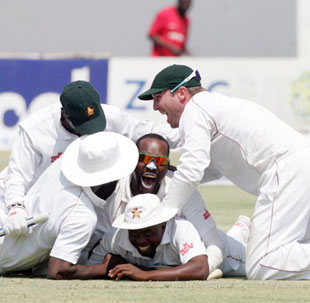
In the end, despite their relatively poor performances, and despite their economic distress, having Zimbabwe playing Tests is good for the game, because it can provide scenes like we saw this morning in Harare…

167239.6

That’s not cold and calculating England ruthlessly dismantling Australia, that’s a group of young, spirited cricketers celebrating the biggest victory of their lives – a victory over a side that just two and half years ago white washed England 3-0 in the UAE.

Upsets are what make sports fun. And you cannot have upsets without teams like Zimbabwe.

But then again: upsets just do not happen in Test cricket. True giant killings in the five day game are incredibly rare. So maybe what we saw in Zimbabwe this morning was not an upset, but a team coming into their own. The ICC gave them time, and now they are, slowly but surely, getting to the point where teams like Pakistan have to take them seriously.

In the end, upset or not, today was a good day for Test cricket.

Congrats to Zimbabwe, I’m looking forward to seeing you among the Test nations for decades to come.

*I am not going to talk about the fact that the Armenian national football team just beat the Czech Republic (#51 in GDP ranking) 2-1 in a World Cup qualifier.