Match Day 7

When I was a kid we would take our vacations at two cottages that belonged to my Grandparents in the upper Peninsula of michigan. They sat on Lake Brevort which was a medium sized lake right outside the tiny village of Moran, Michigan, about an hour north of the Mackinac bridge which connected the lower peninsula to its northern neighbor.

There wasn’t a lot to Moran. A gas station where I would buy soda and baseball cards and candy and my dad and his brothers would buy beer, a hole-in-the-wall dive bar that was always changing ownership and names, and a Catholic church. Moran sat at the intersection of state road M-128–two lanes of black top that crossed the entire peninsula, north to south–and Dukes Road, which ran all the way down to the lake, passing machine shops and bait shops and trailer parks and abandoned farms and an apple orchard and two cemeteries before cresting a hill and bringing the lake into sight.

Brevort Lake was resorts and permanent homes on its eastern side, and all Hiawatha National Forest on its western side–a thick, dark wood interrupted here and there with tall sand dunes. The lake was fed by the Carp River but despite the name there weren’t a lot of fish in the lake. There was a small public swimming area, but our cottages had no sandy beach, just an inlet for my grandfather’s row boat and rocks which were made of the old concrete boardwalk that used to run along the shore but was demolished in the 1980s. There was a fire pit lined with stones near the lake on the southwestern edge of the property line.

The cottages were mirror twins: a bathroom, a main room which served as kitchen and living room, plus two bedrooms and a front porch that looked over the lake. The north cottage was brown and yellow and smacked of 1970s fashion, while the south cottage was comfortable and dark. Both cottages faced west into the lake and would fill with light in the late afternoons followed by sunsets over the lake that were always spectacular and at night the windows would be open and there would be a chill in the air and the only sound would be the waves lapping against the rocks and in the morning the sunlight would be speckled coming through the trees between the road and the cottages and the lake would be still as glass and the smell of fresh coffee would fill the air.

Every summer we would go up there for a week. Driving up the ten hours on I-75 from Cincinnati, my dad in his ball cap with his cigarettes singing Peter, Paul and Mary with mother in the passenger seat, and my sister and I and later our little brother in the back. Sometimes we went up with my dad’s brothers and their families, sometimes with my grandparents–my dad’s parents, who owned the cottages–and sometimes it was just our small family. While we were there we would take the row boat to the drop off and row back, we would go to Lake Michigan and swim in the tall waves of the big lake, we would fish, we would cook hot dogs over the campfire for lunch with the sun on our necks, we would take my Uncle Chuck’s power boat to the sand dunes and run up and down them for hours, we would hike in the national forest swatting away deer flies, we would play touch football in the cottage side yards, we would walk out into the lake until we reached the sandbar, broken sea shells cutting our feet and the water up to our chests, we would drive into St. Ignance and eat walleye at Huron’s Landing, we would get sunburned, eaten a live by mosquitos and eat ourselves sick with marshmallows cooked over the campfire as the sun went down and the lake and forest grew dark.

The summer I was ten years old we had just moved from Cincinnati to upstate New York. We went up to the cottages that year with my dad’s brother Chuck–the one with the aforementioned speedboat, a 1970 wooden beauty–his wife Randee, and their two sons Henry and Andrew. Henry was three years older than me and a year older than my sister. He was short and dark and talked non-stop and his energy was boundless. Andrew was a year older than me and was tall and thin and light and was just cool about everything. I worshipped them both.

That week it rained for the first three days we were there. We played cards inside and watched television on tiny black and white TVs that maybe got three channels if you were lucky. We drove into town and walked the streets of St. Ignace and bought fudge. Andrew had a bow and arrow set that he was dying to use but his parents wouldn’t let him out in the rain so he pouted the entire time. My sister and I fought. My brother and I fought. Henry and Andrew fought. My parents fought. Their parents fought. On the second day during a brief respite from the rain my brother was outside and crawling on my parents car and broke a windshield wiper so on day three we drove through the pouring rain with only one wiper to get the other fixed. Everything was wet. Everything leaked. It was miserable.

On day four the rain finally stopped. It was still deeply overcast and the clouds were low and the air thick with damp but it wasn’t raining. So we all got into our cars and drove to the head of the blue blaze trail in the national forest, nicknamed such as the trail was marked by blue streaks of paint about a foot tall on trees every 200 feet or so. We put on our boots and packed plastic to sit on if we needed a rest and put our rain jackets in backpacks just in case and headed out. We hiked for hours through the dense forest of pine and oak and ferns taller than I was. No one talked. The only smell was that of the damp forest ground.

We hiked for two hours before we came across a marshy clearing that marked our turnaround spot. Emerging from the tree line we saw the sky was dark and threatening above us. My father and his brother stood next each other, looking out into the marsh at the horizon and the blue-grey clouds. After a few moments the sky started to spit rain. You could hear it on the marsh and on the tops of the trees behind us. My uncle sighed and turned to my father.

“Damn rain,” he said.

“God damn rain,” my father replied, keeping his eyes on the horizon.

#

Match Day 6

And just like that, England–the team I didn’t think had a chance–are through to the knockout stages after a convincing albeit unentertaining win over New Zealand today in the Welsh wind and rain.

They are through on their own merit, don’t get me wrong, they did what they were supposed to do: they won their matches. But they are also through because it rained, as all three other teams had a match abandoned due to rain. If New Zealand had gone on to beat Australia had gone on to beat Bangladesh, the table would look like this:

Australia: 4
England: 4
New Zealand: 2
Bangladesh: 0

Meaning England would have had to beat Australia on the final day in order to maybe squeak into the knock outs on Net Run Rate, as they certainly couldn’t rely on Bangladesh beating New Zealand.

But it rained, and England are through, and Australia are on the outside looking in, and New Zealand are in deep trouble, and Bangladesh are in with a shout. Who could have predicted that? Not me.

Now while some might be upset at how the rain has thus far affected the tournament, and that it’s a shame that Australia–the number one ranked side in the world and the World Cup trophy holders–could be packing their bags early, they really isn’t much to complain about. Rain is a part of cricket, it’s in the marrow of its bones. It’s another subplot to this game we love because it is full of so many subplots, layers, tunnels within tunnels. So while I understand complaints about the farcical ending to the Australia-Bangladesh match, that’s on Duckworth-Lewis, not on the rain, and it certainly isn’t on England. I mean, it’s not like they cheated. They won their matches, it rained, and they are moving on.

Plus now they get the added benefit of potentially knockout the Old Enemy out of the tournament in what would otherwise be a dead rubber. And nobody likes a dead rubber.

Speaking of that, what are the implications here? Who goes through?

Here’s how it shakes out (all of the below assumes a New Zealand win):

If England beat Australia, then England and New Zealand go through.

If Australia beat England, then England and Australia go through.

But since this is the 2017 Champions Trophy and it’s June and it’s the British Isles, you have to assume rain.

If England beat Australia and the Bangladesh-New Zealand match is abandoned, then New Zealand (probably) squeak through via NRR.

If Australia beat England and the Bangladesh-New Zealand match is abandoned, then Australia go through as before, Net Run Rate not needed.

Now, if it rains in Birmingham on Saturday and Australia-England is abandoned, then New Zealand go through with a win over Bangladesh, based on NRR (again, probably).

But, hey, since they have to play the games, I shouldn’t count out Bangladesh here: if they beat New Zealand and if England beats Australia then, yes, Bangladesh goes through. Holy hannah now that would be something. I’d avoid the Aussie bars in the UK for the time being if that happens, haha.

My prediction? England and Australia make it to the knockouts. Which is too bad, because I rather like New Zealand.

#

Tomorrow brings us more matches from Group B, and it feels like it has been years since we have seen these teams. Pakistan against South Africa is tomorrow with India against Sri Lanka the next day. South Africa and India are through to the knockouts with wins, which makes these must win matches for their opponents. I think Pakistan are out, but I wouldn’t bat an eye if Sri Lanka put up a fight.

Unless it rains, of course.

Until tomorrow.

Match Day 5

Australia were cruising to victory over Bangladesh in London today but the covers just came on and the players headed for the changing rooms. What a gift for England and New Zealand an abandoned match would be! And it looks like rain is going to continue off and on for the rest of the evening:

Screen Shot 2017-06-05 at 12.51.34 PM

Australia and Bangladesh sharing a point would throw this group into turmoil. It would put England in command with two points and a game in hand, put Australia on two points with only one match left to play (against England) and New Zealand and Bangladesh would each have a point a piece. Tomorrow’s match between England and New Zealand is already a must win for both squads (more so for England, despite what Cricinfo says) and today’s rain adds even more implications to what is shaping to be THE match of the group stage. And the rain would mean that Australia would have to beat England to move on. Something that’s not impossible, of course, in fact most would give the edge to Australia, but it’s a still a tricky tie and a win is not guaranteed.

Oh, and the weather tomorrow in Cardiff? Rain in the morning then clearing after noon. Thank goodness.

There’s still talk of more cricket tonight in London, though, so I’ll stop counting my chickens. And even if the storm blows through and Australia hit whatever target they pull out of the Duckworth/Lewis hat, tomorrow is still set up to be an interesting day.

#

If the rain holds and Bangladesh get their (rather undeserved, frankly) point, then they could, potentially–very potentially–go through to the knock outs. It would take them beating New Zealand AND England beating Australia, and those are two very big asks. But still, it could happen. It won’t though, We all know that. If you ran New Zealand versus Bangladesh through a computer simulation, the Kiwis would win 99 out of 100 matches. They are simply the better side, and in cricket there just aren’t the giant killings you see in other sports (football, mainly). The better team wins in cricket. That’s just how it works. The games still need to played, of course, and in most cases who the better team is is not entirely certain, and when it is certain the margin is thin enough for other factors to come into play (the toss, the conditions, home field advantage). But not in this case.

I understand that, on merit, Bangladesh deserve to the be there. But I can’t help but wonder how much more competitive and entertaining this group would be if the West Indies were there instead of Bangladesh. As it is the three other teams can count on an almost a guaranteed two points. And that simply isn’t fair, to the group, the tournament and to Bangladesh.

We shouldn’t have a team needing to rely on rain in order to salvage points from matches. That’s no way to run a tournament.

But that’s neither here nor there. Bangladesh are in the tournament, and if it rains tomorrow in Cardiff, and in London on Friday, and on Saturday in Birmingham–three things not altogether unlikely–then this group could turn from being highly predictable to the opposite. In spades.

Cardiff tomorrow:

Screen Shot 2017-06-05 at 1.23.38 PM

London on Friday:

Screen Shot 2017-06-05 at 1.24.36 PM

Birmingham on Saturday:

Screen Shot 2017-06-05 at 1.25.34 PM

Ahh, June in the British Isles, what a time to hold a cricket tournament.


London

11836739_10206588723669689_4729248533019073409_n.jpg

Last Saturday 200 Twin Cities Arsenal supporters and I gathered at The Local Irish Pub in downtown Minneapolis to watch the FA Cup final. Before kickoff there was a moment of silence held for the victims of the Manchester bombing. The moment of silence was impeccably observed at the ground … and at the the Pub. You could hear a pin drop in the bar, servers and bartenders stopped what they were doing, and we all just bowed our heads and paid our silent respects to the people who lost their lives for nothing more than attending a pop concert. It was awe-inspiring.

Minneapolis based Arsenal supporters are motley crew, emblematic of the Great American Melting Pot. We are Democrats and Republicans and Libertarians and Who Gives a Shits. We are black, white, Christian, Muslim, Atheist, gay and straight and in between. We are from Zimbabwe and Duluth and Cyprus and Ohio. We are doctors and truck drivers and barbers and shoe salesmen. But despite these differences–differences that in the world outside football might be a bridge too far–we all stood, we were all silent, we were all respectful. And I think that moment of silence at the Pub, that spirit of comradery, that belief that we are all one, that we are all in this together, that we are all human … that is how we will defeat our enemies. I am going to hold that moment of silence in my heart for the rest of my life, and I think others that were there will as well.

#

I love London. It is my favorite city in the world. I have walked those streets, crossed those bridges. And so this attack and the one in March have a personal affect on me. But I know, and we all know, that London will be fine. It’s the capital of the western world, it’s big and diverse and rich and beautiful, and so it has always been under attack by the evil in this world, and it will always be under attack. But whether it’s Nazis or ISIS or some future enemy we have yet to imagine, London will be fine.

And this is where it would be okay to point out my hypocrisy. There have been terrorist attacks all over the world that have claimed more lives than yesterday’s. In May alone there were 147 terrorist incidents. 15 of these took place in Afghanistan–a cricket loving country if there ever was one–and one of those killed more than 100 people and injured close to 500. That attack was just on May 31. Five days ago. And yet it was ignored by the west (for the most part) and ignored on this blog. London will be okay, but I don’t know if we can say the same thing for Kabul. And it’s not just Afghanistan, there were three terrorist incidents in India stemming from the Kashmir conflict that claimed the lives of 10 people. And there was the bombing in Mastung, Pakistan that took the lives of nearly 30 people. Plus attacks in Gwadar and Quetta and Kohat.

I have no answer to the charge of hypocrisy. I am guilty, no doubt. My only defense is that I see London as a spiritual home, and I promise to do better, to see the world as a global citizen, and not just a citizen of the west. This is something that cricket has helped me to do, but I still have a long way to go. We all need to do more than pray for peace, we need to be that peace every single day of the year.

#

And speaking of cricket, while it seems to trite to talk about a silly bat and ball sport after what happened last night, the games must go on, and in those games, maybe we can find the spirit of togetherness I found in the pub that Saturday morning. Furthermore, to see enemies India and Pakistan playing a peaceful game of cricket should give us all hope for the future, despite what happened in the Kashmir region last month (see above).

India for their part dismantled Pakistan in damp Birmingham in a rain shortened match, winning by an impressive 124 runs. And with today’s match we have now seen all eight teams play, and the cream is definitely rising to the crop: South Africa and India look the most impressive, with New Zealand nipping at their heels. Tomorrow Australia play Bangladesh in London and despite obvious security concerns, the game will be played as scheduled.

Until tomorrow then.

Stay safe, everyone.

Match Days 2 & 3

Yesterday threw up a not unexpected curve ball: rain. New Zealand looked dominant and Australia probably felt lucky to get away with their shared point. It’s too bad for the Kiwis as they looked like the better side yesterday and a win would have booked their ticket to the knockouts, but now they have to negotiate a tricky match against the hosts, England, and get past the Bangladesh banana peel. Meanwhile Australia are still in the group’s driver’s seat, based solely on their formidable ODI form as of late. I mean, they are the defending World Champions.

The shared point might have affectively closed the door on England, however. Their hopes surely would have sat with one side leaving the match on zero points. But with both walking away with a point England’s match against New Zealand is now probably a must-win affair, and even a win in that match guarantees them nothing. But then again even before the tournament started the match was a must-win game for England. And that’s the thing about this tournament–as Mark Nichols pointed out on Cricinfo a few days back–there’s no margin for error in this tournament. In the World Cup, the field is so wide and the differences in quality so vast–which is a GOOD thing, don’t get me wrong–that a side can suffer through two or even three slip-ups and still move forward. This tournament? Not so much. Lose a toss on a batting friendly pitch and you might be going home. It feels like every ball matters, ever run in, every wide, every fielding change.

Speaking of which–and also on Cricinfo–Andrew Miller extols the virtues of this tournament. And it’s nice to see the punditry finally coming around on it. It’s a great tournament, and I know it’s future is in doubt, but I hope it sticks around. Here’s Miller:

Or perhaps there was just something inherently satisfying about a tournament designed to produce a hectic sprint for the title. The eight best teams in the world, engaged crowds, a maximum of five matches each … one false move and you’re as good as out. It’s the exact same formula, in fact, that the ATP uses for its hugely successful end-of-season World Tour Finals, and in an era when the World Cup – for all the money it generates – has found itself locked into a cumbersome six-week schedule that drains the goodwill of even its most ardent supporters, such a simple nod to top-notch entertainment is a valuable PR exercise, apart from anything else.

The “PR exercise” is a bit of a backhanded compliment, but he has a point there too. And it’s why I am pulling for England to do well. A home team storming their way to the final and winning it all at the Oval would be something truly grand for not just the ECB, but for the game as whole.

Furthermore, this tournament is giving us something very ODIs do, even those in the World Cup: full stadiums. They are predicting the grounds to be at least 90% full over the next two weeks of play. Big, diverse crowds spread out across three cities and a home team storming to a trophy: that sounds like a recipe for a great tournament.

England vs New Zealand is Tuesday in Cardiff. Mark your calendars, it should be a good one.

#

Today it’s South Africa v Sri Lanka at the Oval in London. Sri Lanka won the toss and chose to field, and South Africa put up a hefty but achievable score of 299. I don’t see Sri Lanka beating India in their second match, making this one yet another must-win affair in a tournament full of them. We’ll see how it goes, but my money is on South Africa successfully defending their total. But I’ve been wrong before. Heck I am wrong most of the time.

Tomorrow brings us India vs Pakistan in Birmingham. Another match to savor. It’s interesting to note as well that–based on 2011 counts–nearly 20% of that city’s population identifies as either Indian or Pakistani. This should make a full crowd and a rollicking ground. I can’t wait. Until tomorrow then.

Match Day 1

And there we are, the first match in the books. As the robots predicted, England won and they did so with pomp and style (which the robots could not have predicted). That’s probably it for Bangladesh for this tournament unless they can pull off shockers against Australia and New Zealand. And wouldn’t that be something?

England, meanwhile, got the job done thanks to a four-fer from Liam Plunkett, a century from Joe Root (which, honestly, the robots could have predicted) and a whiplash 95 off 86 from Alex Hales. Cricinfo also pointed out that it was the first time 300 has been successfully chased in the Champions Trophy AND it was also England’s third highest successful chase of all time. Of course, the “well, it was only Bangladesh” qualifier is accurate here, but it’s still not an easy total to chase, no matter the competition.

Next for England are New Zealand and then Australia. The pressure on England to win the New Zealand tilt is off a tad after their dismantling of Bangladesh, but it’s still more or less a must win, mostly because it’s the more winnable of their final two group matches. In other words, I just don’t see them beating Australia.

One thing, of course, that the robots could not take into account was England’s home field advantage. It matters a little less in England than it does in Asia, but it still matters. And it might just be the edge they need to prove the robots wrong, beat New Zealand, and move on to the knockouts.

**

I followed the match via Cricinfo’s ball by ball coverage, which is preferable to listening to a video stream or listening to the radio coverage. I like it because I have all the information I need and don’t have to deal with dodgy streams or pesky IT employees wondering where all their bandwidth is going. Also, haha, when I have the screen narrowed to the tablet version, it just looks like work stuff to the uninitiated:

cricinfo

Cricinfo, by the way, was one of the first websites to create a mobile version, and their responsive design is still top of the line. Kudos where it’s due.

Unfortunately, this is how I will be following the entire tournament. This is because most matches are during a work day, of course, but also because I was wrong, the tournament is not being streamed on ESPN3, it is only streaming on Willow TV and not on their online player but via Sling TV. So the only way to steam the matches is to A) pay for Willow.TV and B) pay for Sling TV. Someone correct me if I’m wrong here. Here’s a comment on one of my posts from a few days ago which sums it up better:

“I too thought I could watch the Champions Trophy on Willow; however, it seems Sling TV is the provider. If you have a Willow.TV subscription, you get a code to use for Sling TV. I have been watching warm-ups on both Sling and ESPN, through a Roku device (which I recommend for watching cricket, especially if you’re trying to cut the cord).” – Commenter Justin

Reading that again it looks like I would only need the Willow TV subscription. Hm. I’ll have to investigate. If anyone has further info, do let me know.

That’s it for now. Tomorrow brings Australia vs New Zealand, which should be a cracker, with the winner probably booking their spot in the knockouts. Until then.

Figure it out

I read paragraphs like this and I shudder:

“The Caribbean Premier League and the English T20 Blast loom as possible platforms for Australian players to bide their time in the second half of the year. Under normal circumstances, CA must provide no-objection certificates for players to take part in overseas T20 leagues, but pushing players out of contract would open up the market in unprecedented fashion – not only in terms of competitions, but also the commercial and sponsorship rights of players.” – Daniel Brettig writing for Cricinfo.

When the best players in the world turn their back on the international game and its most vaunted traditions like the Ashes and look instead to play in as many T20 leagues as possible–like mercenaries sailing the seven seas looking for loot–then that will be what finally kills off this game.

I am not saying it is the players’ fault, nor am I say it is the fault of Cricket Australia, for who is at fault really doesn’t matter, for in the end an Ashes boycott would truly be the beginning of the end.

Sure, the sport might survive, but it wouldn’t look like the sport we all know, it would be a shadow of its former self. Picture the IPL but 12 months a year. And the players, and Cricket Australia, need to both take a step and realize what they are doing to the game they supposedly love. David Warner was quoted in the same article linked to above as saying that “if we don’t have contracts we are going to have to find some cricket to play somewhere else because that’s what we love doing,” If you love the game so much, Mr. Warner, then have some respect for it.

Again that’s me having a go at the players. Which is only half fair. In a second article (which I recommend wholeheartedly) Mr. Brettig takes a deeper dive on the unfortunate affair saying, in part, that “the inability of either party to communicate effectively with the other is the greater problem, one with roots going back at least five years.” That’s it. That’s all it is. The toxic atmosphere created by both sides’ inability to communicate like grown ups is threatening to postpone the Ashes and cast a long, dark shadow over the whole of the game. It’s time for both sides to do what’s right: pull their socks up, shake hands, make up, and cut a deal. The sport you love–and that has made you a lot of money–is on the line. And it is on the line not just for you, but for the next generation of young cricketers and the generation after them and the generation after them.

Many folks will read this and point to the Major League Baseball in the early 1990s–Brettig himself references this and mentions that it cost the league over $700 million–and those folks will say that despite the financial losses, baseball is stronger than ever. Attendances are up, owners and the union have avoided a single day’s work stoppage for over 20 years, players are fairly compensated, there’s revenue sharing to allow smaller market teams to compete, and finally there is a performance enhancing drug policy with some teeth it. And all those things are true. Baseball is stronger than ever. But it’s also nearly unrecognizable to those of us who grew up with it. Inter-league play, endless playoffs, games that last forever, little to no player loyalty, teams holding cities hostage demanding tax payer funded stadiums as ransom, instant replay, and on and on. The survived, but to survive it had to change, and those changes made the game worse, not better.

Of course that’s just my opinion. Cricket needs to change to survive too, and maybe this how it survives, by becoming a loose knit collection of international T20 leagues. Maybe this is what brings it the Olympics, and even, yes, to America. But I don’t think so. So let’s have it, Cricket Australia and the Australian Cricketer’s Association. Come to the table. Figure it out.

#

I am tired of writing about things like this. I am looking forward to actually writing about something that happens on the field instead of in a boardroom. Thankfully the first ODI of the Champions Trophy is just two weeks away. The tournament opens with England playing Bangladesh at the Oval. This is, truly, a must win match for both teams if they want to have any shot at making the knock out stages. For, as I pointed out in my last post, it’s an uphill climb for both of them.

And that’s why I rather like these quick-hit tournaments. For the lower seeded teams it’s more or less three knock out matches, and for the higher seeded teams it’s three hazardous icy patches they need to negotiate. That packs a lot narrative into a short tournament, and I am very much looking forward to it.

We are the robots, part 2

There’s one thing you can say about cricket that you can’t say about most sports: it’s fair. 99 times out of 100 the better time wins. You don’t see giant killings like you do in other sports. They happen, sure, but they are the definition of rare.

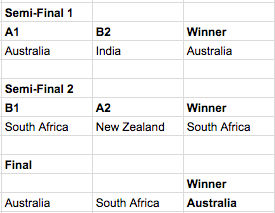
And who the better team is is usually defined using the ICC rankings. And so, as I have done before, I thought I would take the current ICC rankings (as they are today, not as they were when the teams qualified) and see how the upcoming Champions Trophy would play out if the rankings were gospel. I.e. if the team ranked higher always won.

When I did this previously the robots got about 88% of the group stage matches correct (or thereabouts) and three of the four knockout stage teams right (they picked Pakistan which missed out, the West Indies taking their place). They got both semi-final winners right (Sri Lanka and India) and they nailed the final.

Not bad.

So according to the rankings how does the Champions Trophy shape up? Let’s take a look. (This is of course assuming there are zero no-results during the tournament which is of course silly because it’s England in June, but hey this is just meant to be fun.)

Group A:

Screen Shot 2017-05-15 at 8.02.01 PM

Group B:

Screen Shot 2017-05-15 at 8.03.33 PM

Knockout stages:

Screen Shot 2017-05-15 at 8.04.36 PM

And so there we have it. Congrats to Australia.

I’ll check in on the robots during the tournament and see how they’re doing.

#

Robots aside but that India v South Africa Group B match has “match of the tournament” written all over it.

Boycott this

In December of 1979, Soviet Union troops–disguised as Afghani solders–entered the city of Kabul, Afghanistan and led a coup against the internationally recognized government of president Hafizullah Amin, who was killed after the Soviets stormed Tajbeg Palace on the evening of December 27. By next day the coup was complete, the Soviets held Kabul, and Russian tanks, troops, and vehicles spilled over the mountains in an effort to control town and cities throughout the country. It was a sign of unchecked aggression by a nation that most of the world would prefer to stay checked. Most saw the move, which horrified the West, as an attempt for the USSR to ultimately seize control of the entire Middle East and gain access to the Indian Ocean.

The international outcry was swift and severe. Ministers from 34 Muslim nations–including, interestingly, Ayatollah Khomeini, whose newly founded theocracy in Iran was a fierce enemy of most of the West–condemned the invasion and called for immediate Soviet withdrawal. The United Nations General Assembly issued a resolution protesting the Russian action. And the President of the United States, on top of his work with NATO to stem the flow of weapons into the region, famously issued an ultimatum to the Russians in January of 1980: withdraw from Afghanistan in one month or the USA would boycott the 1980 Summer Olympics, due to be held in Moscow the following summer. The Russians stood firm, and the USA stayed home, as did more than 60 other nations. Four years later, the Soviets boycotted the summer Olympics in Los Angeles.

The Russian occupation of Afghanistan, and the ensuing guerrilla war, would last for nine years, one month, three weeks and one day. It would result in the deaths of over 120,000 Russian and Afghanistan troops, as well as the deaths of (estimates vary) at least 500,000 Afghani civilians, but probably a lot more than that.

#

Starting in 1949, the South African government began to issue a series of Apartheid laws. There was the Prohibition of Mixed Marriages Act; the Immorality Act, which banned sexual relations between people of differing races; the Population Registration Act, which classed all citizens into one of four racial categories; and the Group Areas Act, which began segregating the nation’s population based on their predetermined racial category. From 1960 to 1983, nearly four million citizens of color were forced from their homes and into segregated neighborhoods.

The worldwide outcry was not insignificant and notably included an arms and weapon embargo instituted by the United Nations. Also included in the backlash were boycotts of the nation by rock bands, orchestras and, of course, international sport organizations. For instance, four years before the USA boycotted the Moscow Olympics, 26 African nations refused to participate in the 1976 Summer Games in Montreal because the International Olympic Committee refused to ban New Zealand after the All-Blacks traveled to South Africa for a Rugby tour.

Previous to the action in 1976, South Africa had been banned from the 1964 Olympics in Tokyo; in 1968 the United Nations called for an international boycott of all South African sports that support Apartheid (this is the edict that New Zealand, and several other nations, violated); and in 1970 the ECB cancelled the South African’s cricket team’s tour of England after several nations threatened to boycott the Commonwealth Games to be held that summer in Scotland.

Apartheid would last until 1996. It is without a doubt one of the darkest stains on humanity, a stain that will never come clean.

#

Apartheid and the 1980 and 1984 Olympics are arguably the most famous sporting boycotts, but there have been many others. Several nations did not participate in the 1956 Melbourne Olympics for several different reasons; in 1988, North Korea, Cuba, Ethiopia, and Nicaragua boycotted the Seoul Olympics; in 1996, Australia and the West Indies refused to play in Colombo due to security concerns; and in 2009 the England Cricket team cancelled Zimbabwe’s tour because of their government’s human rights abuses.

Every nation pulled out due to various reasons, but they were all justified, or at least logical. Be those reasons geo-political, humanitarian, or the safety of their athletes; Apartheid, unchecked Soviet Aggression leading to a decade long war or state sponsored protestor beatings in Harare. Even less politically sensitive boycotts, such as the ATP tennis players boycotting Wimbledon in 1973 could be seen as attempts to protect the rights of athletes. Sporting boycotts have always been a weapon of last resort, for good reason, as restless populations might see the boycott as a last straw by an oppressive government, and the isolation that ensues after boycotts can be see as detrimental to third world nations getting access to the West’s money and weapons. It is last resort, and the reasons have to be good ones.

India, meanwhile, want to boycott the Champions Trophy because the ICC is making an effort to fix a broken system.

#

Related: BCCI Should Grow Up, via The Full Toss.


Boats against the current

The IPL is happening right now, but I probably didn’t need to tell you that. It used to run in the background like a virus scan but now it is more akin to those constant Adobe software update reminders. Cricinfo, which used to more or less ignore it, is all in, with headline coverage every single day. They treat it now like it is an important cricket league, as opposed to the side show it actually is.

Okay, despite the cheerleaders and the pop music,”side show” is harsh. But really in the end it is just another domestic T20 league, awash in a side of domestic leagues, T20, 50 over or otherwise. Here’s a look at all the other domestic leagues having matches today, just today:

Dhaka Premier Division Cricket League
Pakistan Cup
Royal London One Day Cup
Super Provicinial One Day Cup
Malaysian Premier League
Million Cricket League

Of course, those leagues don’t feature (some of) the best T20 players in the world and aren’t played in the most cricketing mad country of all cricketing mad countries. And so I get it. But the IPL–whether it’s the style of the T20 played or the uniforms or the bombastic television coverage or the money or the corruption–has always bugged me. But it has also always been there. I am not only one of the rare cricket fans who has only known a cricketing world with the T20, I’ve also only known a cricketing world with the IPL. I started following the game in 2007, the first IPL was in 2008. And so it’s always been there, and so it would follow that, unlike old time fans of the game, I would be more accepting of it. And while this is true for the format, it is not true for the IPL.

I think one of my major complaints about the league is that all other international cricket pauses for seven weeks while the tournament is taking place. Not only is it the only domestic league in cricket in which international cricket pauses so it can take place, I think it is the only such league in any sport in the world that takes precedent over their international cousin. Could you imagine UEFA taking a hiatus from its endless series of friendlies and qualifiers because the English Premier League was deemed more important? Me either.

But bringing up the English Premier League brings up the point that cricket is also the only team sport where the international game is top dog and the domestic game is loved but that love is localized. There very few fans of County Cricket who exist outside England or Wales, and fans of specific county teams rarely exist outside of their county. And maybe the IPL is a sign that cricket is finally starting to move to a format that more closely resembles other team sports, where the domestic game is on top of the pile except for every four years when the World Cup happens (except if the trend continues I think it will be, for cricket, as it is for basketball, the Olympics which become the most important international tournament).

I don’t think this is a good thing.

If this happens, if domestic cricket taking precedent becomes the rule instead of the exception, and we are heading in that direction, then cricket will become a brood of international mercenaries flitting from league to league to league every few weeks. Never wearing the same shirt twice, constantly switching allegiances, with all the money going into the pockets of cricketing bureaucrats instead of back into the game. Meanwhile the international game–yes, even The Ashes–will suffer and, slowly, quietly pass it into the past. And lots of people that work at Cricinfo seem already resigned to this fate, which is why they have latched onto the IPL with both barrels. But if the international game loses out to the domestic game, then I think that will be what finally kills off cricket for good. And that, I think, more than any other reason, is why the IPL leaves me with a bad taste in my mouth. It’s a harbinger of doom.

That is not to say that domestic leagues shouldn’t exist or should be weak. I believe the opposite is true. Domestic leagues in every cricket playing country on earth should be rock solid and entertaining and popular. They should just take a backseat to the international format, for the good of the game.

But all of that said, all the doomsday rhetoric and anti-IPL musings, I also believe–and I know this negates everything above–that you can’t kill cricket. Cricket is bulletproof. Cricket is like our current buffoon of a President in that every time we all think it’s down for the count, it comes raging back to life. I hope that’s true forever. And that’s why every time I write about the death of the game, I add one simple caveat: I hope I’m wrong.

For instance: Yesterday was Sachin Tendulkar’s 44th birthday. He’s only 44! He played so long that if you had told me he was 50 or even older I wouldn’t have batted an eye. I was reading about him yesterday and realized that he was only 19 when he played that one season for Yorkshire. He was their first player of color, and one of a very players that didn’t come Yorkshire proper. It was 1992, and that makes this the 25th anniversary of that summer he spent making waves across England. And while 25 years might seem like a lifetime, it is also yesterday. But so much has changed in the last 25 years, in domestic cricket, in international cricket, in England, in India, the world over. As Oliver Brown put it in this wonderful piece on that summer Sachin spent in Yorkshire, it made be only a handful of years, but the photos are already “bathed in sepia.” So much has changed, but cricket has soldiered on, bow beating against the waves. In fact it is one of the few constants in a world that lacks them also completely. And that is something worth celebrating, and that’s why I am not going to worry too much about the IPL. QED.

#

A domestic USA television/streaming update: a lot of sites out there list Willow TV as the network that’s covering the Champions Trophy in the USA. This is only half true. Willow TV will be showing the matches on its television channel, but the matches will be streamed on ESPN3, not on Willow dot TV, Willow TV’s online component.