Getting back to why we’re here

I was at work event in, I don’t know, Orlando, or maybe Las Vegas, or maybe Seattle, in the days just after David Beckham had announced that he was signing for the LA Galaxy in MLS. The people I was with didn’t understand that, no, he would not be playing soccer now for the US national team, he woulds continue to play for England just as he’d always done. They were dumbfounded.

During the 2014 World Cup, one of the most intelligent people I’ve ever encountered, tweeted out inquiring why the Portugal-US group stage match hadn’t gone to penalties after ending in a 2-2 draw.

Americans — most Americans — will never get soccer. It will always be this mysterious little sport that pops up on their radars every couple of years and then disappears and they promptly forget everything they know about it. Trying to explain to them the nuts and bolts of how the competitions function — not offsides rules or any nonsense like that, but simply why certain teams are playing who and why — is almost impossible. Every American soccer fan has had this conversation. There’s the national teams. Okay. Got it. Then there’s the club teams. Okay, hanging in there, I think. And each club team plays in several different competitions. Huh? Yeah, there’s the league, and then the cup, and the other cup, and if they are good they get to play in this entirely different league (actually two leagues depending on how good they, and their league, are), and of course their’s World Club Cup which is like the World Cup only for clubs.

At that point their eyes have glazed over and, to them, you have ceased speaking a language that they understand.

And that’s soccer.

Where does even start with cricket?

Okay so there’s the national team, and then there’s club teams in several different leagues and players can play for their national team but also can play for a several clubs in several different leagues. Like, say, a English player can play for the English side, but he can also play for a English club team, an Indian club team, a Bangladeshi club team and an Australian club team. Oh, then there’s the different formats. The test, of course, the one with the white sweaters, and then there’s the one day international, and the twenty20 and this new thing called the 100 or something know one really knows and in England they play for a trophy in each format but in other leagues they only play one format except for club system like Shield Cricket in Australia and internationally there’s the World Cup, and the other World Cup, and the Asia Cup and the Champions Trophy, oh and all the play-in competitions for those cups that sometimes last for years. What were we talking about again? I think I blacked out.

Americans will never get cricket either.

And the problem is two-fold. First of all, there’s the nomenclature with which we are choosing to explain both it and soccer. Americans who know American sport know it well. All the leagues, even the ones they don’t follow very closely, make sense to them. And so when explaining international sports, we tend to use the lexicon of American sports: playoff, division, etc. But the problem there is that international sports are so much more nuanced that once you reach a certain point, you run of out of known words, and that’s when the person you are speaking to starts to look for a different conversation to join.

The second is, simply, access to knowledge about the game on an ongoing basis. If you are exposed to the game — even for just a few minutes a day — that’s usually enough, over a period of time, to give people a decent understanding of what it’s all about.

When it comest to cricket, this is where I want this blog to step in, and hopefully help with both of the above.

This blog has existed for several years, and it never really had strong, focused purpose. I drifted all over the place. World War 1, England, Pakistan, America, wherever my whims dictated, that’s what I would write about. I think the blog has been at its best when I’ve woven my personal narrative into stories about cricket. But that’s a difficult construct to pull off and not one that’s sustainable long term. So while I will still write about all of the above, I hope to move toward a daily — that’s blue sky, it will probably be weekly or monthly considering — posts that talk to Americans and explains to them what is happening in cricket and why it’s cool and why they should care. It’s something I have been wanting to do for a while. I hope to move it, at some point, into an email newsletter, but we will see what happens there. And the goal is also to make it not just fun reading for cricket newbs, but for life long fans of the game, too.

This will start on Jan. 1. It’s not a new year’s resolution, but it’s close.

Because the thing is, I had a pretty good thing going here, back when I was posting almost every weekday. It felt good. I had an audience and fans. And I want that back. And I want to keep writing, and I want to keep writing about cricket, and I want to help more people understand the game and why I — and a billion others — love it so much. I have always felt that American cricket fans have a bit of a duty to help grow the game in this country, and I hope this new focus helps to do that, if even a little.

The tagline of this blog has always been: An American Cricket Blog. And now I think it will finally be living up to that name.

I can’t wait to get started.
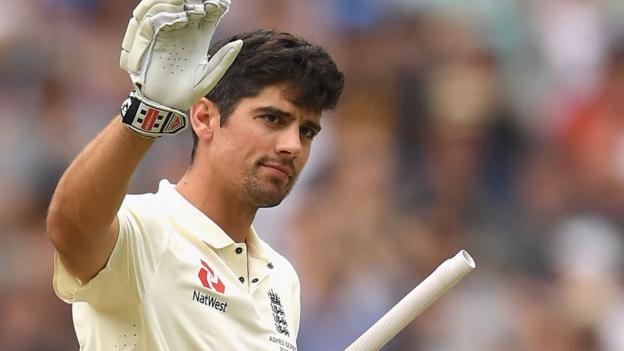
 

On Alastair Cook: When You Leave

The week of August 6th was the worst week of my entire life. Monday spiraled into Tuesday which spiraled into Wednesday. Each minute was worse than the next. I felt like I was slowly being sliced open, and my insides allowed to drip, drip, drip out onto the street. Then I hit bottom. And then it was over. The wound was still there, but it no longer bled. I was on the back porch of my mother’s house in suburban Minneapolis. It was a beautiful summer’s day. A Thursday. August the 9th. I was drinking coffee and I had my book and the day off and nowhere in particular to be. It was then that I received a Medium post from my newly ex-wife entitled: When You’re Left.

I read it through in its entirety. Each word was salt into the still gaping wound in that space just beneath my heart. I read it, deleted the email in which she sent the link, and promised myself I would never read it again. I finished my coffee and sat in that chair there in the sun on my mother’s back patio for a long time, thinking about what I had just read. And what I just done: left.

My ex-wife is an excellent writer. Clear, direct, authentic. She avoids hyperbole and over-dramatization. She just writes. One of those people that makes it look easy. In the Medium post she described what it was like to have been left. That everything in our house reminded her of us, of what we’d had, and around every corner was a reminder of that loss. It was deeply sad.

She wrote about how when uses the shower in what was once our house, our home, she cannot help but think of how we had just gotten the bathroom redone, and how I had never gotten a chance to use it. When she goes out into what was once our giant and beautiful and green backyard, she cannot help but think of all the good times that we’d had out there, or about the first day we looked at the house in 2005 and fell in love with that big expanse of private green. When she pets our dog, she thinks of us; when she makes dinner, she thinks of us; when she goes to the grocery store, she thinks of us; when she puts a record on, she thinks of us. It’s a never-ending cycle of reminders, followed by a sharp twist of pain in that space, that space I described above, that little space in your chest just below your heart. You know the one I am talking about.

She wrote about the first few seconds of her day. When she would wake up, roll over, and wonder where I was, before she remembered that I was gone. She wrote about the little changes she was making to the house: painting the kitchen and the bathroom and the living room. And she would catch herself wondering if I would like it when I, eventually, came home, and how she would have to remind herself that I wasn’t coming home.

Her pain was visceral. I could reach out and touch it. I could smell it. It was a room inside me that I could not leave.

She wrote about not just what we had lost from the past, or the present, but also about what we had lost from the future. All our dreams, all that we had been looking forward to. All her happiness, potential or otherwise, gone.

That letter, and so many other events this past summer, will haunt me forever. Not a day will go by that I don’t remember her pain. “I’d had a happy life,” she wrote. “And now that life was gone.”

Her loss was total.

Then again. So was mine.

And that’s what people fail to understand. Of course, I don’t expect my ex-wife to understand, or to even try to attempt to understand, that’s not something I will or would ever ask of her. But, sometimes, I feel like people forget that to leave, is also to mourn. It is an active choice for happiness but also for pain, sadness — that of others and of your own. There are painful memories around every corner for me, too, just in a different way. Every time I shower in my little apartment in St. Paul, I think about the shower in the bathroom that we had just redone, and how I never got to enjoy it, after 12 years of living with it as it fell apart around us. Every time I see a dog, any dog, I think of the beloved and sweet and loving dog I had left behind. Every time I look out longingly into the paved and gray alley next to my building, I think of that big expanse of green where I used to read for hours on summer days, that expanse of green that I will never get to enjoy again. When I make dinner, I think of what is lost; when I go to the grocery store, I think of what is lost; when I put a record on, I think of what is lost. I, too, mourn for all that was lost. Is lost. Will be lost.

And all of it was my choice. Whether or not that choice was, or is, or will be, the right one, it was still an active choice for life altering change, for hardship, for pain, for happiness that is not real happiness, not yet, but is only potential, future happiness. And you think about going back, because you can’t help but think that maybe, just maybe, you had a few innings left to play, and then all of a sudden it’s too late to ever go back. And you are alone, and no one seems to understand that you grieve, too.

And that is what it is like to leave.

Image result for alastair cook retirement

*


That Michael Vaughan tweet

I have always rather liked Michael Vaughan. Yeah, I know, he’s a blowhard, and all he can ever talk about is how his England squads were the greatest squads in the history of the world. But I don’t mind that. I don’t mind a bit of bluster from athletes. When they are overly humble, it just seems fake. And I also follow Michael Vaughan on Instagram and he seems like an all right guy, enjoying life after a good career, playing with his kids, doing his commentary bit, plus of course slagging off Australians.

And I have also always known — or at least assumed — that most professional athletes are conservatives. Just like everyone in Hollywood is a liberal, most people who put on uniforms and chase balls around for a living are Republicans. It’s a financial thing at its core. Most professional athletes are super wealthy, and the super wealthy — except for the Hollywood elite — tend to vote for the more conservative party. And in America, that’s the Republicans, the party of our president, Donald Trump.

But then the other morning I come out to my phone to find this:

IMG_6631.png

My first reaction was “fuck you, Twitter, get your algorithms right.” My second thought was: “fuck you, Michael Vaughan. Unfollow, block, report.” But then I calmed down and dialed it back and said: no, I am going to keep following him. It’s his right to express opinions, and I can listen to those opinions and disagree with them and still think he’s an okay dude, still enjoy his bluster, his dorky instagram posts. I was rather proud of myself. Not to toot my own horn, but I bet he lost a lot followers that day, and I am glad that I wasn’t one of them. We can’t poke our heads in the sand every time anyone expresses any sort of opinion that we don’t like. Our echo chambers are why we are in this mess. And despite what a lot of people think, athletes and actors and musicians have just as much right to their opinions as everyone else. And if they want to use the platform they have as a megaphone to voice those opinions, then that is their right, too. We can’t just say: “you have that right as long as I agree with you.” That’s BS and you all know it. We have to allow it from both sides. (Within reason, of course.)

And so I didn’t unfollow, block, report. I just went about my day. And later I watched one of Vaughan’s dumb instastories and didn’t even think about the tweet from earlier in the day.

I will say this though: you are wrong, Mr. Vaughan. The last thing the world needs is more leaders like President Trump. We don’t need more divisive, fragile male egos in power. We need kind, impassioned, educated leaders who lead with a strong moral compass, with the best interests of all in mind, and who see public service as an important and vital mission that will, in the end, hopefully, help raise all boats.

No, Mr. Vaughan, we don’t need more Donald Trumps. That is the last thing we need. Yeah, both our countries’ politics are a bit of a dumpster fire. But reality show politicians who do little but gin up their base with racist dog whistles aren’t going to solve that. We need leaders. Not snake oil salesman.

You are wrong, but I still think you’re all right.

Tradition

Yesterday was Thanksgiving here in the states, or as they call it in the rest of the world: Thursday. Anyway. Everyone has the day off and we all go to see family and eat turkey (veggie burger for me) and drink beer and watch football. It’s nice. It’s something that Americans have done right with regard to holidays. It’s Christmas without all the nonsense stress of gift giving. It’s always been my favorite holiday — despite its rather unfortunate and not-so-tenuous connections to the mass slaughter of Native Americans by Europeans, but we will save that debate for another day.

My family has its own Thanksgiving traditions, just like every family does. We all meet at our mother’s — it’s small group, just seven or eight of us, depending — and we have some beer and wine and hang out in the kitchen and then we eat around 4 p.m. (which is late for some people) and the meal is very traditional and rarely changes: turkey, mashed potatoes, stuffing, broccoli casserole, green beans with almonds, cranberries from a can, rolls and pumpkin pie. Then we do the dishes and clean up the entire kitchen and then we usually play a game and then everyone goes home. The whole shebang takes about six hours.

Yesterday was different, though, harder. For there was an empty chair, a chair that many people — myself included — thought would never be empty. Everything else was the same, but one person was missing. And in that sense, the traditions of the day didn’t comfort, as one would assume they would, but instead added to the hurt, the darkness of the day. Furthermore, I knew that that someone who was missing was somewhere else, that the traditions she had had were no longer available to her, that she was instead somewhere else starting new traditions.

It was not a good day.

And in that vein is why I am okay with the evolving nature of things. Traditions are made to be broken and sometimes that breaking is positive, it allows us to see the world as anew, changing, fresh. That life is not the past nor is it the future, it is the present.

People ask me a lot what it will take for cricket to work in America. I have thought about the question a great deal over the years, as have many of you, I’m sure. The short answer that I have finally settled on is: Time. Not the length of the matches, mind you, for Americans have zero problem watching a four day golf tournament or a six hour tennis final. The ODI was been around since 1971 — 47 years, nearly a half century — and hasn’t made a dent on the sport in America except giving ex-pats something to do on Saturdays. The T20 has been around since 2003 — 15 years, oof, that makes me feel old — and same deal. And if anyone thinks the ill-fated 100 is going to change anything, they are sadly mistakenly.

No, I don’t mean time as in the length of matches, but in the time of day. The when, not the what or the how long.

I subscribed to Willow again for the third time earlier this summer and have watched a grand total of maybe two hours of cricket. Why? Because the matches are on in the middle of the night. Even the Australian and New Zealand summers which have kicked off don’t solve the problem completely. Yes, you get a little prime time cricket, but it’s just the first session or two of Test matches and then you are past everyone’s bed time. ODIs start at midnight, U.S. time, T20s as late as 3 a.m.

For cricket to work in America: this is the tradition that needs to be broken: the when of matches. This is why I am in favor of the day-night test. But you’ll need to go a step further than that: have night-night tests, or move IPL matches to the morning in India so they are on during the evening in America. It would be a sea change that the sport — any sport, really — has never seen. But it would work. I think. Americans are thirsty for sport, for entertainment, for new. and cricket ticks all those boxes.

People will disagree, of course, and say that the sport has to start at the youth level. And, fine, I see that point, but if the kids that are exposed to cricket still can’t watch it when they are older and have expendable income, then you are still nowhere.

No, for cricket to work, you need to change the when. Not the how or the why or the what. The when. That’s the tradition you need to not break, but shatter, for cricket to work in America.

If, of course, that’s something you want.

Traditions are made to be broken, but they are also how we mark time, and how we find sameness in an ever-changing world. They are comfort, despite the pain they can occasionally bring, Yeah, Americans might not ever tune in to a test that starts at midnight, but maybe that’s okay. Maybe it’s worth the loss to have the tradition. In that spirit, while yesterday was hard, it was also comforting to know that despite all the change of the last year, some things hadn’t changed. And I think I am okay with that. Because there is such a thing as too much change. And when you reach that point, you need to ask yourself: will everything we change be worth it?

That’s not the question you want to ask in hindsight.

For now, let’s keep the turkey and the late dinner time and the Trivial Pursuit, and let’s also keep those long shadows creeping over Lord’s as the late afternoon of a test becomes early evening and the game is still in doubt.

Change is good. Traditions can be better.

Overlooking a bakery

It’s snowing in St. Paul this morning. I am sitting at my kitchen table, writing, and watching it drift down onto the parking lot outside my window. The skinny trees at the edge of the alley still have their leaves, their light covering of snow incongruous with their yellow-ish green. The world is wet, and droopy, and lovely, and perfect.

On the other side of the world, in Hyderabad, India, earlier today, Umesh took a ten-for and India beat the West Indies by 10 wickets in three days. It happened as I slept, as I dreamed. As the cold drifted in through my leaky storm windows and I felt its chill settle in the room around me. In Hyderabad it was 90 some degrees with humidity and no breeze. The opposite of this 40 degrees with damp snow. Here, there is no cricket, only wet streets and grumpy midwesterners. Here, cricket doesn’t even exist. It’s like we are on separate worlds, but we’re not, we’re on the same planet, together, linked, hurtling through space.

Umesh’s ten-for reminded me of a post from the Old Batsman:

Simon did it. The last two, from memory, were bowled. We surrounded him. We had Junaid Khan smiles. He was a lovely guy, always great to play with. He deserved it. It had taken maybe an hour and a half. They’d only made 60-odd and we knocked them off quickly, on the ground surrounded by trees, underneath the perfect sky.

It’s a melancholic feeling, thinking about it now. I wonder what happened to Simon, and to everyone that played that day. Have they had good lives since then? I hope so. Nothing ties us except that game, but I doubt that anyone who played has forgotten it. All ten. Not bad. Well done, mate.

And so when I pulled up Cricinfo this morning, I didn’t think of India or Umesh or 10 straight home series wins, I thought of the Old Batsman, and Simon, and I wondered too where he was, where they all were. And I thought about life and the places it takes us, and the changes it brings, sometimes without us even knowing that the change was happening. We are always drifting away from a past, always moving away not just from places but from people, things, dogs, books, comfort, homes.

Today I am writing this on West 7th in St. Paul. Earlier this year I was somewhere else. There’s been so much change. Life has taken me not to the other side of the world where the world is baking in high hazy sun, where cricket exists, but still to a place so alien, so new,  so different than all that I am accustomed to. And there’s a life that I had that is now gone, and in that life were people, and I am drifting away from them, and they from me. Some of them were Simons, small heroes that I loved, that I will think about now and again, and I will wonder how they are doing, where they are, whether they still think of me, of a memory of a day we shared.

That post quoted above is from February of 2012. Six and a half years ago. If May seems alien to me now, than February of 2012 feels like another plane of existence entirely. I was writing about cricket a lot then. Almost every day I would post something here. But then I drifted away. But cricket kept going, and the Old Batsman kept writing, though maybe not as much as he used to. I drifted away, but then I came back. It wasn’t the same, but it was still familiar. We hold on to these old houses that we used to call home, we keep them in our hearts, maintain them, keep them up, go back now and again and fix peeling paint and weed overgrown gardens, so that someday, if we want, we can go back, move back in, accept that they’re different, that we’re different, but also familiar.

And then we are reminded that the houses inside us are just that, inside us. We build them, we hold them close, we carry them with us, we can raze them if we want. They are moveable feasts. I can write about cricket and read the Old Batsman at this kitchen table that looks out over a parking lot, or at my old kitchen table that looked out over a half acre of green. You can’t go home again but you can go home anytime want. Sometimes all it takes is an Umesh ten-for to bring you there, to remind you of the way.

A few years ago I wrote a post about how important the smallest of things are — in life, and in cricket. Those small things are not always small, or are different sizes for different people. Umesh’s ten-for was massive for him, but small for me. But did he know just how massive it was? That it rippled across oceans to St. Paul, Minnesota, to a little apartment above a Home Health Care business overlooking a bakery where someone was sleeping, dreaming, and would soon wake and read about it and spiral back through time to someone else’s moment, to the Old Batsman, to Simon. What we do matters, what we do is a wave across the world.

Three days ago I was struggling. Then I found records that I didn’t know I still had. That I thought were gone from my life forever. And a switch flipped. And I felt better. Six years ago the Old Batsman thought of Simon and a day decades in the past. And he felt not better but maybe less alone. And he wrote about it. Today on the other side of this giant world Umeshkumar Tilak Yadav took his 10th wicket and together we spiraled down into a chasm of memory. Years and decades like cliff walls hidden in the black, the rush of air drying our tears, the ground forever away.

Emotional Rescue

I play on an adult rec-league soccer team. It’s a pub league without the pub. I have played on the same team for 10 years, every May through October. We play soccer, then we drink beer and stand around. It’s the perfect way to close out a weekend. These days, we win or draw just about as many games as we lose, more or less. But when we first started out, we were terrible. We lost every single game of our first season together. And all of the games our second season together, until the very last game. It was a cold late fall night. Mist turned into a light snow in the second half. It was dark. The flood lights were on. Early in the second half we scored a garbage goal and it was the first time we had ever led during a game. The second half wore on and we held onto that lead. But with a minute or so left the other team scored and the game ended in a 1-1 draw. But we didn’t care. We hadn’t lost. For us, it was a victory.

#

Earlier this week Australia rescued a draw in their first Test match against Pakistan. It was never meant to be that close. But Usman Khawaja held on for an incredible 302 balls, and Nathan Lyon of all people saw off 11 overs with his captain. It was a great escape from a match they looked destined to lose from the first session onward.

Rescue. Escape. Those are words you don’t hear very often in American sports. And that’s because we, as a nation, abhor draws. We want winners, and we want losers. We want black and white. Never gray. People can wrest victory from the jaws of defeat — and vice versa — but they can never rescue a tie. They can never pull a great escape, walk away bruised, bloodied, but still walking. Still breathing.

In this way, European sports — sports that allow for draws (and ties) — are a better reflection of our daily lives. Life, for us, is rarely black & white. In fact 99% of the time it is some shade of gray. Sometimes we walk away just barely hanging on by a thread to whatever is keeping us whole, and that’s enough, to rescue a day, escape with some loose change in our pocket and a black eye and torn jeans, but able to go out and fight another round.

And while there’s of course the rare joy that is a comeback victory, there’s also joy in the escape. Draws that somehow feel like wins are one of the great parts about following a sport that allows shades of gray — and when that feeling is compared to a draw that feels like a loss, like Pakistan must feel today — it shows the rich textures of these games that we follow, textures that American sports simply do not have to offer.

To rescue: “to free from confinement, danger, or evil”

To escape: “to get away”

Australia rescue a match. And look toward the second Test.

We rescue a day. And we live to fight on.

I watch cricket not always for the game itself, but for the hope that there’s a way out. This week Australia reminded me — reminded us all — that’s there always light at the end, you just have to keep batting. And when you emerge from the tunnel you might not feel like you’ve won, but you’ll feel like you’ve survived, and most of the time that’s enough to see you through.

It’s a big old world, Sophie.

On Thursday I re-re-subscribed to Willow.TV. It was only $10 a month, which I think is five dollars cheaper than it used to be. I’m not sure why it’s less expensive, as nothing in this world ever gets cheaper, but I will take it.

The subscription to Willow came with a free subscription to Gaana, which is the Indian version of Spotify. Western bands like Radiohead and The National and Sigur Ros are only available to subscribers in India, but I am able to listen to the latest in Bollywood and Punjabi pop music.

I must say, I don’t quite get it. It is so vastly different than the music I usually listen to (see above) and honestly vastly different than pop music here in the states or in Europe. Which, I don’t know, I kind of like. I might not like the music, but I do like that it’s different. India is such a huge and interesting place, and so widely variant from western culture. Sure, it’s a small world, but it’s also a very, very big world, and I take heart in knowing that we aren’t all the same, that we are in fact very different.

There’s a beer that you can only buy Wisconsin called Spotted Cow. Everyone that loves beer loves Spotted Cow. And whenever you drive through Wisconsin, you make a point to stop at a liquor store and pick some up. The owners think that’s how it should be. That beer should taste different in Colorado and Wisconsin and Florida. That everything shouldn’t taste the same, and that you shouldn’t be be able to buy everything everywhere. That you should be constantly reminded of just how big America is. I’ve always rather liked that. But I digress.

India might be very different than western nations, but at the same time the fact that they love the same bat and ball sport that western nations do goes to show the power of the game, as well as the power of Imperialism. Sports really do bridge cultures, and cricket more so than any other sport — even soccer — as the cultures that it attracts are just so different. Of course, I realize that when it was first introduced to India and the Caribbean it was an instrument of empire building, but in the decades since it has become very much an uniquely Indian pastime. Yeah, you could say that parts of the game have been Americanized, but also I think the influence of Indian culture has had a profound impact on the game, which further cements its stance as a bridge between east and west.

And that’s also a part of enjoying global sports that you don’t get when you just watch baseball or basketball: you get exposed to not just a new game, but a new culture. Its music, its fashion, its food, its people. I have traveled domestically rather extensively — been to 40+ states and most major American cities — and I have to say that the differences between, say, New York and Seattle are pretty minor. I was just in Boston this past week and was struck by how much Cambridge reminded me of San Francisco, of how much Beacon Hill reminded me of Cincinnati. But the gap between Mumbai and Minneapolis is vast and wide, and I love that I am exposed not just to a slight variation on my own culture, like I would be if I was an avid NFL fan, but to cultures so different that it reminds us just how big and wonderful this dumb old world is.

And that’s a real gift, I think. Most people in America know India is a place and that a lot of people live there, but honestly that’s really about it. I like that I — and my fellow cricket following Americans — understand it just a bit more than the rest.

I probably won’t stream Gaana very often, but I will now again, to recall that there’s seven billion people on this rock, and each and everyone of us is a completely different person, with different interests, values, knowledge, passions. The fact that it takes cricket to teach me that some might say is evidence of a flawed educational system, emblematic of how insular America is. And yeah they are probably right. But I will also say that I don’t care what makes you a global citizen, as long as you get there in the end. Music, sport, literature, travel, film: whatever it takes to know that the world doesn’t end once you step off American soil.

You’d be surprised at how many Americans believe that.

Then again, maybe you wouldn’t be.

Cause and effect

Oh, right. This is a cricket blog, haha.

Cricinfo has been posting this graphic a lot:

Which got me thinking: is there any correlation between winning or finishing second in the Asia Cup and a team’s performance at the next World Cup? I mean, it would make sense, when you think about it. Cricket is like all sports: it’s about momentum and confidence and getting hot at the right time. And winning and finishing second at a major tournament would be indicative of all three.

So I had a look:

Screen Shot 2018-10-01 at 4.53.51 PM.png

And, interestingly (or not), winning the Asia Cup is not the slightest bit indicative of World Cup performance. India is the only team that won an Asia Cup and a World Cup back to back. In fact, it’s twice as likely for the team that lost the Asia Cup final to win the next World Cup. On top of that, no team has gone back to back — winner or runner-up — at a World Cup that didn’t take place on the sub-continent.

So, there you go. Bad luck, India and Bangladesh.

My money is still on New Zealand.

Say it ain’t so

Yesterday we all watched as Joe Mauer played what was probably his last home game for the Minnesota Twins. He hit a double in his last at bat, then donned his old catcher’s gear and caught one pitch before waving to the crowd and disappearing into the tunnel. It was a wonderful end to his 14 seasons at the club, 14 seasons that had their shares of ups and downs — and about a million seven hoppers to second base — but that never quite reached the heights we were all promised when the Twins drafted him out of high school, choosing baseball over a chance to play quarterback for Florida State.

He made his debut in 2004 against the indians to much fanfare. Like he was the second coming of Christ. He went two for three that day and caught a good game. A few days later I was standing in my kitchen listening to the game as it wasn’t on TV. Drinking cans of beer and ducking out between innings for cigarettes. My wife and new dog were upstairs. I could hear her laughter every time the dog did something funny. It filled me with all this love, all this happiness, emotions I wasn’t sure how to deal with then.

The game was at the Metrodome. A tired old stadium with artificial turf like concrete. The Twins batters would bounce the ball off the turf in front of home plate and easily convert the hoppers into singles. Around the fifth inning or so, Mauer tracked a fly ball back behind home plate, making the catch but sliding knee first into the wall. He would end up having to leave the game with an injury to the medial meniscus in his left knee. He came back in June but the knee still kept giving him trouble and by July his season was done

I think about that incident a lot. Yeah, sure, Mauer had a good — if not a great — career. He won batting titles and an MVP. But injuries always seemed to hound him, and never let him get over that proverbial hump from good to great, from All-Star to Hall of Famer. And I always trace those injuries back to that night in 2004, when he had all the promise, all the potential, and then it was just gone in the span of a few seconds. So while Mauer’s career was, of course, one to be proud of, there was always this note of tragedy in his eyes, his gait, his body language. Like he carried the weight of the team’s failings, of his massive contract, of the sneers of fans on his back, on his sleeve, and in his heart. His was a tragic character. Something you don’t see a lot in sports. Maybe even an introvert in the mold of Mesut Ozil. Quiet, quality players lambasted for not being bombastic captains.

Mauer then joins other Alastair Cook (who’s farewell was somehow even more poetic than Mauer’s) and Paul Collingwood and Jonathan Trott (speaking of tragic figures) who walked into the tunnel this summer, never to emerge again. Who let the sun sit squarely on their backs one last time before hanging their boots up forever. It adds to this sense of a chapter closing that I just cannot shake. Life feels like a series of endings these days, and I am in desperate need of a beginning. Of potential and promise not marred but one ill-timed slide on artificial turf. When life just opens up, and all you see is clear road ahead of you.

“There are endings and then there are endings,” Hanif Abdurraqib wrote. I keep waiting for the latter, because the former is all I have, and I have them over and over and over again.

Cheers for a great career, Joe, though I wish you would have given it one more season. I’ve had enough change, enough endings, to last a lifetime, but it feels like that’s all that life is now: endings. Endings and change. Every week, something or someone gone forever.

mauer.png


A time of innocence / A time of confidences

Two days ago Surrey County Cricket Club finished off their County Championship season against Essex with a last ball loss that denied them the proper end to their fairy tale season but still allowed them to celebrate on their home patch under the long shadows at the Oval in South London.

It was their first County Championship since 2002, the year I was married. And so since this year is the year of my divorce, the Surrey Championships bookend my entire marriage.

Surrey won the title in 2002 with an aging team of rock star 90s cricketers. Alec Stewart, Mark Butcher, Graham Thorpe, et al. It was at the tail end of a period of great success in the Championship, with titles in 1999 and 2001, as well. That August my wife and I were married at her sister’s house in the middle of a Wrath of God, Old Testament-style thunderstorm. We were living in a downtown Minneapolis high rise and we spent our honeymoon just hanging around town, with the week off work, drinking beer and wishing the Twins were in town.

In the fall of the next year, we bought our first house together. I got promoted the following January, and two months later we brought home our first dog, Murray, on a dark late winter night. He was the light of our lives for the next seven years. Surrey for their part were relegated in 2005, won promotion in 2006, but were relegated again in 2008. My wife and I bought our second house the August of their first relegation, we both quit smoking in 2007 and I started following cricket, and then in July of that year we both took new jobs, leaving the jobs we thought we would end up working at forever. We refinanced our home, we laughed a lot, we walked the dog together every morning.

Surrey were never even close to promotion the following few seasons. I was laid off in 2009 and took the worst job I’ve ever had. I was miserable. But there was money coming in. And thus started a rather tumultuous but lovely time in our lives together. We cancelled cable and started going out again. Niki started playing music and formed her own band. I went back to school. We went to London and Paris. Murray aged. We fought a lot but we were okay, maybe more than okay, maybe happy.

In the fall of 2011 Surrey finally won promotion back to Division One by the margin of a single point, after winning their final four matches. The previous August Niki and I went to the wedding of my friend Rob in Ashland, Wisconsin. It was a magical long weekend full of friends and love. Maybe the best weekend of my whole life, surely the best weekend of my marriage. Murray stayed with my mother. When we picked him up it looked as though he had aged 1,000 years since we’d last saw him. He could barely hold his head up. A month later on a cloudy Tuesday September morning we said goodbye to our precious boy on the cold floor of a sterile vet’s office. We wrapped him in a blanket, turned out the light, and left him sleeping. We never stopped mourning. Niki got laid off one month later. Her dad got sick. Things were hard.

The following June the immensely talented Surrey cricketer, Tom Maynard, was killed under sad and heartbreaking circumstances. It cast a shadow over Surrey’s season, one in which they barely survived relegation. Meanwhile, Niki and I grieved. We walked away from our house. And then we came back. It was a hard, terrible, wonderful year. We adopted Robbie, a hound mutt with big floppy ears who made us laugh everyday. I graduated from school, and took a new job and started this blog. Life shuffled on. 2013 saw Surrey finish at the bottom of Division One, sending them back to Division Two, where they would stay until 2015. That same year, I took another new job, so did Niki. We went on trips and bought records and laughed a lot in our kitchen, just like we always did. We got a new car and a new roof and a new furnace. We saw live music and went for walks in the woods with the dog on fall days. Niki’s dad died. My sister got cancer.

On Friday, April 20th, Surrey kicked of their 2018 County Championship campaign against Hampshire at the Oval, winning by 133 runs. Two weeks later, I left Niki, left my home. One month after that, I got my own apartment in St. Paul’s West 7th neighborhood. Two days after I signed my lease we filed divorce papers in the cold cubicle of a paralegal in a soulless government building. Three weeks after that, our divorce was final. In mid-August Niki met someone else. One month later, at the New Road against Worcestershire, Surrey won their first County Championship in 16 years with two matches to spare.  And today I sit here alone, writing this, my tea growing cold, autumn settling in outside my window.

16 years between Division One titles. A marriage. A lifetime. So much happened. So much life, and so much cricket. 16 years. And the above was the only the big moments. The houses and the dogs and the promotions and the relegations. It doesn’t even scratch the surface of all that truly happened in that time period. All those long days at the Oval in front of sparse crowds as the players shivered in April, or the days of long shadows at Old Trafford in September. Or the quiet mornings with coffee and a walk, or movies together, or concerts, or dinners. Birthdays, anniversaries, inside jokes, secret lexicons. Trips to the bank. Trips to the record store. Oil changes and grocery shopping. Countless small moments that make up a marriage, a life. I cannot turn a corner without a memory smacking me in the back of the head, reminding me of all that’s changed, of all that’s lost.

16 years. That’s such a long time to wait for fans of Surrey County Cricket Club. Just look at all that can happen in that length of time. And that’s just my story. What’s yours? Kids and aging parents and new houses and success at work. Plus quiet nights on the patio with the sunset, or a mug of tea on a winter’s afternoon, its steam visible in the low sunlight from the kitchen window. All those moments that make up a day, a week, a month, a year. Now add up 16 years worth of those moments, and you start to understand how long those suffering Surrey fans had to wait, and you also understand why my heart is broken, even though I was the one who left.

All that time. All that life. Gone forever.