The executive summary from the latest Oxfam Briefing Paper, dated 20 January, 2014 and entitled ‘Working for the Few’ (emphasis mine):
Economic inequality is rapidly increasing in the majority of
countries. The wealth of the world is divided in two: almost half
going to the richest one percent; the other half to the remaining 99
percent. The World Economic Forum has identified this as a major
risk to human progress. Extreme economic inequality and political
capture are too often interdependent. Left unchecked, political
institutions become undermined and governments overwhelmingly
serve the interests of economic elites to the detriment of ordinary
people. Extreme inequality is not inevitable, and it can and must be reversed quickly.
One of my favorite Twitter accounts is the official account of Lord’s Cricket Ground: @homeofcricket. Sure they do their fair share of ticket and event pimping, but they also tweet out pictures of the ground covered in snow or of the pitch on the morning before a big match. It’s that kind of stuff that makes me love Twitter generally and I wish more grounds did it. Some of the County Grounds do it, of course, but very few of the major Test grounds, which is why the spreadsheet ranking the major Test grounds’ Twitter accounts is so small:
The Lord’s account is obviously the most successful. They do a really nice job with it and I am surprised more grounds have not taken the time to follow their lead. Cricket grounds may be inanimate objects officially, but they are actually living and breathing monuments to the memories of millions of cricket fans the world over. The outcry when Perth hosted its last Test is just one example of this. I think the management team of all grounds would find it beneficial to give their stadiums a Twitter account, and thereby a touch of humanity.
Caveats:
**Five Test minimum
**These are ground specific accounts only. I left out @trentbridge, for instance, because that is Lancashire CCC’s official account handle and I covered the Counties already.
**Twitter Strike Rate is the term coined by @paperstargirl for the stat I invented, formerly known as “Tweets per Follower” or “TPF”.
Simply put, Twitter Strike Rate is the number of tweets divided by the number of followers. The lower the number, the more effective the social media campaign…supposedly. It is by no means scientific.
As an example, ECB’s Twitter SR is .05, which means they are earning 20 followers per tweet. While mine is 9.95, so I am earning one follower every 10 tweets or so.
It has taken me a couple days of reflection on the news out of the ICC earlier this week in order to form a semblance of an opinion.
I have always been an optimist when it comes to Test cricket’s future. The game has been around for 130+ years. It has seen action in three different centuries. It has survived two world wars, the introduction of the helmet and DRS. It has seen half its member nations go nuclear, two of which against the better wishes of the international community, and still it soldiers on. It has survived the introduction of two new formats, the IPL, the Big Bash League and dwindling attendance records. It has weathered the storms of Kashmir, the Mumbai and Pakistan terror attacks, and countless other attempts to derail it – both external and internal.
Cricket will be fine, I always say, even Test cricket. It has battled against history and time throughout its entire existence. It can handle whatever you want to throw at it. Do your worst, cricket will still be standing.
And cricket supporters, as @dbackwardpoint mentions, do a lot of crying wolf when it comes to the death of the game’s oldest format:
It’s for times like these that I’ve been begging people to dial down the “test cricket is dying” outrage. [1/2]
I remember when the ICC planned to kick the Associates out of the 50 over World Cup and supporters the world over were up in arms. It was the death of World Cricket, they said. But it wasn’t. The ICC heard the fervor and reversed course and the most powerful Associate member, Ireland, is stronger than ever.
And so I admit, my first reaction to the leaked revamp paper was “relax, everyone. It’s cool. Cricket will be fine. Just like it always is.”
But for some reason, after a few more days reading and reflecting, I realized that this time things were different somehow. The Internet was not littered with “the sky is falling” loonies, it was instead my favorite cricket journalists and bloggers writing logical and reasoned pieces on why this could really and truly be the final nail in the coffin of this game we love. It was reasonable people whose opinion about the game I deeply respect, figuratively dropping to their knees and wailing in despair for the future of this game that has brought them so much joy.
It comes down to this: one of the biggest problems in world cricket is too much power in the hands of too few. And the leaked proposal puts even more power in the hands of even fewer people.
And that spells death knell.
And so now that we have decided this is a problem – what can we do to fight it?
Step number one of course is hoping that cooler heads prevail and the proposal is sent to the incinerator where belongs – but what’s step number two?
The always brilliant Jarrod Kimber – cricket’s white knight if it ever had one – suggests, as he always does, just doing something simple: writing to the heads of CA, the ECB and BCCI. The links to their contact pages are here, here and here, respectively. I have done so, and suggest you do the same. It takes all of 15 minutes.
As Kimber says, the ICC is counting on our silence, but now is not the time for silence. It is the time for action. I cannot do what I have always done and just assume the game is going to be fine. It needs our help to continue.
The good news? Again as mentioned by Kimber in the piece for Cricinfo above, there are a lot of good people working to help keep the game alive. Let us not stand idly by as they carry this weight alone, let us – the collective massives – help shoulder their burden.
For the game does not belong to England, India and Australia. It does not belong to the Test playing nations and it does not belong to the ICC. It does not belong to the advertisers or the TV networks. It does not belong to the players. It doesn’t even belong to us. It instead belongs to our children, our grandchildren and our great-grandchildren. We are all stewards of this game, and we must act accordingly.
*
So what else should we do to help preserve this game? Well, based on some inspiring tweets from the aforementioned DeepBackwardPoint, I suggest that we all find a way to support cricket in all its forms and at all its many levels. Don’t just watch Tests between the big three. Watch and support the Associates and the Women’s game. Financially support your local club, or better yet sign up and start playing. Contribute a few bucks to your favorite blogger or buy one of their t-shirts. If you live in the States, pay $15 a month for Willow and watch legal streams of Ranji, County Cricket and lesser Test nations.
Personally, I am going to make an effort to learn more about the Associates and the Women’s game – and in turn write more about them. First step is making sure I add their matches to the Internet Schedule for US Viewers. It is not updated accordingly yet, but I hope to have it done soon. Hopefully this will be a tool we can all use to support “outsider” cricket. Bookmark it and check back often, as it is updated every Sunday. And then take in a ladies Test match, or maybe a First Class match between Ireland and Nepal. There is lots of cricket out there, and the best way to ensure it stays that way is to not ignore it as too many of us have been doing.
The other day I talked about finding the little things in the game, and using those to inspire my blog posts. Along those same lines, there are dozens of cricket matches every day of the week on every corner of this big old world, and there are dozen stories in each them just waiting to be told. And those are the stories I want to tell. And hopefully by telling them I will be doing something tangible – in my own small way – to make sure those stories are there for the telling for the next thousand years.
I live about 500 feet from Highway 36, a major freeway that runs between Northeast Minneapolis and the Eastside of St. Paul. It is an elevated road, and looks down over my neighborhood. In the winter when the trees are bare I can see the cars whizzing by when I walk out front to get the mail.
The noise took some getting used to – as it is only two lanes and therefore does not necessitate a sound barrier (which is fine because interstates divided our neighborhoods enough, the last thing we need are walls to further divide us) – but over the years I have gotten used to it. I barely notice the hum any longer – and when I do I don’t mind it. As I mentioned it is not a major interstate like I-94 or I-35W, so it quiets down at night.
Sometimes, when I am alone, and I hear the hum – when I am laying in bed, or sitting on the front stoop – I often contemplate as to whether or not the passengers in those cars I hear are thinking about me. Wondering who I am. What my story is in this little sunken, tree lined neighborhood jammed between two downtowns.
And of course they are, because we have all been there, too. We have all pushed our face up against the passenger window as our car flew through Kansas or Oklahoma or Upstate New York or Montana and looked out at those neighborhoods in the middle of this vast land – those tiny lights in an endless landscape of lights – and wondered who those people were down there. We wondered about their great loves, their tragedies, their great failures, their great successes. Their darkest moments. Their greatest joys.
But we – the melancholic passenger poet – were missing the point.
The beauty and magic of living a life day to day – hour to hour – minute to minute – is in the mundanity of existence. In the minutiae of every moment. A father coming home from work to have his burdened lifted just by seeing his daughter. A quiet evening with the ballgame on the radio for the housewife who wonders where the time has gone. Taking the trash out and catching the perfect sunset. Coming home to a warm, well lit house on a dark winter’s night.
That’s life in America. That’s life everywhere. That’s what makes this all count. That’s why we get up everyday. Not for the grand moments or the pinnacles or the valleys. But for that moment every single day when every little thing we do becomes worth it just for a few seconds.
*
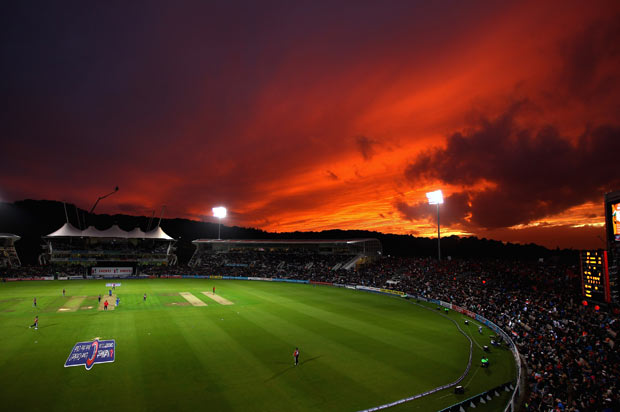
When it comes to cricket, I too often have been the car passenger counting streetlights from the turnpike. Watching the matches whiz by me, looking for the big stories, the big ideas – but those grand and great ideas are few and far between. The magic in cricket is in the little things. The quiet moments when the game breathes. The small stories of success. The perfect delivery. The one great cover drive. The perfect sunset over what cynical me would call just another meaningless One Day International:
Those are the moments that I need to be writing about.
On Twitter I mentioned that I was out of things to say about cricket. But that is hardly the right case. I just need to start seeing the forest for the trees.
Or, I guess, vice versa, in my case.
Stop looking for the big picture – and look again at the small picture.
I often whine that cricket is too infinite for my American sensibilities. But that’s just not true. Cricket is just as finite as any other sport. We just need to look for the mundanity that gives it its ending and purpose. If we take too wide a view, we miss it.
That’s what two of most favorite bloggers – Gary Naylor and Jon Hotten – do. Find those small moments – those little moments of magic that make this game what it is, that give it depth, and pattern, and meaning – and write about them.
And so that is what I am going to do.
I am going start by, ahem, live tweeting – of all things – a Big Bash League match. Adelaide vs Brisbane. 20:45 eastern time here in the states.
In July of last year I wrote this post lambasting Cricinfo for its online gambling banner ads.
An excerpt:
Therefore I call on Cricinfo to cease doing business with betting websites. I know their money is green, and I know that times are hard, and I am sure there is the aforementioned firewall that protects your editors, but for a site that focuses on cricket to do business with a gambling website is quite simply the wrong thing to do.
In the same post I also enquired as to how my fellow bloggers would react if they were offered ad money from an online gambling organization.
Again, an excerpt:
People from several sites (Alternative Cricket, CricketEurope, and Deep Backward Point) popped up on Twitter and mentioned that they had been approached by betting sites regarding advertising but have turned them down. Andrew Nixon of CricketEurope went on to say that they instruct their networks not to serve betting related ads.
Finally, Alternative Cricket said that while they agree with my sentiment, they disagree with my reasons. They turn down betting related ads (for not a little amount of money) because their core audience is young people in India and they do not want to be responsible for getting a kid hooked.
Are you listening, Cricinfo? There are bloggers out there who do this for free or for very little money and they are turning down betting ads…it’s high time you did so, as well.
Finally, today I received the following email with the subject line Advertorial/Post Link Enquiry for https://limitedovers.wordpress.comfrom a Micah Davis of Marketers Unlimited:
Please correct me if this is the wrong email address for this subject.
I work for Marketers Unlimited, a marketing agency affiliated to the online gambling industry and I am currently looking to promote one of our client’s sports betting section by a blog post or article with a link to my client’s website.
I have seen there are sections on your site where you can place the news/article with my client’s link on it. Is this possible?
If that’s something you would do, please let me know your offer and I am more than willing to discuss further details.
I hope to hear back from you, preferably with a favourable response.
I am not going to respond to Micah because, well, for one thing the above feels a bit like a scam to me and also, of course, because of the high moral standard maintained here at Limited Overs.
Seriously, though, it gave me pause. ‘Should I write her back?’ I thought for a second. ‘At least see what this is all about?’
But I am not going to. If it is wrong for Cricinfo, it is also wrong for my puny little blog. And so, again, I ask: are you listening, ESPN?
2013, despite being a rather eventful year for cricket, can be summed up in just two words: Ashes and Sachin.
Looking back over my blog – and while I freely admit that is a poor barometer – but when it comes to things actually happening on the field of play, those are the only two things that happened.
The Ashes. And Sachin.
I am speaking in hyperbole, of course, as there were other tours and matches and leagues and tournaments that produced thrilling chases and jaw dropping conclusions and brilliant stands. And there were other players that retired this year. Not just Sachin. Players like Kallis. And Swann. And Ponting:
And the players shake hands..Surrey declare on 395-8…and Ricky Ponting ends his First Class career under blue skies 169*
And so really, maybe it was truly the year of Test Cricket and Retirement, not just the Ashes and Sachin.
And therefore, maybe, cricket in 2013 can be summed up in one day. July 11, 2013. Day two of the Ashes Test. The day Ashton Agar scored that remarkable 98. And it was also day four of the last First Class match ever for one Ricky Ponting.
Test Cricket. And retirement. The entire year summed up in one sentence and two tweets:
Two images remain from today, one of a 19-year-old lad who may already have played the innings of his life and the other from a 38 year old man who has no more left to play.
But that discounts the Champions Trophy, which really held its own as a 50 Over tournament and gave India and Dhoni yet another piece of silverware.
And so maybe it was the year of Cricket. And retirement.
But then again, that’s every year. All of them blending together. Until we all forget who retired what year and who retired the other year. Or if that 150 from that one player happened in Melbourne in ’03 or in Sydney in ’04. Cricket just keeps chugging along. Unaware that we have decided to arbitrarily flip the calendar over. But 2013 did produce those two indelible moments above, and those are the moments that I will know forever took place in the year of our Lord, two thousand and thirteen.
*
Well, those two moments and Sachin’s 74 against the West Indies in Mumbai, of course. But that one’s a no brainer:
And the bus was gone. So was Sachin in the only way I’d known him. Never ever again.
– Subash (aka The Cricket Couch) from my favorite blog post of the year
*
On the site, this was the year I invented the Twitter Strike Rate. And it was the year I linked Sachin’s career to my dad. And it was the year I wrote my favorite sentence ever:
There was no talk of war in the pubs or in the streets or in the House of Commons – war instead fell like a hammer from the sky. (Full post)
I also wrote an Open Letter to American Sports Fans. And posted daily recaps of each day of the Ashes – an exercise which I found both rewarding and phenomenally difficult. It was inspired by Gideon Haigh’s book about the 2005 Ashes series – which was more or less just a collection of his newspaper articles from the time. He wrote about every single day. Plus recaps and previews and travel logs. It was, like I said, inspiring, but it also taught me how difficult and relentless sports journalism truly is. Yes, it was Haigh’s JOB, but it is not an easy job by any means.
And, well, a bunch of other stuff. 131 posts according to WordPress. Which is a lot more than I thought there would be. Stats and summaries and posts about football and baseball and history and religion. A pretty good year overall, looking back.
Finally, it was my best traffic year ever. By far. Thanks to everyone for reading, commenting, retweeting and reblogging.
And that’s that. It’s all over. Australia have won the Ashes. And the back to back five Test series we have been drooling over since July are all but done.
Sure there are two more Tests, but like too many cricket games these days, they are meaningless matches.
The Perth Test, though, reminded us all why we love this game. A deteriorating pitch, brave men making one last stand, bowlers showing us why they are the professionals and we are the bloggers, all on a sun washed and brilliant green underneath an expanse of blue on the far edge of the other side of the world.
It’s a great game, Test cricket. And I am a little down that the Year of the Ashes is now done – and its ending cast a pall on my entire day. From Ashton Agar to Ben Stokes. It’s been a long arc that bended toward brilliance – often cracking but never breaking – finally settling in Western Australia for its final act.
The end.
*
When series end, the BBC or Sky or whatever will show a a highlight reel of the series with a musical accompaniment as it rolls its long form credits.
And so I bring you the highlights from all of my posts about the two Ashes series.
But first, your music:
And now, the highlights:
*****
14 wickets fell at Trent Bridge today in what was a thrilling day one of the first Ashes Test.
And as Ponting’s first class career was ending, Agar’s was launching into the stratosphere. A poetic end for what was a wonderful day for Australian cricket on the shores of England.
Yesterday Australia were sailing along, tonight they are lost in a deep, dark pit.
In Shakespearian dramas, the fifth act bring us redemption, resolution, and retribution. Let us hope tomorrow brings all three of those to the great stage that is Trent Bridge, that is the Ashes, that is Test cricket.
In the end, Jimmy Anderson proved too much, Haddin edged to Prior, and England celebrated like they had just won the World Cup.
Australia, England, Australia.
I am one of those Americans.
It is boring and it is slow, but it is also painfully and thoroughly and demoralizingly and tortuously effective.
Nightmare scenario for Australia…
And we’re back…
Otherwise this series is going to fizzle out like a doused campfire.
But now it is all over. After all of the build-up, all of the hype, all of the brouhaha, all of the sledging, all of the controversy, all of the really terrible hashtags, after all of the press conferences, pre-match interviews, warm-up matches, predictions, and back page after page of punditry and statistical analyses and team selection dust ups and injuries…after months of anticipating…after everything…it’s over. Just like that. On a gloomy Monday afternoon in Manchester. With the covers on the pitch and the players in the clubhouse.
What this might also mean is that this winter’s Ashes Part 2 might actually be a closer contest than most of us think. Australia, at home, with a proper strategy and a proper team selection might end up giving England a run for their money. We shall see.
I guess what I am trying to say is that England would make for a very good legal secretary.
He was not a metronome. He was not a machine. He was a human athlete: flawed, artful, menacing, and brilliant. Over-flowing with contagious personality.
In cricket, there are very few actual endings. The cycles start up again almost immediately after stopping. And so I must say that while the melancholy of ending is there, it’s easier to shake than it usually is. Sometimes, in world cricket, it is nice to be able to put a cap on things for a bit – like we got today in London.
********
The curtain rises on Brisbane, and another Ashes series begins.
It was an inspiring and transformative time – to say the least.
Australia looked cool, stylish, talented. They had swagger and panache. And England meanwhile looked lost.
Confused.
Old.
And then the cricket was just not quite there either.
And since he is wearing the armband, his struggles are notable.
The play never stops ticking over.
Until it does.
Bell can bat forever, but I worry about Stokes, and when Stokes falls the weight falls to an out-of-form Matt Prior, and then the tail. And then it is Tea on day three and they are still 100 runs behind.
Now let’s just hope England can reverse the trend with a miracle today in Perth.
When the whistle blows and the clock runs out, that’s it. It’s over.
The Perth Test, though, reminded us all why we love this game.
****
Thank you for indulging me.
Looking forward here on Limited Overs: I have a couple recap posts on the Ashes I am working on, but I won’t be writing about each day for the final two Tests. I will also be going back to my bread and butter – the Associates – with a tribute to Ireland’s successful world title – and I have a year-end recap in the works, too.
One of my favorite movies of all time is The Fellowship of the Ring.
One of my least favorite movies of all time is The Return of the King.
I disliked the former for many reasons. It’s heavy handed, too long, too slow and Jackson strayed too far from the book.
But mostly I hated it because of all of the false endings. You kept thinking it was over…but it just kept going…and going…and going…
…and going…
*
There are no truly false endings in sport. When the whistle blows and the clock runs out, that’s it. It’s over.
We as fans do invent false endings however. Last night, for instance, when Cook got out for a golden duck, most spectators declared the series over.
But it’s not. It was a false ending. And let’s hope it was a very false ending. That England go on to bat all day. Delay the end for just one more Test.
Let’s not let Cook’s duck be Frodo and Sam surrounded by lava and waiting for the Eagles, let’s hope it is instead the end of The Towers. Let’s hope for many more false endings and new dawns. For I am not ready for this to be over yet.
Not six months since beating Australia 4-0 in England, England are on the verge of going down 3-0 in Australia, to Australia, and in the process lose retention of the Ashes, a trophy they have held since 2009.
**
Two Australian summers ago, Australia whitewashed guests India 4-0, only to lose 4-0 to the same opponent on foreign soil a year later.
**
The above are just two examples of support for an opinion I see daily now: Cricket teams cannot win Tests away from home anymore.
The one major outlier is of course South Africa. They have – just since 2012 – won series in England, in the UAE, in Australia and in New Zealand.
But the question remains: are teams losing more on the road now than in years past? I am not sure. So I did what any dedicated cricket follower would do: I pulled up Statsguru and looked into it.
(Now, of course, if teams are losing more now than in years past, then a more interesting discussion would be on the WHY – but let’s not get ahead of ourselves.)
(Note: there is one major flaw in this data. Statsguru counts Pakistan’s home matches in the UAE as taking place in a neutral venue, so those matches therefore do not have a “home” or “away” team, and are not considered in the data. I did not notice this until it was too late and I am loathe to go back and fix it. If this was my job and I was getting paid, I would do so, but it isn’t and I don’t…so I am not going to do that.)
*
To compare era to era, I am going to use Cricinfo’s W/L ratio – which is simply the number of wins divided by the number of losses. It discounts the draws, unfortunately, but I think it is fair stat to use in this case.
*
Looking first at the last 12 months: there have been 38 Test matches, and the traveling team has won exactly two of them, while the home team has won 26, for a W/L of a dismal .08.
But the last year is too small a sample size. I mean, shoot, India hasn’t even played a single Test – home or away – in the last 12 months. But the last year has seen most teams experience abysmal away form, which is probably why everyone thinks no one can win on the road anymore…but is this part of a long term trend? Or are people reading too much into the last year?
The last five years: Out of 139 Test matches, the traveling team has won 35 and lost 68 for a W/L ratio of .51. Better, but still not great.
In the five years before that (2003-2008) the W/L ratio for the traveling team was .32.
And so in that case, one could surmise that teams are actually getting better on the road, not worse.
Diving deeper:
The last 10 years: .47
The ten years before that: .44
Again, the last 10 years show an improvement of Test teams’ away form, not the opposite, despite all the punditry.
The last 20 years: .45
The 20 years before that: .43
*
Just by simply looking at the above numbers, there is simply no way that one could argue that teams struggle more on the road now than they have in the recent past.
Skewing the data a bit, of course, is the dominance of teams like the West Indies (W/L ratio of 2.0 from 1974 to 2003 – which means they won twice as many Tests as they lost during that time period) and Australia, who consistently won on the road from the 70s through the late 00s.
*
Looking by decade, and going further back, however, the data begins to get interesting:
And so the conclusion here is: teams are losing on the road more than they were in the 50s through the 80s, but not any more so than they have in the recent past (2000 and onward.)
So this is a new-ish phenomenon, but not a brand new one – it is a longterm trend, and not the fault of, say, the IPL.
*
But what (or who) is at fault? Of that I am not so sure…there are probably many answers to that question and they would all be correct in their own way.
My quick-hit opinion, though? Well, I used the word “trend” twice above, and so that is what I think this is. A trend. Nothing more. Due to certain reasons, teams are struggling on the road. Boards and and coaches and players are aware of this, and will make efforts to correct it, and when they do, their teams will start winning on the road again.
That’s my two cents.
Now let’s just hope England can reverse the trend with a miracle today in Perth.
A sorely needed and decent 72 from their captain was the only highlight of their first innings, and now the entire weight of the Ashes rests solely on the shoulders of Ian Bell and Ben Stokes.
Bell can bat forever, but I worry about Stokes, and when Stokes falls the weight falls to an out-of-form Matt Prior, and then the tail. And then it is Tea on day three and they are still 100 runs behind.
All of the above is worst-case-scenario stuff, but none of it is out of the question.
Actually, worst case possible is if Bell falls early. And it is going to be nearly 100 degrees Fahrenheit today in Perth. And that kind of heat – if one is not acclimated – makes everything more difficult and can affect judgment and reflexes. And today is Sunday, so the WACA is going to be a cauldron of noise – as the Australian supporters will know that if their boys can bowl out England before lunch, then the Ashes might very well be coming back to Australia.
But we shall see what happens tonight. In sport, nothing is a forgone conclusion.
*
If – and it is a mighty big if – England can play out this match to a draw, then they will need to win back-to-back matches in Australia in order to retain the trophy.
England won two Tests in a row in Australia during the 2010-11 series of course – but before that you have to go all the way back to 1979 to find England beating Australia twice in a row down-under.
So it has happened twice – in 34 years.
The weight of the Ashes is on England’s shoulders, but so is the weight of history.
However if they can pull it off, it will be their greatest triumph – and it would go a long way toward improving the health of the game in England. And the retention would have every Cricket loving eye on earth watching the fifth Test – which would be great for the game globally.
And so I am supporting England.
I am supporting England because I want a competitive fourth and fifth Test. I am supporting England because retaining the Ashes would be great for this game I love. And I am supporting England because more than anything, Test cricket needs a competitive five-Test series.

 Limited Overs