
Predictions
Over on the Sight Screen, I predicted that the Associates would be THE story of the ICC World T20 group stage.
And, well, I was right.
But not in the way I thought I would be.
The Associates (Ireland and Afghanistan) and fellow minnows Bangladesh and Zimbabwe are THE story (so far) of the group stage, but the story is not one of David slaying Goliath or David even giving Goliath a little scare like I thought it would be, but instead it is the fact the Associates (and Bangladesh, and Zimbabwe) simply do not belong in this tournament.
They are just not good enough.
And while in some ways that really is too bad for the overall future of world cricket, it is unfortunately the hard truth.
All of world cricket was up in arms when the ICC kicked the Associates out of the 2015 50-over World Cup, but now I think we can all see that they had it right, and we all had it wrong. Having the Associates and even low level Test nations in knockout tournaments makes for far too many lopsided matches, far too many dead rubbers, and, well, makes the tournament just simply too long.
And, so, despite my initial protests at the lack of Associate inclusion in the upcoming 50-over world cup, I think the ICC should move to only allow the top eight Test nations into its knock-out tournaments.
The tournaments would be shorter and the matches more meaningful, thereby making the entire tournament more accessible to the average fan, or even the prospective fan.
For instance: ESPN here in the states has been promoting the heck of the World T20, and if by any chance an American has tuned in, all they have seen is a Test nation kicking the crap out of a Minnow, not exactly a great advertisement for the sport, in other words. But imagine if they tuned in and the first match they say was India v England, or South Africa v Sri Lanka? The difference is marked.
And so while limiting the participation of the Associates (and Bangladesh and Zimbabwe) from major tournaments might stunt the growth of the game, I think that more competitive and more accessible and more entertaining tournaments will surely make up for that lack of growth…and then some.
That’s my story, and I am sticking to it.
Now let’s hope this tournament really kicks off during the Super 8s.
And, don’t worry, I won’t be making any more predictions.
*
Refer
Hey, I wrote a post for The Sight Screen, it’s a preview of the Associate nations for the World Twenty20. Check it out!
The T20 World Cup: What am I looking forward to?
Hey, look at that, we have ourselves a World Cup.
As David Hopps pointed out over on Cricinfo, T20s feel tired and listless and tacked on when they happen after a big test series, but when they are part of a tournament all on their own, they take on a whole new life. And so despite the fact that the T20 is my least favorite format, I am quite looking forward to it. And here’s why:
Unanswered Questions:
Will South Africa choke? Can Sri Lanka take full advantage of their home patch? Can England overcome the KP nastiness and repeat as Champions? Can the Associates make some noise? Can New Zealand get past the semi-finals of a major tournament?
All great questions that will be answered over the next 19 days. The questions and answers will make for some very intriguing storylines, and those storylines will make for even more questions: who will be the hero? The goat? The cinderella story?
Tournaments always fascinate because despite our best guesses at what is going to happen, despite all of the statisticians and the punditry, no one knows for sure how it is all going to play out.
The above is not just why we love tournaments, it is why we love sports.
The Associates
Unfortunately, there are only two Associate member nations in the tournament, Afghanistan and Ireland. However, both have a great opportunity to make a significant amount of noise. If one or both can make a run deep into the knockout stages, then that will have a revolutionizing effect on the game. Not just on the T20 format either, but on world cricket overall.
The Cricket
The cricket itself will be loose and fun and joyful. It will be swashbuckling, sub-continental limited overs cricket. Floodlights, humidity, and (hopefully) excitable and large crowds.
Television Coverage
Every single match will be live on ESPN3. And the matches are actually on at “doable” times. Either 6:45am Minneapolis time or 9:45am Minneapolis time.
It’s Short
The first match is tomorrow morning and the final is on October the 7th. 19 days. That’s it. Considering the 50 over world cup stretches on for what feels like months, it will be nice to have a nice quick tournament.
The Grounds
The vast majority of the matches are at either the R Premadasa Stadium in Colombo or the Pallekele International Cricket Stadium. Both are terrific venues and will make for fine hosts.
Respectively:
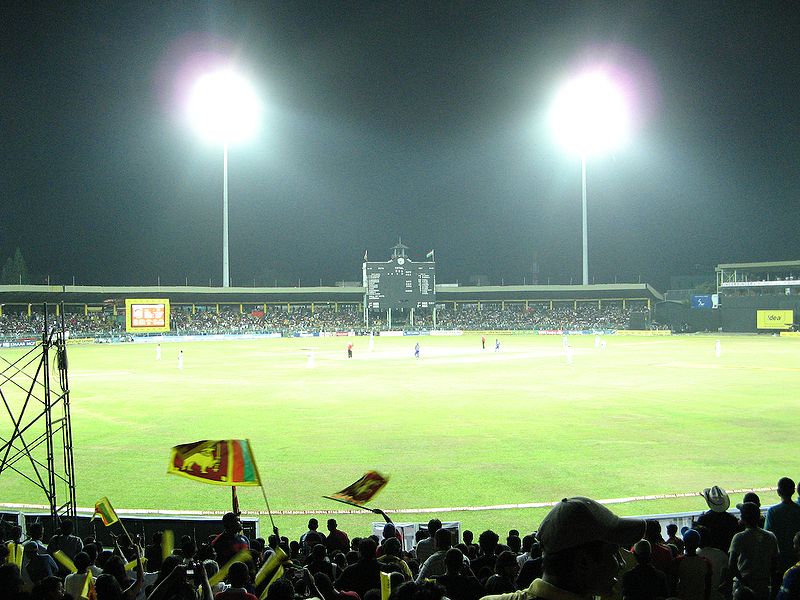

The Two Chucks
Our favorite video-casting duo will be doing shows in Sri Lanka, and they always make everything a bit more fun.
My Predictions?
England will crash out, Ireland and Afghanistan will make noise, and South Africa will win it all.
*
Some light housekeeping: I won’t have a lot of time to write over the next couple of weeks. But I should be back at it soon.
Also, I have started a second blog. It is not about cricket, but I think my regular reader will enjoy it nonetheless. I will pass on the link once it gets its sea legs.
And it’s a hard rain…
My plan today was to watch a bit of the England v South Africa T20 and then write a bit about the upcoming World Cup. But, of course, the match has been delayed and delayed and delayed again due to rain. And so I thought about writing a post about overs lost due to weather, or maybe how many times the D/L method has been used, or how many matches have been outright abandoned due to poor weather.
But after spending an hour or so with Statsguru, it just wasn’t happening.
So I searched for “rain” on cricinfo for a laugh and the results included 520 blog posts, 55 photo galleries, and almost 1600 Wisden Almanak stories, not to mention the countless regular cricinfo stories and match reports.
The first Wisden story to mention rain was a report on a inter-university match between Cambridge and Oxford in June of 1870. The match was supposed to start on a Monday, but the toss was delayed for five hours due to a deluge. The two day match was decided on Tuesday in front of 8,000 of England’s finest. Cambridge won by 58 runs. 14 of the 20 wickets taken were taken, at least in part, by the wicket keepers.
And then a quick look through the galleries led me to this picture from Lord’s during last summers test series against Sri Lanka. An image that strikes dread in the heart of every cricket fan everywhere, surely:
 Cricket and rain. Rain and cricket. Like a silent and sexless arranged marriage.
I pulled up this map of worldwide rainfall:
 Of course, as you can see, the majority of test cricket happens in the darkest greenest regions on the map. Instead of looking to expand to Ireland or in the USA, the ICC should look to include north Africa countries, or the middle east, or even Russia. That would at least delay the spread of the scourge that is killing cricket.
Anyway, enough silliness for today, here’s a song about rain featuring a Englishman performed at a benefit for test nation Bangladesh in 1971 (the year of the first ODI):
Infinity and Beyond
Last night, and this afternoon, I had written about 500 words or so on the ICC rankings. About how the one-day rankings are silly because there are World Cup tournaments in those formats, and therefore, for example, England is not the number one ODI side in the world, India is, because they are the world champions.
But the more I wrote, the more I had trouble believing what I was saying, and the more I wrote, the more I realized I disagreed with myself.
One of the major issues I have with American sports is their playoff systems; specifically with how many teams are able to qualify for the postseason. In the NBA and the NHL, sixteen (!!) teams make the playoffs, for example. Major League Baseball used to have a phenomenal playoff system, but it keeps getting expanded and now 12 teams make the their playoffs. Too many.
Now all of this is great for the respective leagues and the playoff games are cash cows for the individual teams, but it really does take all the effort out of winning a championship. A team can have a medicore season, squeak into the playoffs, get red hot, and win the whole damn thing. It just doesn’t seem right to me. Titles don’t mean what they used to mean.
I admit that, for the most part, the teams that deserve to win based on their regular season play end up winning in the playoffs, but not always. The best example of all this that I can think of is the 2008 Super Bowl: the New England Patriots versus the New York Giants in Phoenix. Now, I am not an NFL fan in the slightest, but I was in New York City during the game and watched it in a packed midtown bar (The Joshua Tree), so I have pretty strong memories of the game.
New York was a 5th seed in the playoffs, after finishing the regular season with nine wins and seven losses, only one game over .500. Meanwhile, New England had finished the season a perfect 16-0. But in the championship game, there were a few bad bounces and a few weird calls and New York won 17-14. The team that finished 9-7 was the NFL champions and the team that went undefeated had to settle for second. It just doesn’t seem right.
It is for this reason that I am constantly extolling the virtues of the English Premiere League (and all similar leagues): every team plays every other team twice, once at home and once away; you get three points for a win, one point for a tie, and zero points for a loss; and the team with the most points at the end of the season is league champion. There is no better test of a team’s mettle. It is the perfect system for deciding a champion.
And that’s why I realized I was contradicting myself with the post I deleted. I like the ICC rankings, I like the fact that they are based on results over the long term, that they are a marathon and not a sprint. The fact that England is the number one ODI team in the world does not mean that India is no longer World Champions. They can both exist on the same plane, in perfect harmony.
All of that said: I still think World Cricket needs a Test Cricket League to run alongside the ICC rankings, as do the one day formats in addition to their two world cups. Similar to the ICC Intercontinental Championships that the Associates have. Not a month long, rock em, sock em tournament, but something with a definite beginning, a definite end, and a definite champion. Cricket is just too infinite. When I think about it too much, it gives me that vague feeling of emptiness and sadness and fear that I used to get when I would lay in bed at night and think about space and time and forever.
*
In other news: Yuvraj is back tomorrow. The match will actually be on at a decent time here in the states, so I hope to be able to watch at least some of it on Willow TV. Looking forward to it.
*
I hate to get all political, but this open letter from the Minnesota Vikings Punter, Chris Kluwe, makes me want to be an NFL fan again. Bloody fucking brilliant, Chris. You are my new hero.
Until next time.
US T20
There has been a lot of talk over the last couple days about the US Twenty20 tournament, now tentatively scheduled to be held in July of next year. According to the article linked to above, it will feature six franchises, three in New York and three in San Francisco. The league is being formed by Cricket Holdings America, which is a partnership between the US Cricket Association and, interestingly enough, New Zealand Cricket.
There is also talk of international players participating in the tournament. And that news is what prompted me to post about the league here on the blog.
First of all, as a cricket fan, I can tell you that the league is going to suck. It’s going to be nothing but “razmattaz” and pop music and plastic pitches. Heck they aren’t even going to call it cricket, they are going to call it Twenty20. The cricket itself will probably be, well, okay. What I have watched of the Bangladesh Premiere League and the Sri Lanka Premiere League tells me that the cricket in the US tournament will be loose and fun and crowd pleasing. The Ashes it won’t be, but it also won’t be super bloody terrible. It just won’t be cricket. If that makes any sense at all.
Cricinfo commentors are dismissing the tournament out right, however. “You’re having a laugh, Cricket Holdings America, if you think your silly little league is going to even make a ripple in world cricket,” is what they are saying.
And I must say that I disagree.
Niche sport leagues work in America. Major League Soccer and the National Lacrosse League are just two examples. Americans like novelty, and they like to drink beer and watch sports. So honestly it really could work.
Major League Soccer of course is starting to take off because of the growth of the youth game over the last two generations. People, like me, who grew up playing the game throughout the 80s, are now old enough and have enough expendable income to shell out for premium cable channels, Arsenal kits, and trips to London. When I am at the local watering hole watching football, the people around are all about my age, perhaps trending a bit younger.
The National Lacrosse League is a very different story. While it is growing in popularity as a youth sport, it has no way near the rec sport pedigree that soccer has. Anecdotally, based on the one National Lacrosse League match I have attended (St Paul versus Rochester at the Xcel Energy Center this past February) the crowds attending those matches are not at all related to young people whatsoever. The atmosphere was not the slightest bit kid-friendly. It was not decidedly anti-children either, but obviously the event organizers were trying to appeal to a more adult and blue collar fan. As such, the crowd consisted of primarily middle-to-working class adults drinking beer. And based on what I saw there that day (sizable and passionate crowd), there is room for more sports in this country.
People say that the American entertainment landscape is just too crowded for another sport. They say that the “big four” of baseball, football, hockey, and basketball are plenty, thankyouverymuch. But personally, I think that is rubbish. Motor sports are just as popular as hockey. And then there is MMA. And golf. And tennis. And the aforementioned sports of soccer and lacrosse. There is plenty of room for cricket.
And so using the National Lacrosse League as an example, I think the US T20 league has a legitimate shot at success. Furthermore, cricket has something going for it that lacrosse did not: a built in fan base. Legions of Southeast Asians have immigrated to the United States over the last 20 years. Not to mention the strong West Indian and Afro-Caribbean culture on the east coast.
Unfortunately, the built in fan base could prove to be a detriment in the end. White America might very well steer clear of what they will perceive as a sport for brown people. I know that sounds awful and cynical, but I am afraid it is true. Even in Obama’s America, racism invades academia, the private business sector, the entertainment industry, and yes even athletics.
The optimist in me likes to think that Americans will embrace the multi-cultural aspect of cricket, but I really doubt it. There is a reason Irish national sports like hurling and Gaelic football never took hold here: because Americans didn’t like the Irish. And it took 30 years for basketball to rid itself of the unhealthy and gross stereotype that it is a sport only for urban black youth. People loved the Boston Celtics in the 80s because they fielded five white dudes. And even more recently Allen Iverson was given flack for his corn rows being too “ghetto”.
That said, lacrosse is the national sport of (gasp) Canada, and Americans love to bag on Canadians, so maybe I am wrong about all of this.
I hope I am.
To sum it all up: the US T20 has a shot, and it should not be so easily dismissed by those in World Cricket.
The cricket itself, however, is going to suck.
Labored Days
It is Labor Day weekend here in the States, also known as the unofficial end of summer. It’s a melancholy time…memories of heading back to school, the smell of burning of leaves, a chill in the air, the coming of winter – but also of fresh starts. Of change. I am always a little sad over Labor Day weekend, but quietly hopeful, as well. Especially this year, as my life is about to become about nothing but change, and hope.
Also the three day weekend is always nice.
Today was also the last international match of the summer at Lord’s. England beat South Africa by six wickets to take a 2-1 lead in the series.
Now of course there is the fifth ODI at Nottingham to come, and the three T20s at Durham, Old Trafford, and Edgbaston, but the last match at Lord’s always gives me that “well, summer is well and truly over” feeling.
*
I had a whole bit here about last matches of the summer at Lord’s, but the direction was not what I wanted to head in. Lord’s has hosted a lot of matches in late August, though most of them in the last 40 years or so. Tests against the West Indies, ODIs against Pakistan, the Ashes. In all of those matches surely the shadows were growing long and there was probably a chill in the air or if it was hot, it was that false, fleeting hot. Autumn heat is different than summer heat. The overall point being: the last match of summer at Lord’s always represents the beginning of autumn.
I mentioned in a previous post that I mark time by the Olympics, but I guess in a lot of ways sport overall marks time for me, as sad as that must sound. The last match at Lord’s means the end of summer; the World Series means a chill in the air and leaves under feet; the Boxing Day cricket and football represents the darkest, coldest days of winter; baseball’s opening day is wet, sloppy late spring; the FA cup final is brilliant early summer sunshine; and then there is the first international match of the summer at Lord’s and the skies are deep blue and high and it’s light out until 10pm and the whole world is alive with summer; and then the cycle starts all over again.
I talk a lot about what sport means to me on the blog, and I always mention how it all makes me feel a little silly sometimes. But it is nice to have something to mark the passage of time by. Some use holidays, or birthdays, or anniversaries, and I guess I use those, too. But special days only happen but once a year, while sport is, thanks to Sky and ESPN, a year long, daily, adventure. I guess what I am trying to say is that it is okay to let sport be important to you. Because it is more than just grown men chasing a ball around. It is time and the passage of time. It is aging. It is change. It is a fresh start. Nearly every single day we open ourselves up and let sport mark the time for us. And that’s not really a bad thing, I don’t think.
Today was late summer, Lord’s, Arsenal at Anfield.
It was not all that, of course, because it was other, more personal, things too. But we all mark time in different ways. When I look back on today, I will remember Podolski’s gut busting 70 yard run and his first Arsenal goal and I will feel the autumn heat on my shoulders and remember how it was during those last few bittersweet days in our current house.
I will remember Bell’s steady knock at Lord’s and I will feel the evening September chill and the hope that is change and fresh starts and autumn.
Time, marked.
God Defend New Zealand
This afternoon, as I was thinking about the 2nd test between New Zealand and India that starts tonight it suddenly struck me: I talk a lot about New Zealand on this blog.
I am not sure if I talk about them more than England, or India, or Australia, or any other major test playing nation, but I do talk about them more than other of the “fringe” test playing nations: the West Indies, Pakistan, Sri Lanka Bangladesh, Zimbabwe…etc. And I really do not understand why this is. I am not particularly enamored with any of their former or current cricketers, and actually I think that their former captain, Daniel Vettori, looks like a complete doofus in his glasses (note: I wear glasses). I have also never visited the country, and honestly know very little about it other than Lord of the Rings, rugby, Flight of the Choncords, and sheep. Oh, my sister has visited there once, as has my friend Arzu, and both have said it is just wonderful. And now that I think about it, the few interactions I have had on Twitter with New Zealanders have been beyond pleasant.
And so it is odd that I write about their cricket so much, and sad that I know so little about their cricketing past, and so little about their history overall.
Therefore, I present to you, dear reader: a brief history of New Zealand, using cricket as a backdrop.
(Two quick fun facts first. Actually, not really “fun” as much as important and awesome):
1. In 1984, at the height of the Cold War, New Zealand banned nuclear weapons. Sea, land, and air space became what are known as “nuclear free zones.” This is the opposite of, say, Pakistan, which takes such odd and immense pride in its nuclear weapons program, and I think a fantastic vanguard for western civilization. More info here.
2. In 1893, they became the first nation to grant women the right to vote. 25 years before the United States passed the 19th amendment.
Now on to the history:
New Zealand was one of the last pieces of land settled by humans, due to its remoteness – initially settlement did not begin until 1280 CE. In 1642 when it was “discovered” by the Dutch, the Maori aboriginal culture was the dominant culture of the land.
Europeans began to immigrate and dominate the landscape over the next 200 years, culminating in a treaty between the British in the Maori in 1837 and the imposition of British Law. It was also about this time that Charles Darwin reported seeing a game of cricket being played by freed Maori slaves.
The first recorded game took place in 1842 in Wellington.
In 1852, New Zealand created its first representational government separate, though still subservient to, British Authority. This is followed by a long period of Maori resistance; resistance that would continue for many, many decades.
In 1907, Britain granted New Zealand Dominion status, 20 years later the national cricket team toured England, and three years later they were granted test status, playing, and losing, their first test to England in January 1930 at Christchurch.
In 1947, a year which saw their cricketers play England again at Christchurch, securing a draw this time, New Zealand parliament passed the Statute of Westminster Act, thereby giving their parliament full control of the country, and the ability to amend their constitution, but not releasing them completely from British control. That would not happen until 1986, when the Constitution Act ended the British right to pass laws for New Zealand. 1986 was also a banner year for the Kiwi cricketers: playing six tests (three against Australia in New Zealand and three against England in England) where they won two and drew four, losing none.
Throughout the 20th century, being a westernized nation, New Zealand experienced many of the same ebbs and flows as the rest of the western world: the influenza outbreak, World War One, the Great Depression, World War Two, as well their own version of a civil rights movement. (I want to read much, much more about the Maori people, and I apologize profusely for not including them more in this brief history than I did). Along the way, their cricket team played in 354 test matches, winning 71 and losing 148. They also had their heroes in Bert Sutcliffe, Jack Cowie, Richard Hadlee, Martin Crowe, Chris Cairns, and the aforementioned Daniel Vettori.
They also have made their share of noise in one-day tournaments: making the semi-finals of the World Cup SIX times, and losing every time. In 2000, they won the Champions Trophy, and in 2007 they made it to the semi-finals of the inaugural World T20 Championship – which they lost.
Finally, one cannot discuss New Zealand cricket without bringing up the underarm incident. That video has over 6.7 million views on YouTube. Amazing.
The last words I will leave to New Zealand’s own Neil Finn and his band Crowded House…this is easily one of my favorites songs from the 80s:
(I would link to the proper video but it makes you watch a Justin Bieber ad):
Two Teams to Watch
After beating England in the second ODI by 80 runs today in Southampton, South Africa are now the number one side in the world: in all three formats.
They also dominate the Player Rankings in the Test category: Amla is the second best batsman; Steyn and Philander are one and two in the bowling category; and Kallis is the number two all rounder.
In other words, no other country comes close to South Africa’s dominance of world cricket over the last two years.
Yes, I know, they have a dismal record in knockout competitions, but that is really the only strike against them. And I honestly believe they will make a great deal of noise at the World Twenty20s next month. If they win in Sri Lanka, then that last strike is gone. And if they have a better year than England did as world Test number one, then they surely will have cemented themselves as one of the best all around sides ever.
They can win the short game, they can win the long game. They can win on friendly pitches and they can win on alien pitches.
And, finally, and least importantly to some but most importantly to the game itself, they do it with style. Who doesn’t like watching Amla bat? Steyn bowl? No one. That’s who.
It is going to be an interesting next 12 months for two of cricket’s quietest test nations: South Africa and New Zealand. The former to prove themselves one of the best ever, and the latter to prove themselves one of the present day elite nations.
I know my latter sounds ridiculous, especially considering how they were dismantled by India in the first test a few days ago, but if they can win a couple big matches (and they have A LOT of big matches over the next year) and if they can get over the semi-final hump at the World Twenty20, then I think all of cricket will need to start paying attention to New Zealand.
The Saffers and the Kiwis: two teams to watch over the next year.
 Limited Overs