A visual representation of how long a Test match is in comparison to other sports…
******
***
Inspiration here.

A Cricket Blog
A visual representation of how long a Test match is in comparison to other sports…
******
***
Inspiration here.
(Note: for the purposes of this post, when I refer to “DRS”, I am specifically referring to the ICC’s Umpire Decision Review System and its rules and guidelines as they stand today. I am not referring generally to a technology based review system. Clear as mud? Good.)
Ah, DRS. What would we all talk about if it wasn’t for DRS? Cricket, probably. You know, things like strike rates and pitch conditions and the like.
But instead, we get DRS as a discussion topic time and again. And with the ICC meet up happening this week in Dubai, we can expect yet another round of debate about the flawed review system.
First of all – cricket and DRS aside – I am of two minds when it comes to technology in sport, as I am sure most fans are. On one hand, I approve of and support the use of technology in officiating – no matter the sport. It works quite well in gridiron football, basketball, rugby, and tennis. Baseball is new to the technology party but it seems to be working all right so far, well enough to expand it starting next season. Association football is lagging far behind other sports, but this season the Premier League instituted goal line technology which is a step in the right direction.
And the above progression toward technology is a good thing because it is important, in the end, to get the call right, and it is worth a couple of delays in the game here and there. We, as fans, have all seen our team end up on the wrong side of a blown call, and so it is comforting to know that most sports have tried to take that out of their respective games. But fandom aside, there is simply so much money involved in sport these days that the financial stakeholders need to have assurances that calls are being made with the upmost accuracy. Otherwise the investment is just too risky, the money leaves, and the leagues collapse.
Get the call right, the technology is there, and it should be used.
That said: my other mind thinks that it really does take all of the rock n’ roll out of the game. I positively loathe those interminable checks for no-balls after big wickets in big games, for instance. And the review system in baseball just feels wrong – like it has stripped away the last vestiges of that great 20th century tradition that was BASEBALL in America.
And sport is great because it is unscripted – it is about human effort overcoming obstacles despite pressure both mental and physical. And the officials are part of that drama; but removing their humanity makes the games slightly more scripted – which is a real shame.
Like I said: two minds.
But then we come to cricket, and the DRS, and the situation becomes even more gray – it becomes three minds instead of two – because DRS, more so than any review system in any sport, is flawed beyond repair. And while some might disagree with that statement – that when used properly it works fine – it is too late, as the system has become so irrevocably controversial that the only solution is throw the entire system out of the ballpark.
Then what though? Go back to letting the umpires on the field make every call – like what we have in County Cricket and other domestic leagues – while waiting for something better to come along? Or does the ICC allow the DRS to limp along until said better system can be introduced?
Tough questions. But these are the questions we should be debating, and these are the questions the ICC should be answering in Dubai this week.
Because while we all might be of two minds with regard to technology when it comes to sport, we should all be of one mind with regard to cricket’s DRS as it stands today:
It needs to go.
**
Note: this is blog post number 400.
Today, in Harare, Zimbabwe beat Pakistan by 24 runs. It was their first victory in a Test match that wasn’t against Bangladesh since June of 2001 when they beat India by four wickets. It was also only their 11th Test victory against any opposition since gaining Test Status in 1992.
94 matches, 11 wins.
To put that into perspective England have played 940 Test matches and won 336.
Ten times the number of Tests played and 30 times the number of Test victories.
And Zimbabwe and England are both part of the exclusive global club that is Test playing nations – and so therefore are, for all intents and purposes, in the same league. Which is kind of ridiculous when you think about it.
But is it really? I mean every team needs to start somewhere. Should Zimbabwe be “relegated” back to Associate status?
Their population is 12 million, which is more than New Zealand’s and Ireland’s combined, and only 10 million less than Australia’s. Meanwhile, fellow minnows Bangladesh have a population of over 150 million.
Population therefore cannot be a factor used in relegation. But what about GDP? Using the IMF’s formula Zimbabwe ranks 132 out of 184 – sandwiched between the economic powerhouses of Armenia* and Macedonia. The next closest Test nation is Sri Lanka at number 69. So maybe we are getting somewhere.
But then Bangladesh comes in and screws everything up: they are at number 59 – ahead of Sri Lanka in GDP but miles behind them on the cricket pitch.
Then again: The United Kingdom (I could not find just England numbers) has a GDP of 2.435 trillion USD, while Zimbabwe’s GDP is currently 10.81 billion USD.
The UK’s GDP is therefore 225 times great than Zimbabwe.
I had to double check that number.
To put that into some sort of perspective for my American readers, including myself: The GDP of the New York City metro area is a staggering 1.2 trillion dollars – 110 times greater than Zimbabwe’s. While even the GDP of lowly Cincinnati is 100 billion – ten times greater.
And using GDP, the UK is to Zimbabwe what New York City is to American cities with a GDP of around 5 billion. Cities like Abilene, TX or Farmington, NM or La Crosse, WI.
Could you imagine any of those cities fielding a Major League baseball team against the likes of the Yankees or the Mets and being anywhere near competitive?
Yeah, me neither. But somehow we are all okay with pitting Zimbabwe against England on the cricket field.
**
Based on the above economic data, should we disqualify Zimbabwe from Test status? Or should we give them more time to play the game and find their footing?
They are not the first newly promoted Test team to struggle in their early years.
Pakistan only won 10 of their first 50 Tests. Sri Lanka only four. Based on that latter stat, Zimbabwe’s 11 out of 94 doesn’t look all that terrible.
Of course, once you drill down on that number, you see that Sri Lanka didn’t have Bangladesh to push around. And Sri Lanka has only had Test status for ten years longer than Zimbabwe – and yet they have played more than twice the number of Tests (222) and won an impressive 66 of them.
Which brings us to the crux of this matter: Zimbabwe has had Test status since 1992, but between September of 2005 and September of 2011, they did not play a single match in the longest format. And so while last year was the 20th anniversary of their elevation to Test status, it was really only like their 14 anniversary. Which make today’s win against Pakistan even more impressive.
**
In the end, despite their relatively poor performances, and despite their economic distress, having Zimbabwe playing Tests is good for the game, because it can provide scenes like we saw this morning in Harare…
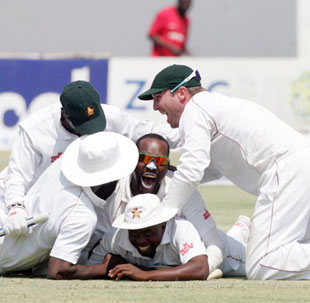
That’s not cold and calculating England ruthlessly dismantling Australia, that’s a group of young, spirited cricketers celebrating the biggest victory of their lives – a victory over a side that just two and half years ago white washed England 3-0 in the UAE.
Upsets are what make sports fun. And you cannot have upsets without teams like Zimbabwe.
But then again: upsets just do not happen in Test cricket. True giant killings in the five day game are incredibly rare. So maybe what we saw in Zimbabwe this morning was not an upset, but a team coming into their own. The ICC gave them time, and now they are, slowly but surely, getting to the point where teams like Pakistan have to take them seriously.
In the end, upset or not, today was a good day for Test cricket.
Congrats to Zimbabwe, I’m looking forward to seeing you among the Test nations for decades to come.
*I am not going to talk about the fact that the Armenian national football team just beat the Czech Republic (#51 in GDP ranking) 2-1 in a World Cup qualifier.
A few weeks ago I mentioned that the best way to reinvigorate the supporters of a struggling team was, quite simply, to win.
But there is another way: buy new players.
Look at Arsenal as of late: they have both won and bought players and now the entire Arsenal universe is awash in positivity.
Beat Tottenham, buy Özil, and their problems are solved. Wenger is a genius again, and the entire frustrating summer and the awful loss to Villa are all but forgotten.
Unfortunately, in cricket, international squads do not have this option. Australia cannot, for instance, reload their squad with a simple influx of cash and make the next Ashes series a competitive one. They cannot go out and buy Amla and Steyn and Ajmal. They have to develop talent from within, and that can take years, even decades. Australian cricket supporters are looking at a long road back to where they were in the 90s and 00s – andas they travel that long road they will simultaneously watch in horror as the sport they love slowly but surely ebbs in popularity down under. There is no other option. They are a national team, not a club side, and so have to rely on the talent their country produces.
That last sentence, of course, as we all know, is utter bullshit.
It’s not a black and white anymore when it comes to national team eligibility rules. Not in football, not in the Olympics, and definitely not in cricket.
Looking just at the England team (which is like shooting fish in a barrel): Ed Joyce and Eoin Morgan are Irish; and Craig Kieswetter, Matt Prior, Kevin Pietersen, and Jonathon Trott were all born in South Africa, as were Jade Dernbach and Stuart Meaker.
All a non-English cricketer has to do to play for England is live in England or Wales for four years.
That’s it.
Farcical.
And England is not alone.
Just two weeks ago Australia relaxed their rules on eligibility when it comes to their domestic tournaments in order to “strengthen their talent base.”
It’s all getting a little ridiculous.
So I propose we throw the entire system out the window.
Oh, there will still be an English Cricket Team that trains in England and whose home matches are at English grounds – and a New Zealand cricket team who calls New Zealand home and a South African side that calls South Africa home and so on – but just like how the New York Yankees are not forced to field all New Yorkers, the English cricket team can recruit and buy players from all over the globe, sign them to a contract, and give them a kit with the Three Lions on the left breast.
There will be an outcry from the supporters at first – they will come across as hypocrites because they have been cheering on Kevin Pietersen since 2005 – but sooner or later they will get used to it – just like Minnesota Twins fans don’t care that most Twins players couldn’t find St. Paul on a map, and just like Brits the world over couldn’t care less that Mo Farah was born in Somalia and trains in Oregon. He was wearing the right colors, so they cheered themselves hoarse for him.
It’s 2013, let’s give up on the ill-fated 20th century dream that was Nationalism and find another ism that is better suited to our modern world.
Sure there will have to be financial fair play rules put into place, and maybe some revenue sharing, or something like that, but let’s give up on the joke that ICC and ECB eligibility rules have become and let’s have the best cricketers play the best cricketers. Let’s not make the West Indies wait 20 years to field another competitive side – because waiting that long has all but killed cricket in the Caribbean.
The world has moved on. It has moved away from borders and nationalistic fervor, and sport needs to move on as well. Maybe this an area where our favorite anachronism, the game of cricket, could the lead way for all international sport.
Hey, a guy can dream, right?
“(b)e comforted in the fact that the ache in your heart and the confusion in your soul means that you are still alive, still human, and still open to the beauty of the world…” – Paul Harding, Tinkers
*
I pulled up Cricinfo this morning looking for blog post ideas. This is never a good sign, as it is a sign that I am out of ideas, and that the post will be a struggle.
When writing is a struggle, it is no fun, and this is supposed to be fun.
At a work happy hour the other night, a work pal was talking to another work pal about reading and how sometimes she felt obligated to read in the evenings – pleasure reading, mind you – and the other work pal said to her (sans benefit of diction), “honestly, if it doesn’t get you excited and you don’t have to do it, then don’t do it – life is too short.”
Lately writing here has felt like a chore – and so in that case I have thought about quitting. Just stopping. If spending time on this site isn’t fun then why stress about it – and I do stress about it – why spend time on it. Just stop. Move on.
In the past few weeks, I have found inspiration and joy in cooking, in Arsenal, in the great fiction I have been reading this summer, in bike rides, in my volunteer work. I have not found inspiration in cricket or in writing, and especially not in writing about cricket.
And so it should follow that it is time to hang it up. To go dark.
I thought long and hard about it this summer, especially since the aforementioned work happy hour discussion, and today I have decided to stick with it. To keep writing, to keep writing about cricket, to keep writing here.
And, yes, I can be a tad dramatic when it comes to this silly little blog, but this space means a lot to me – I am quite proud of I have done here – and nothing worth doing is ever easy. If it was, then everyone would paint and write and sing and bake perfect scones and run triathlons and play baseball professionally. But we don’t all do all of those things. Because doing just one of those things is hard. They are supposed to be hard – that is one thing that makes them worth doing.
If I could come here every day and dash off 1,000 words with ease, then I would be bored within six months. But the struggle, and the work, and the difficulty is what keeps us coming back to these things we love: be they writing, or painting, or fixing up old cars. I need to just remind myself of that every once in a while.
*
Yesterday I was in a bike accident. I am fine, physically, but I have been a real state of melancholy ever since. When I fell I was shocked by how few people stopped to ask me if I was all right. Completely shocked. I was curled up in a ball in the middle of the street, bleeding, and cars just drove right by. I found their lack of compassion for a fellow human utterly disheartening.
Two people did stop, though. They made sure I was okay, got my bike out of the street, and offered me a ride home. I think about their kindness and I get a lump in my throat. And the anger I feel about those who did not stop disappears.
We are all connected, and the world runs on the energy and the compassion we put back out into the world. I think about those two people, those two complete strangers who stopped, and I think: that is the kind of compassion that keeps the earth spinning around. I have been trying in the last year to be a better person, to forgive a little more freely, to check my anger, to say hello to strangers, to smile at passers by – and I like to think that the positive energy I have been trying to muster came back to me yesterday.
The preceding three paragraphs sound like a digression but they are not. The world runs on our energy. It runs on us creating, and struggling, and putting our creations and our struggles back out into the ether. And so while writing a cricket blog might seem completely inconsequential, it is not. It is a small cog in the machine that makes being human worth it – that allows for us to see a fellow human in trouble and stop and make sure they are okay.
That goes for all of you fellow cricket bloggers out there – even those of you rolling your eyes at me – you sitting down and struggling and getting a post out is what helps keep the stars from going out.
*
I guess what I am trying to say is that you are stuck with me for a least a little while longer.
And that’s that. The Ashes are done and dusted. England win 3-0 with today’s play, fittingly, ending in an umpiring controversy, in the London gloaming.
There’s not a great deal more to add at this point. The real dissections will come later from all sides. Kneejerk reactions to Test cricket do not do it justice, and it is always best to take a couple days and let the day, match, and series sink in.
But here are some things we do know:
1. Ian Bell and Kevin Pietersen are two of the most stylish and prolific batsmen on earth.
2. DRS is broken.
3. The bad light rule needs to be re-written
4. Australia are really poor, but not as bad as 3-0 makes them look
5. England’s bowling attack needs work if they are to bring the Ashes back home this winter
6. Cook has proven himself a capable and worthy England captain
7. The series was far more entertaining than it appears on paper
8. Test cricket is not just the heart and soul of cricket – it is the skin and the brains and the bones, too. It is the best format times 1,000.
And now we have that sense of melancholy that always comes with endings of much anticipated events: sport, vacations, long weekends, weddings, holidays. Few things make me more blue than the Olympic Closing Ceremonies and the taking down of the Christmas tree, for instance. I think about where I am now, and where I will be next year, or two years from now, or four years from now. All that is guaranteed is that I will be older, and that is not even a guarantee.
I was very much looking forward to this series, and now it is over. Just like that. And we will all wake up tomorrow and there won’t be a Test match to think about – after 46 days of thinking about the match ongoing, or the match that was, or the match that will be.
The good news, here, however, is that we all get another Ashes in just three short months – not to mention County Cricket and India v Australia and Pakistan vs South Africa and South Africa vs India and on and on and on. And so some of the melancholic wistfulness is missing – which is fine.
In cricket, there are very few actual endings. The cycles start up again almost immediately after stopping. And so I must say that while the melancholy of ending is there, it’s easier to shake than it usually is. Sometimes, in world cricket, it is nice to be able to put a cap on things for a bit – like we got today in London.
And now: back to our regularly scheduled programming.
Watching your team lose is never fun, but it is part of being a sports fan. We just kind of get used to it, I guess. If you follow a baseball team closely, for instance, even the very best teams are going to lose four out of ten games. And only one football team in modern history, Arsenal in 2003-04, has finished a top flight campaign undefeated.
Teams lose. That’s what they do. There is always tomorrow, or next Saturday, or next year.
But watching your team completely unravel, completely fall apart, complete disintegrate right before your eyes – that is something else entirely.
We have all been there at one time or another – that moment when you realize that things have gotten so bad that you are not even sure you want to tune in next weekend to watch them (but you do anyway, of course). Complete disaster. Dark tunnels. No way back.
This was Arsenal on Saturday afternoon at about 4:55 UK time. The team is broken. And at this moment it looks like it is going to be broken for a very, very long time.
And this was, surely, Australia on day four at Durham. The Ashes were already staying in England, but there was still hope for 2-2; hope for momentum into the one-dayers; and momentum into Ashes Part 2 in Australia this winter. Sure, there was still a lot wrong with the squad, but things were looking up for Australia and their supporters. And then Stuart Broad. And then collapse.
Completely failure. Unscalable cliffs. No way back.
Except, there is one way to change everything – and it is really simple: just win.
Australia: force the follow on and win by an innings this week at the Oval and all is forgiven.
Sport is a simple equation: 1) Win and all is fine. 2) Lose once and there’s always tomorrow. 3) Lose twice and the world is ending. But win, just bloody win, and things immediately start to look better – and it all reverts back to #1. The darkness is forgotten. And supporters regain their hope.
There will he an inquest at Cricket Australia after this Ashes series. Heads will be called for and heads will roll. But if Australia can win this week at the Oval a great deal of the pain will be forgotten – and many Australian crickets will be forgiven.
Whether that is a good thing or not is up to you.
But winning is always better.
Some Arsenal fans will hope for them to crash out of the Champions League – a wake up call for the manager and the board. And some Australian fans are hoping for the 4-0 rout – so a similar wake up call is delivered to the players and coaches and selectors.
But I simply do not understand that.
Our team winning is why we all do this. We are aching for unblemished victories in our daily lives – yearning for pure moments when everything, EVERYTHING, is going to be okay – and sport is one simple way – maybe the only way – that we get such moments. Ever. At all. And therefore cheering for ones team to lose is anti-sport. It destroys sport. It renders all of this meaningless.
Winning is always better.
And so, Australia – and so, Arsenal – just go out there this week and win. Win to be forgiven, win for your fans with the shitty jobs and the rotten marriages, win to create meaning in all of this trivial bullshit that is modern athletics, win for your teammates, for the players that came before you, win for us all.
There will be plenty of time for inquests and finding joy in losing campaigns later – this week, just this week: all you have to do is win. Just win. And everything will be better.
Last night I went to a Minnesota Twins baseball game.
It was a perfect night, weather wise, and the seats we had were well above average. And while the Twins are not very good – at all – last night they played technically sound baseball and thanks to a two-hit, complete game shutout from rookie Andrew Albers, they beat the Cleveland Indians 3-0 in a very tidy two hours and 21 minutes.
Albers was just brilliant. He changed speeds at will – one pitch at 67mph with the next at 85mph – and the ball dipped and moved out of his hand and the opposing batters looked completely lost. It was a clinic. A real show. And great fun to watch.
And so despite the fact that the Twins are 10 games below .500, and despite the fact that they are 15 and 1/2 games back in the Central Division, the crowd of about 25,000 at Target Field rose to their feet as Albers took the mound in the 9th inning to try and complete his shutout (a true rarity in baseball these days) and we all cheered every strike and went positively wild when the third out was recorded, and Albers was surrounded by his teammates – hugs and high fives all around.
In that moment, that one moment, no one cared that the Twins are terrible, no one cared about the Twins at all in fact, all they cared about was this 27 year old journeyman left-hander, who was released outright by the Padres in 2010 and who had to wait a year before signing with another team – this soft-throwing lefty from North Battleford, Saskatchewan, Canada, who had just pitched a complete game shutout, in the Major Leagues, under perfect August summer skies, in the shadow of a great American city. It was a pure moment, the kind we only get in sport. And we all forgot about our jobs and our lives – we all forgot about steroids and tax-payer funded stadiums for millionaires – and we all just basked in the moment. And I, for one, remembered why I like sports in the first place.
I love cricket, but because of how removed I am from it, it doesn’t give me what last night gave me. And it probably never will. And that’s fine, of course, I am not going anywhere, but last night it was nice to remember what brought me here in the first place.
*
One other moment stands out: from our seats, we had a great view into the Cleveland Indians dugout. The Cleveland Indians are doing better than the Twins, but they are not very good either: a few games above .500, but seven and a half out of first place, and really, for the most, floundering. But despite the fact that this was game number 119 of a 162 game season, and despite the fact that it was a Monday night in front of a sparse crowd against a team also not in the playoff hunt, every single Cleveland Indian player was up off the bench and standing up against the railing, watching every pitch, for the entire game. It was just something you don’t see much anymore.
Athletes can come across as so utterly jaded these days, so completely and terribly disloyal – and so for once it was nice to see players actively showing a vested interest in the outcome of a what is truly a meaningless game in month five of a six month season.
*
All in all, a great night all around.
http://instagram.com/p/c7trcXj1aj/
http://instagram.com/p/c7uEaCj1bC/
*
Sport, like everything, is all just a matter of perspective. Some people look at Jimmy Anderson and see a relentless bowling machine; while others see an artist, a creative genius at the peak of his powers. Some people watch Ian Bell bowl and see beauty and flair and style; others see a skilled professional who is seeing the ball really, really well all of a sudden.
It’s all a matter of perspective, of perception.
And in the end, depending on our mood, our background, our allegiance, or just about anything, we see what we want to see.
We see what we want to see.
*
I know of a couple of sportswriters who watch games with the sound on mute, so their perceptions are not colored by the commentary team. I am not sure how common it is, but in a lot of ways it make sense to me. Commentators see what they want to see, just like we do, and therefore their perspective has a huge affect on us.
We have all, for instance, at one time or another, gone to a game live and in person only to go home and read the recap and think “was this guy watching the same game?”
And so while you might look at this England team and see artists and poets and flair, I look at them and see a pressure cooker that sucks the life out of other teams. This is not a bad thing, mind you, and it does not mean that England are actually boring or devoid of personality, that is just simply how I perceive them. I see what I want to see. And I see slow suffocation, I see pressure cooker, I see relentless professionalism.
Until today, of course.
Today was different.
Today was something special.
Stuart Broad rolled up his sleeves and went to battle, decimating Australia and winning the Ashes for his country. He didn’t go out there after tea to pile on pressure, he went out there to slit throats. I apologize for the violent imagery. But that’s what I saw today at Chester le-Street.
He was not a metronome. He was not a machine. He was a human athlete: flawed, artful, menacing, and brilliant. Over-flowing with contagious personality.
There is room in Test cricket for every thing. Blocking, slogging, efficiency, and swagger. Pressure, suffocation, wide open spaces, and solitude. Machinery, poetry, and humanity. All of it. Every last ounce of everything possible in cricket. And Test cricket is at its best when it delivers all of the above – and we got just such a match this week in Durham.
Yesterday I was grumpy and bored and frustrated with cricket, with England, with the Ashes. Today I was alive and awake and in the mood. It is all perception, it is all perspective. I see what I want to see. And today I saw magic. I saw the opposite of rigidness. And it was just grand.
And I will admit that my turnaround was not entirely an internal conversion, not even close – the comment on yesterday’s post, plus a couple @s on Twitter, gave me sincere pause – I decided I needed to step back and see the game differently, see England differently – so that’s what I did. And the comments and the @s are why I do this, why I write about cricket, why I write period. I put my perceptions into the ether in the hope that people will react to them – whether it be to challenge me, or agree with me, or whatever – just react. For those reactions to our perspectives are how we learn about everything that is important to us: sports, politics, religion, each other, and ourselves.
*
Congrats to England. Well played all around.
I have to admit that I am kind of sick of writing about the Ashes.
England are relentlessly grinding down Australia…again; on their way to another comprehensive win…again. And there just isn’t much for me to say about that. It’s effective cricket, but it is also boring cricket.
Last summer, South Africa were good enough to overturn England’s style and use it against them (witness Amla’s bone crushing 311* at the Oval), and their bowling attack was superior enough to not allow England’s batting to lull them to sleep.
But Australia is not South Africa. And so you get what we have got here this summer. England sneaking into Australia’s bedroom at night, and slowly but surely suffocating them with their own pillow – and the game and the series along with them.
*
In football, this is called “parking the bus”. Setting up shop defensively, putting 10 men behind the ball, staying organized, working hard, and hoping to grab one on the counter. It’s effective – very effective even (see Chelsea in the Mourinho era) – but it is also boring. And while we can’t expect all teams to play like 1970s era Brazil or early 2000s Arsenal, you do hope for a little flair, a little attack, a little style now and again.
England’s cricketers, however, give us none of those things.
Don’t get me wrong, they are fine cricketers, very good at what they do. But they are a machine keeping time. A metronome. Ticking along over after over. They have none of the swagger and fun and flash we see in Indian cricket, South African cricket, Pakistani cricket. But at the same time, what they are doing is very effective. And they are winning.
And cricket is not a game that too often rewards style over substance like, say, basketball or football. It is a game that rewards pressure, consistency, and rigidness. Unlike other sports, where there is room for magic, cricket is highly organized – six balls per over, 90 overs per day – and so therefore rewards efficient, well organized, detail oriented play.
Play like we are seeing from England this summer.
“Efficient, well organized, and detail oriented.” I guess what I am trying to say is that England would make for a very good legal secretary.
*
All of this sounds like I am giving England a bum rap – that I am calling their style “anti-cricket” the way Arsene Wenger decried, say, Bolton for playing “anti-football”. But I am not. This is my way of congratulating them. They went out this summer with a job to do and they have done it. I love seeing personality and flair on the cricket pitch, but I can also appreciate well organized and efficient cricket – because in a lot of ways, that is how the game is meant to be played.
*
Until tomorrow.
 Limited Overs