We are the robots, part 2

There’s one thing you can say about cricket that you can’t say about most sports: it’s fair. 99 times out of 100 the better time wins. You don’t see giant killings like you do in other sports. They happen, sure, but they are the definition of rare.

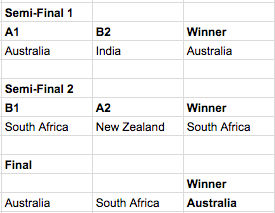
And who the better team is is usually defined using the ICC rankings. And so, as I have done before, I thought I would take the current ICC rankings (as they are today, not as they were when the teams qualified) and see how the upcoming Champions Trophy would play out if the rankings were gospel. I.e. if the team ranked higher always won.

When I did this previously the robots got about 88% of the group stage matches correct (or thereabouts) and three of the four knockout stage teams right (they picked Pakistan which missed out, the West Indies taking their place). They got both semi-final winners right (Sri Lanka and India) and they nailed the final.

Not bad.

So according to the rankings how does the Champions Trophy shape up? Let’s take a look. (This is of course assuming there are zero no-results during the tournament which is of course silly because it’s England in June, but hey this is just meant to be fun.)

Group A:

Screen Shot 2017-05-15 at 8.02.01 PM

Group B:

Screen Shot 2017-05-15 at 8.03.33 PM

Knockout stages:

Screen Shot 2017-05-15 at 8.04.36 PM

And so there we have it. Congrats to Australia.

I’ll check in on the robots during the tournament and see how they’re doing.

#

Robots aside but that India v South Africa Group B match has “match of the tournament” written all over it.

Boycott this

In December of 1979, Soviet Union troops–disguised as Afghani solders–entered the city of Kabul, Afghanistan and led a coup against the internationally recognized government of president Hafizullah Amin, who was killed after the Soviets stormed Tajbeg Palace on the evening of December 27. By next day the coup was complete, the Soviets held Kabul, and Russian tanks, troops, and vehicles spilled over the mountains in an effort to control town and cities throughout the country. It was a sign of unchecked aggression by a nation that most of the world would prefer to stay checked. Most saw the move, which horrified the West, as an attempt for the USSR to ultimately seize control of the entire Middle East and gain access to the Indian Ocean.

The international outcry was swift and severe. Ministers from 34 Muslim nations–including, interestingly, Ayatollah Khomeini, whose newly founded theocracy in Iran was a fierce enemy of most of the West–condemned the invasion and called for immediate Soviet withdrawal. The United Nations General Assembly issued a resolution protesting the Russian action. And the President of the United States, on top of his work with NATO to stem the flow of weapons into the region, famously issued an ultimatum to the Russians in January of 1980: withdraw from Afghanistan in one month or the USA would boycott the 1980 Summer Olympics, due to be held in Moscow the following summer. The Russians stood firm, and the USA stayed home, as did more than 60 other nations. Four years later, the Soviets boycotted the summer Olympics in Los Angeles.

The Russian occupation of Afghanistan, and the ensuing guerrilla war, would last for nine years, one month, three weeks and one day. It would result in the deaths of over 120,000 Russian and Afghanistan troops, as well as the deaths of (estimates vary) at least 500,000 Afghani civilians, but probably a lot more than that.

#

Starting in 1949, the South African government began to issue a series of Apartheid laws. There was the Prohibition of Mixed Marriages Act; the Immorality Act, which banned sexual relations between people of differing races; the Population Registration Act, which classed all citizens into one of four racial categories; and the Group Areas Act, which began segregating the nation’s population based on their predetermined racial category. From 1960 to 1983, nearly four million citizens of color were forced from their homes and into segregated neighborhoods.

The worldwide outcry was not insignificant and notably included an arms and weapon embargo instituted by the United Nations. Also included in the backlash were boycotts of the nation by rock bands, orchestras and, of course, international sport organizations. For instance, four years before the USA boycotted the Moscow Olympics, 26 African nations refused to participate in the 1976 Summer Games in Montreal because the International Olympic Committee refused to ban New Zealand after the All-Blacks traveled to South Africa for a Rugby tour.

Previous to the action in 1976, South Africa had been banned from the 1964 Olympics in Tokyo; in 1968 the United Nations called for an international boycott of all South African sports that support Apartheid (this is the edict that New Zealand, and several other nations, violated); and in 1970 the ECB cancelled the South African’s cricket team’s tour of England after several nations threatened to boycott the Commonwealth Games to be held that summer in Scotland.

Apartheid would last until 1996. It is without a doubt one of the darkest stains on humanity, a stain that will never come clean.

#

Apartheid and the 1980 and 1984 Olympics are arguably the most famous sporting boycotts, but there have been many others. Several nations did not participate in the 1956 Melbourne Olympics for several different reasons; in 1988, North Korea, Cuba, Ethiopia, and Nicaragua boycotted the Seoul Olympics; in 1996, Australia and the West Indies refused to play in Colombo due to security concerns; and in 2009 the England Cricket team cancelled Zimbabwe’s tour because of their government’s human rights abuses.

Every nation pulled out due to various reasons, but they were all justified, or at least logical. Be those reasons geo-political, humanitarian, or the safety of their athletes; Apartheid, unchecked Soviet Aggression leading to a decade long war or state sponsored protestor beatings in Harare. Even less politically sensitive boycotts, such as the ATP tennis players boycotting Wimbledon in 1973 could be seen as attempts to protect the rights of athletes. Sporting boycotts have always been a weapon of last resort, for good reason, as restless populations might see the boycott as a last straw by an oppressive government, and the isolation that ensues after boycotts can be see as detrimental to third world nations getting access to the West’s money and weapons. It is last resort, and the reasons have to be good ones.

India, meanwhile, want to boycott the Champions Trophy because the ICC is making an effort to fix a broken system.

#

Related: BCCI Should Grow Up, via The Full Toss.


Boats against the current

The IPL is happening right now, but I probably didn’t need to tell you that. It used to run in the background like a virus scan but now it is more akin to those constant Adobe software update reminders. Cricinfo, which used to more or less ignore it, is all in, with headline coverage every single day. They treat it now like it is an important cricket league, as opposed to the side show it actually is.

Okay, despite the cheerleaders and the pop music,”side show” is harsh. But really in the end it is just another domestic T20 league, awash in a side of domestic leagues, T20, 50 over or otherwise. Here’s a look at all the other domestic leagues having matches today, just today:

Dhaka Premier Division Cricket League
Pakistan Cup
Royal London One Day Cup
Super Provicinial One Day Cup
Malaysian Premier League
Million Cricket League

Of course, those leagues don’t feature (some of) the best T20 players in the world and aren’t played in the most cricketing mad country of all cricketing mad countries. And so I get it. But the IPL–whether it’s the style of the T20 played or the uniforms or the bombastic television coverage or the money or the corruption–has always bugged me. But it has also always been there. I am not only one of the rare cricket fans who has only known a cricketing world with the T20, I’ve also only known a cricketing world with the IPL. I started following the game in 2007, the first IPL was in 2008. And so it’s always been there, and so it would follow that, unlike old time fans of the game, I would be more accepting of it. And while this is true for the format, it is not true for the IPL.

I think one of my major complaints about the league is that all other international cricket pauses for seven weeks while the tournament is taking place. Not only is it the only domestic league in cricket in which international cricket pauses so it can take place, I think it is the only such league in any sport in the world that takes precedent over their international cousin. Could you imagine UEFA taking a hiatus from its endless series of friendlies and qualifiers because the English Premier League was deemed more important? Me either.

But bringing up the English Premier League brings up the point that cricket is also the only team sport where the international game is top dog and the domestic game is loved but that love is localized. There very few fans of County Cricket who exist outside England or Wales, and fans of specific county teams rarely exist outside of their county. And maybe the IPL is a sign that cricket is finally starting to move to a format that more closely resembles other team sports, where the domestic game is on top of the pile except for every four years when the World Cup happens (except if the trend continues I think it will be, for cricket, as it is for basketball, the Olympics which become the most important international tournament).

I don’t think this is a good thing.

If this happens, if domestic cricket taking precedent becomes the rule instead of the exception, and we are heading in that direction, then cricket will become a brood of international mercenaries flitting from league to league to league every few weeks. Never wearing the same shirt twice, constantly switching allegiances, with all the money going into the pockets of cricketing bureaucrats instead of back into the game. Meanwhile the international game–yes, even The Ashes–will suffer and, slowly, quietly pass it into the past. And lots of people that work at Cricinfo seem already resigned to this fate, which is why they have latched onto the IPL with both barrels. But if the international game loses out to the domestic game, then I think that will be what finally kills off cricket for good. And that, I think, more than any other reason, is why the IPL leaves me with a bad taste in my mouth. It’s a harbinger of doom.

That is not to say that domestic leagues shouldn’t exist or should be weak. I believe the opposite is true. Domestic leagues in every cricket playing country on earth should be rock solid and entertaining and popular. They should just take a backseat to the international format, for the good of the game.

But all of that said, all the doomsday rhetoric and anti-IPL musings, I also believe–and I know this negates everything above–that you can’t kill cricket. Cricket is bulletproof. Cricket is like our current buffoon of a President in that every time we all think it’s down for the count, it comes raging back to life. I hope that’s true forever. And that’s why every time I write about the death of the game, I add one simple caveat: I hope I’m wrong.

For instance: Yesterday was Sachin Tendulkar’s 44th birthday. He’s only 44! He played so long that if you had told me he was 50 or even older I wouldn’t have batted an eye. I was reading about him yesterday and realized that he was only 19 when he played that one season for Yorkshire. He was their first player of color, and one of a very players that didn’t come Yorkshire proper. It was 1992, and that makes this the 25th anniversary of that summer he spent making waves across England. And while 25 years might seem like a lifetime, it is also yesterday. But so much has changed in the last 25 years, in domestic cricket, in international cricket, in England, in India, the world over. As Oliver Brown put it in this wonderful piece on that summer Sachin spent in Yorkshire, it made be only a handful of years, but the photos are already “bathed in sepia.” So much has changed, but cricket has soldiered on, bow beating against the waves. In fact it is one of the few constants in a world that lacks them also completely. And that is something worth celebrating, and that’s why I am not going to worry too much about the IPL. QED.

#

A domestic USA television/streaming update: a lot of sites out there list Willow TV as the network that’s covering the Champions Trophy in the USA. This is only half true. Willow TV will be showing the matches on its television channel, but the matches will be streamed on ESPN3, not on Willow dot TV, Willow TV’s online component.

This was hard, it was fun

On April 9 Facebook reminded me that it had been ten years since I smoked my last cigarette. This also meant it had been 10 years since I first discovered the sport of cricket, as I often credit my discovery of the sport–and the 2007 World Cup that was happening at the same time–as one of the reasons I was able to quit successfully. It gave me something to obsess over that I did not associate with smoking.

A couple years later I started this blog, and for almost five years it was my daily companion. And while I don’t post here anymore, I still come back here a lot. I read my old posts and the old comments and it is part nostalgia and part embarrassment and part awe in what I was able to accomplish in this space.  All it took was writing a post every single day. I look back on the earlier posts and juxtapose them against the later posts and I see growth not just in my understanding of the game and all its intricacies, but in my writing too. Which was why I started the blog to begin with.

But I moved on. I wanted to do other things. I didn’t want to write about cricket anymore. Unfortunately, without having this site as my backbone, my foundation, I stopped writing altogether. Up until about a year ago, that is, when all of a sudden, for reasons I cannot explain, I started writing again. The words flowed and flowed. Medium posts and short stories and one unfinished novel and one finished novel and now a memoir about the 13 years, six months and eight days I was able to spend with my father.

When I say that I finished a novel, I mean I “finished” it. There’s nothing more I can do with it. It’s a good story, I think. It’s a love story at its heart but it’s also about how it is when someone we love dies and how sometimes good things happen that wouldn’t have happened if they had lived, and it’s about coming face to face with that irony. It’s about art and the meaning we store in objects. And yes there’s cricket in it. But’s also deeply flawed and so I am not sure what to do with it. Someone else needs to read it, and provide critique, but I don’t think I have the intestinal fortitude to go through that. And so I am taking a break from it, which is what brings me here.

I still follow cricket. I don’t watch it much outside of highlights and old YouTube clips. And I mostly steer clear of stories about corruption and everything that’s wrong with the game, preferring to stick to recaps and scorecards. But lately I have found myself once again getting deeply interested in the game, watching hours of old matches on YouTube and watching Flintoff bowl that one perfect over again and again and remembering what a great, just great, game this is. More than anything though–and maybe this is because the ODI was my introduction to the sport–I am incredibly excited about the Champions Trophy taking place this summer. Yeah, I know, it’s pointless and bloated but c’mon it’s going to be fun and I can’t wait.

And so I came back here. To write about this game I remembered that I loved, and to get away from the book I don’t want to think about anymore, and to keep writing in a space where I feel comfortable. I can’t promise daily posts, but I am holding myself to two posts a week, starting now, and then daily posts during the Champions Trophy. After that who knows? But I’ll cross that bridge when I come to it.

It’s good to be back. What’s everyone been up to?

England v The West Indies

England’s first three settlements in the Caribbean were failures. Colonies in St. Luica, Grenada and Guiana folded rapidly. But in the 1620s, settlements in St. Kitts, Barbados and Nevis took hold and soon the entire region became one of Britain’s most lucrative colonies – mostly thanks, sadly, to sugar plantations run with slave labor.

The African slave trade would last for almost two hundred years, and wasn’t finally outlawed in the British Empire until 1807. During that time, the Royal African Company would transport 3.5 million African slaves to the Americas, which accounted for a third of all slaves transported across the Atlantic.

The mortality rate for slaves during the crossing was one in seven.

One in seven.

But the trade was hugely profitable for those that happened to be born the right skin color, in Africa, in England (particularly for port cities like Liverpool) and in the Americas.

The trade greatly increased the percentage of the population with African descent in the Caribbean – raising from 25% in 1650 to 80% in 1780.

Slavery was finally outlawed in the West Indies altogether in 1839. 215 years after the first colony was founded, and 26 years before the United States ratified the 13th amendment.

It’s a sad and tragic mark on our global history.

*

Following World War Two, England was bankrupt – and with anti-colonialism on the rise and not wanting to sink themselves into costly wars – they began a policy of peaceful disengagement from their colonies.

Most of the Caribbean declared and were granted independence in the early 1960s, with Guyana being the last in 1966. Several colonies, of course, chose to stay under British rule, but for the most part, the Caribbean was on its own. Finally. After 360 years.

*

The first cricket matches took place in the Caribbean in the early 19th century, brought over from England by the British Military, which had cricket pitches integrated into their forts.

At first, the game was a tool of imperialism, a way for Africans to learn more about English society. But soon the game became – famously – a tool for revolution, for disproving the fallacy that one race is superior to another race. For throwing the shackles of colonialism off and beating the colonizers at their own game, on their own patch. It was the great unifier of the region, and cultural touch point for West Indian people from Guyana to Jamaica.

*

The West Indies have played its former masters in two tournament finals: The 1979 World Cup and the 2004 Champions Trophy, both hosted by England. And the lads from the Caribbean have won them both.

On Sunday they will meet in a final for the third time.

Nearly 400 years after British sailors first walked up the beaches of St. Kitts, the former Empire will play its former colony on the other side of the world on the home patch of another former colony.

*

On the field, Cricket is a complicated game. It’s one of the reasons we all like it. The sport is filled with back-alleys and tunnels and twists and turns and cloverleafs. But off the field, the game – with its colonial history – is just as complex, and makes the games even more riveting. On Sunday, The West Indies, with its team of mostly Africans, will face England, a team of mostly whites. And while the themes of colonizer vs colonized and slaver vs slave seem rote, they add both to the complexity and richness of the game.

West Indies have only been playing Test cricket since 1928, but in more than one way, they have been battling England since 1602. And that is just one tiny subplot in a match – and a sport – that is full of sub-plots. And will be just one more thing for us all to think about as Chris Gayle of Kingston, Jamaica strides to the crease in Kolkata – a city that under British rule had a Black Town and a White Town – to face the blue eyed Peter Willey of Northampton, Northhamptonshire.

Layers upon counter plots upon layers.

That’s cricket, ladies and gentlemen.

On Ashton Agar

Two images remain from today, one of a 19-year-old lad who may already have played the innings of his life and the other from a 38 year old man who has no more left to play.

-The Old Batsman (full post)

Around the 12 or 13th over of Sunday’s India v Australia match, a substitute fielder came on for an Australian bowler. I think the subbed bowler might have been Faulkner, but I am not entirely sure. It’s beside the point. The point is actually who the substitute was: Ashton Agar. He of the once-in-a-lifetime 98 at Trent Bridge during the first Test of the 2013 Ashes.

For those that don’t remember – all two of you – Agar, a 19 year old kid making his Test debut in the simmering cauldron of the Ashes – came in to bat at number 11 when Australia were falling off a cliff at 117/9. He then didn’t do much but bat for two runs shy of a debut Test century and the highest ever partnership for the 10th wicket (since broken). He kept Australia’s hopes alive in the first Test only to have them dashed in the end, falling 15 runs short of the rare successful chase of 300-plus runs.

It was a truly magical innings for a 19-year-old on debut, and his grace under such extreme pressure made me think Australia had itself a real special cricketer on its hands. But then he struggled with the ball, fell ill, returned home before the fourth Test, and hasn’t made a Test appearance for Australia since.

In the years between his 98 and his substitute fielder appearance on Sunday, he has played a lot of domestic cricket and appeared in a handful of ODIs. But all that promise that was on display that day in Nottingham has not re-appeared. (However, it goes to show the Australian team’s faith in his ability to handle pressure by throwing him into the field in front of a hostile ground in what was for all intents and purposes a knock-out match.)

And so it seems we have what The Old Batsman predicted above: a 22-year-old kid who played the innings of his life when he was only 19, and while he might very well prove someday to be more than just the answer to a Pub Quiz question, for now he exists forever 19, forever smiling the perfect smile of a kid “in love with absurdity of it all.” And that’s okay, I think. Well, it’s okay, of course, but it’s also a little tragic to peak so young, to be 22 and know that your best moment on a cricket pitch is always behind you, lurking.

But, that said, just as it’s better to have loved and lost, it’s also better to have scored a 98 in an Ashes Test than to have not scored a 98 in an Ashes Test – no matter the age you were when it happened.

I just hope that those two runs don’t haunt him too much.

*

Forgotten from that day due to the Agar Show was the man at the other end of the crease: Philip Hughes. Hughes who batted for nearly 4 hours that day, scoring 88 off of 111 balls. Hughes who would die so young and so tragically not 18 months later.

While Agar’s story might be tinged with a bit of melancholy for potential and promise never fully realized, Hughes’ story is of course far sadder. That said, both stories serve to remind us of one very important point: what happens off the cricket field is far, far more important than what happens on it. Agar’s life will not be defined by what happened at Trent Bridge, just as Hughes’ loss is not felt at the batting crease as much as it is felt in the hearts and minds of those that knew and loved him.

*

A footnote: in the quote above The Old Batsman is referencing the fact that Agar’s knock came on the same day as Ricky Ponting’s final First Class innings.

And to quote The Old Batsman one final time:

The gap between it and Ponting’s at the Oval, that brief window of time in which sportsmen have their lives and all of us are young, closes before anyone notices. What a day it was today.

Which is one more lesson that Ponting and Agar and Hughes and, well, cricket can teach us: life is short. Damn short. So enjoy the moments we are given, for they – along with the people we share them with – are always gone far too soon.

On Kohli

About halfway through India’s chase today, I made the rather bold claim that Virat Kohli is the most exciting athlete on earth right now. And by exciting I mean best, most entertaining, and the most gifted. This is not a new sentiment for me, it’s actually something I have been saying for years.

Now, no one who watched today’s match could possibly disagree with me. He was simply brilliant. He came on in the 3rd over, and calmly guided his squad through the middle of the match. Scratching out singles with a hobbling Yuvi, and caressed the game at easy rate of a run a ball. There was a lot of pressure on him to stay in the game, and he shouldered it well.

After Yuvraj fell, Dhoni took over as Kohli’s partner, and absorbed some of the pressure, allowing Kohli to bat with a bit more freedom. Singles became twos, and he teased us slowly with the occasional boundary. But with 39 needed of just three overs, he exploded into life, delivering such a shock and awe display that it left us all breathless – even Dhoni apparently. It was so quick yet so amazing and beautiful that when it was over Twitter was surprisingly a little quiet as we all basked in the afterglow of such a perfect innings.

It was like being made love to.

And everyone in the stands, and those of us watching in India, America, England, wherever, we all knew that we had just witnessed something very special. Very, very special.

And everyone in the stands, and those of us watching in India, America, England, wherever, we all knew that even when the match was seemingly drifting Australia’s way, we were all sure that as long as Kohli was at the crease it was India’s match to win. And win it they did. With such a flurry of boundaries that sitting down became impossible, no matter if you were neutral, Indian or Australian.

So, sure, it’s easy to backup the claim that he is the world’s best athlete to a cricket fan, but what about supporters of other sports?

Can one make that the claim – apples to oranges – that he is better than Messi, Ronaldo, Curry, or Newton? I think so, I think he is. The way he put 1.3 billion people on his shoulders today and carried them across the line proves it. No one faces the level of pressure that he faces, and to respond with such aplomb is the mark of a truly amazing athlete. Sure, you can have all the talent, but until you do it on the biggest stage with the most on the line that you could possibly imagine, you have proven nothing.

Let’s see Messi do what Kohli did today. Let’s see Ronaldo carry an entire nation. Let’s see Stephen Curry make love to a billion people all at the same time.

If you want to see the absolute best that the sporting world has to offer, then you need to watch Kohli in a run chase.

Full stop.

*

A few other notes:

  • I love Yuvraj, his story is one of my favorites. From World Cup winner to cancer ward to triumphant comeback. But his decision to stay in the match with his bum ankle very nearly cost India the match. He should have gone off for treatment. Those early singles should have been twos and the increasing required run rate put a lot of undue pressure on Kohli – the man that the team needed at the crease – in the middle innings. Thankfully, all is forgiven thanks to the Kohli Show.
  • Yesterday I resubscribed to Willow, after unsubscribing back in 2014. (This was when ESPN had all the best series, so Willow at the time wasn’t worth the $15 a month.) And I must say I was highly, highly impressed with their stream today. Not a single hiccup. Not a single one.
  • I have never liked Australia and I am always happy to see them lose. I think this is because they have ruined two World Cup Finals for me (2007 and 2015). These were matches I was so looking forward to and Australia just swaggered in and won them both running away. Boring. Thankfully we won’t have to worry about them any more in this tournament.

Outlier

I came to cricket late in life. A full grown adult who hadn’t the slightest of knowledge about the game. But that is so utterly rare in sport that it’s almost unheard of.

Sports are, at their core, games for little kids that certain grown ups are able to play for a living. And that’s why we love the sports that we bonded with as children. I grew up around baseball and soccer, so those were the games that formed the core of my athletic fandom.

In other words, convincing grown up American adults to embrace the sport of cricket – or any sport that they didn’t grow up playing – is incredibly difficult. The Olympics are one exception, but that’s only every four years, and between competitions most people could not care less about figure skating, track & field or, say, water polo.

And with that in mind, the only way to grow the game in this country is start at the youth level. Get kids – all kids – playing the game. USACA doesn’t matter. The ACF doesn’t matter. The national team doesn’t matter. What matters is the kids, playing the game, bonding with it, and creating a lifelong love for it.

And that is exactly what’s happening in small pockets all across America. I look at this picture and I get chills:

BEST6
Photo by Jamie Harrison. Used with permission

(More photos and the full story can be found on USYCA’s site.)

You get the kids, and the game gets a solid footing, and from that launching pad anything is possible.

Look at what’s happened with soccer. The game was practically non-existent until the mid-1970s in this country. Then parents saw the game as a safe little sport for their kids to play, and all of a sudden every kid in every city in every state was donning shin guards and learning how to execute a throw-in. Fast-forward 30 years and we are all grown up, are getting our kids into the game, and using our incomes to attend matches, fly to Europe and purchase spendy cable packages.

The above is the blueprint for cricket in America. And it shouldn’t be a hard sell. It’s a safe game at the youth level, and with the current backlash against sports where concussions are common (read: all of them), youth cricket is one that parents can feel safe signing their kids up for. And with the “global village” our world has become, a lot of parents want to expose their kids to things are outside of their cultural bubble – cricket is one of those things.

Get the kids into the game, and in just one generation we might have a team at the T20 World Cup. Wouldn’t that be something? I am going to do what I can to make it happen, and you should too.


On the Teevee

And what do you say about a Test match like that? I have no idea.

It had everything. Peaks, valleys, hidden tunnels. Heroes, goats, villains. From Stokes setting Lord’s alight and reminding us all of Flintoff at Edgbaston; to Moeen Ali making the catch of a lifetime on the boundary; to Jimmy Anderson searching and poking and prodding; to the Kiwis showing all the heart in the world in an attempt to just…hang…on.

The match was five perfect days of everything Test cricket has to offer the world. And for five days in London the format reminded us all that not only is the game’s longest format its most entertaining, but when played like England and New Zealand played it, a Test match is the pinnacle of ALL sport. It can be the most entertaining game on earth when played at its zenith.

And what else you say about a Test match like that? I have no idea. So I will leave it to the professionals to offer proper tributes, and instead use this space to talk about one very personal aspect of this match:

I was able to watch it on tv.

Not on a computer. Or a tablet. Or a smartphone. But on an actual television set. Like an actual human being.

I had finally gotten around to connecting my Xbox to the Internet, and I downloaded the (free) ESPN3 app, and – huzzah! – cricket live on the telly.

The stream was crisp, clean and perfect, with only the occasional hiccup. And so I was able to watch on while on the couch with a cup of tea instead of at my desk in a desk chair with headphones on.

As you probably know, the game is different when watched on a television. And it was almost as if I was seeing the game again for the first time. Actually not even almost as if, it was as if I was seeing the game with fresh eyes, different eyes, new eyes.

I was able to see the little moments in the game that you miss when watching on a stream on a computer. The flight of the ball, the looks on the players’ faces, the foot movement of the batsman and the subtle differences in fast bowlers’ run ups.

Cricket is a game of many facets. It is millions of small moments that create a detailed landscape when laid on top of one another. And sure the game is interesting and entertaining when you only can see the landscape, but it becomes infinitely more so when you are able to see the individual blades of grass.

To say it was a more entertaining experience would be a rather large understatement.

And for the first Test match I’d been able to watch on television to be that Test match? Well, the stars were aligned, surely.

Checking ESPN’s schedule, it looks like they have the entirety of the New Zealand tour available to watch, plus a healthy dose of County Cricket. I do not, however, see the Ashes. It would be a real shame of tWWL made that series a pay-per-view like they did with the World Cup and the IPL. We shall see.

If anyone has any inside information on that, I would appreciate it.

Until then, I am going to bask in the glow of the perfect Test match for a little longer, then get ready to do it all over again at Headingley.

I will save my whining about the two Test series for another day (probably tomorrow).

The cricket for the corruption

But watching Root and Stokes battle back at a zesty five runs an over in glorious sunshine was a reminder that cricket – and all sport for that matter – is often best enjoyed by unhooking from the issues that blight its administration and simply drinking in what unfolds in front of you.

Ali Martin, via The Guardian

That’s it right there, isn’t it? Not just sport, but life. Seeing the forest for the trees. Separating what’s really important from what is simply trivial. Being able to sit back and simply see the beauty that exists in this big, old, sad world.

And cricket – on a nearly daily basis – brings us wide swaths of that beauty. In moments both big and small, it brings us the ballet, the drama, the grit that is inherent to sport

It also shows us – outside its lines – humanity’s ugly side. Its corruption, its greed, its hypocrisy.

But like in life, we are better off if we can take a few moments each day to forget about the horrors that exist, and focus on the beauty that exists in tandem with the evil. A Beethoven piano sonata, a Donna Tartt novel and, yes, a cracking counterattack on a perfect summer’s day in the heart of the world’s greatest city.

Just another lesson cricket can teach us. If we let it.